
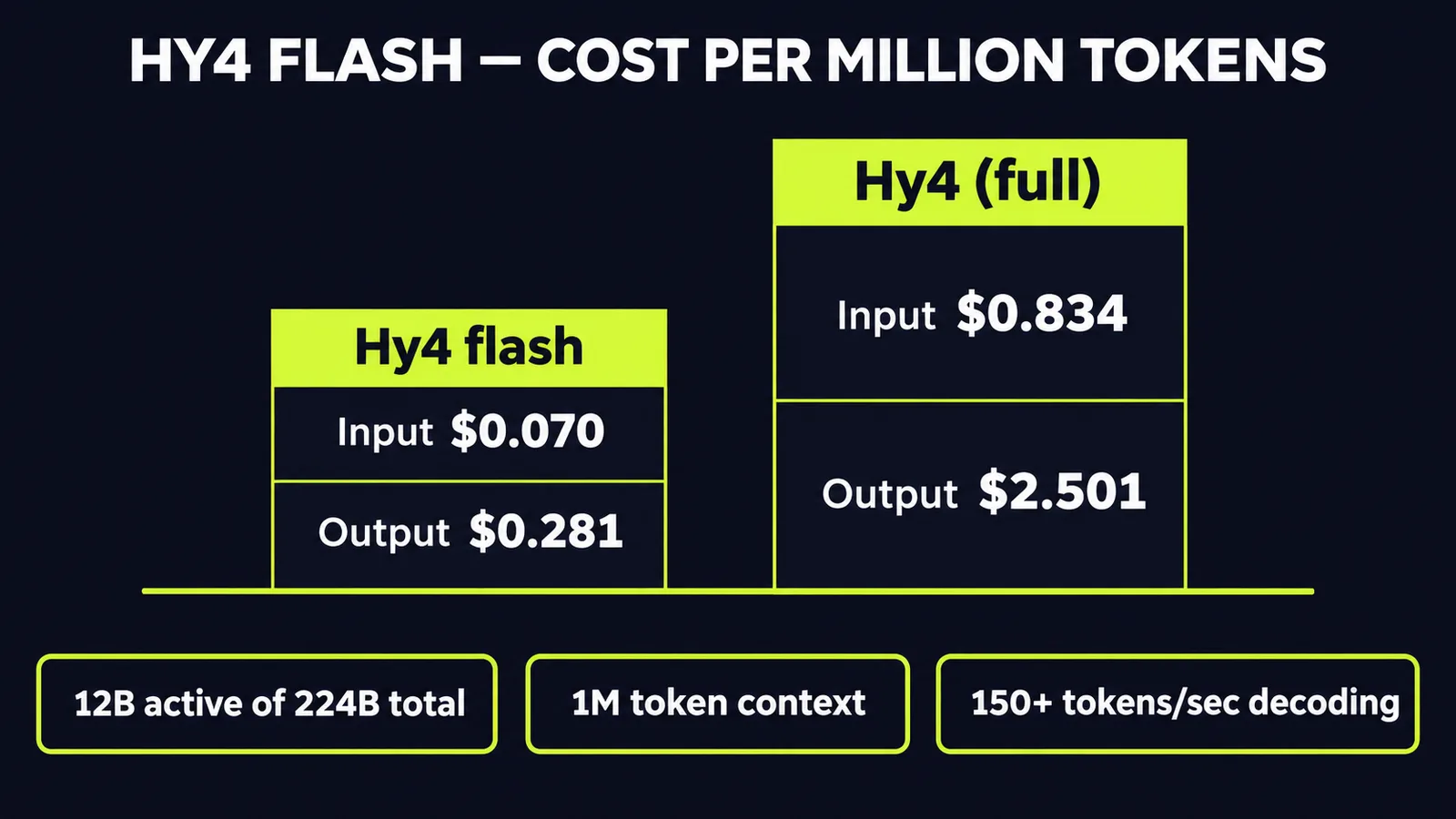
Tencent announced Hy4 flash on Monday, November 16: a lower-priced version of its flagship Hy4 model, positioned for the everyday office work — research, documents, slides and spreadsheets — that makes up much of what businesses ask AI to do, per Tencent Launches Hy4 flash, a Cut-Price AI Model It Says Handles Everyday Office Work at a Fraction of the Cost. Tencent lists API rates of $0.070 per million input tokens, $0.281 per million output tokens and $0.003 per million cached input tokens, against $0.834 input, $2.501 output and $0.042 cached for the full Hy4, per the same source and Hy4 flash: 224B/12B MoE, 1M context, $0.07/1M input. At list prices, before discounts, that is 11.9 times cheaper on input and 8.9 times cheaper on output than the flagship in the same family. The question is what quality you give up to get it, and for which workloads.
What shipped on November 16
Hy4 flash has 224 billion parameters in total, including 64 billion so-called Engram parameters, but activates only 12 billion of them at a time, which lets a large model run with the computing bill of a much smaller one, per Tencent Launches Hy4 flash, a Cut-Price AI Model It Says Handles Everyday Office Work at a Fraction of the Cost. Like Hy4, it accepts multimodal inputs and supports a context window of up to one million tokens, per the same source. A spec summary records the same figures — 224 billion total parameters, 12 billion active, a one-million-token context and the $0.070 / $0.281 price pair — and lists availability through Tencent Cloud TokenHub under the model ID `hy4-flash`, per Hy4 flash: 224B/12B MoE, 1M context, $0.07/1M input.
Access is broad from day one. The model is available through Tencent Cloud TokenHub, WorkBuddy, Yuanbao, WeCom, QQ, ima and Marvis, with OpenRouter integration to follow, per Tencent Launches Hy4 flash, a Cut-Price AI Model It Says Handles Everyday Office Work at a Fraction of the Cost. Until November 30, WorkBuddy users can use it free and TokenHub is offering API access at half the standard price, per the same source. Tencent also plans to release the model as open weights, though no date has been announced, per the same source. Tencent's own routing advice is explicit: use flash for most everyday tasks, including deep research, document processing, slide generation, simple front-end demos and computer use, and use the full Hy4, released on November 4, for complex jobs such as long-horizon software engineering, per the same source.
How the cost came down
Three engineering choices do most of the work, per Tencent Launches Hy4 flash, a Cut-Price AI Model It Says Handles Everyday Office Work at a Fraction of the Cost. The model's memory cache is one-sixth the size of Hy4's. Reinforcement learning cut average output length per task by 50 per cent — the model simply writes less per answer. And a combination of megakernels, 4-bit quantisation and a technique Tencent calls DFly pushes decoding speeds beyond 150 tokens per second, per the same source.
That middle item deserves a second look. Halving output length lowers cost on every task, but it also changes the product: shorter outputs are a feature for a spreadsheet repair and a risk for a research brief, where the missing half may be the analysis you were paying for. When you test a model whose efficiency comes partly from brevity, your acceptance tests need to check completeness, not just correctness.
On WorkIndex, an internal benchmark built around typical tasks in the WorkBuddy app — creating and editing slide decks, editing documents, repairing spreadsheets, processing audio and video and visual understanding — Tencent said Hy4 flash cost one-twentieth as much per task as Hy4, one-thirteenth as much as the larger Hy4 Preview, and one-eighth as much as DeepSeek-V4.1-Flash-1017 at peak-hour pricing, per Tencent Launches Hy4 flash, a Cut-Price AI Model It Says Handles Everyday Office Work at a Fraction of the Cost. A benchmark tabulation puts its WorkIndex average score at 42.1 and notes that it slightly outperforms Hy4 Preview, a model with 770 billion total and 49 billion active parameters, in overall effectiveness on that suite, per Hy4 flash: 224B/12B MoE, 1M context, $0.07/1M input.
The evidence is promising — and entirely the vendor's
Every figure in this section is Tencent's own. In a blind evaluation with 85 internal WorkBuddy users across 259 tasks in 27 categories, Tencent said Hy4 flash achieved user satisfaction close to Anthropic's Claude Haiku 5.5, with the shortest completion time and the lowest per-task cost of the models tested, per Tencent Launches Hy4 flash, a Cut-Price AI Model It Says Handles Everyday Office Work at a Fraction of the Cost. The tabulated figures put satisfaction at 2.79 out of 4 against 2.81 for Claude Haiku 5.5 — a 0.02 gap, within noise — and 3.09 for DeepSeek-V4.1-Flash-1017, with a median task time of 6.7 minutes, the shortest of the four models, and a per-task cost of ¥0.26 against ¥4.73 for Haiku in the same test, per Hy4 flash: 224B/12B MoE, 1M context, $0.07/1M input.
Every one of those numbers is Tencent's own. The launch report itself notes that these are the company's tests rather than independent benchmarks, per Tencent Launches Hy4 flash, a Cut-Price AI Model It Says Handles Everyday Office Work at a Fraction of the Cost. A pricing analysis reaches the same caution from the other side: the satisfaction claim is "close to" a rival in a company-run test with no independent confirmation yet, per Tencent Hy4 Flash pricing: the $0.07 model vs Claude Haiku 5.5. The blind test also used internal users on the vendor's own app and task set, which is exactly the environment the model was tuned for. Treat the results as a reason to run your own trial, not as a buying decision.
The limits are visible in Tencent's own comparison tables. On Terminal-Bench 4.0, Hy4 flash scores 19.2 against 44.4 for the full Hy4, and on ProgramBench it scores 16.0 against 30.0, per Tencent Hy4 Flash pricing: the $0.07 model vs Claude Haiku 5.5. A launch review summarises the pattern: the model trails Hy4 on all nine public benchmark rows Tencent lists, per Tencent Hy4 Flash Review: Cheap Office Agent, Weaker Coder. That is not a failure of the product — it is the product. Flash is an office-work tier that gives up long-horizon coding depth for price and speed, and Tencent says so itself by pointing complex engineering work back to the full model.
What this means for your business
1. Route by task, not by brand. The economics now favour a two-tier setup: a cheap, fast model for document processing, slide and spreadsheet work, research drafts and routine computer use, and a flagship tier reserved for long, high-stakes tasks. Tencent's own guidance draws exactly that line. Put the routing rule in configuration, not in each prompt, so the split is auditable and changeable in one place.
2. Price the trial, not the token. At $0.070 per million input tokens, token price stops being the deciding factor for office workloads. Your real costs become evaluation time, error correction and integration. Spend the trial budget on acceptance tests over 20 to 30 real tasks from your own backlog.
3. Test for completeness, not just correctness. Part of the saving comes from outputs that are 50 per cent shorter. For research and drafting work, check whether shorter answers still cover what the task required before you route volume to the cheaper tier.
4. Do not route long-horizon coding to the cheap tier. A 19.2 against 44.4 on Terminal-Bench 4.0, in the vendor's own table, is a clear boundary. Keep repository-scale engineering on the flagship tier and measure cost per passed task there separately.
5. Use the launch window, but do not budget around it. Free WorkBuddy use and half-price TokenHub access run only until November 30, and the promised open weights have no date. Evaluate at list price; treat the discount as trial subsidy, not as your run rate.
6. Keep the exit open. The OpenRouter listing is still to come and the weights are not yet downloadable, so today this is a hosted dependency — do not plan a migration around either promise until it ships. Keep the model ID behind one configuration value, keep a second provider tested, and test the fallback before you need it, so a price or terms change is a config edit, not a rebuild. Before any production documents move, verify the data-handling and retention terms of the channel you use; the launch materials do not detail them.
Hy4 flash is a disciplined release: a model deliberately narrowed to the office tasks businesses run most, priced low enough that the interesting question moves from "can we afford the tokens" to "can we verify the output". Its weakness is proof — every headline number is the vendor's. The teams that benefit will route the routine work to the cheap tier, keep the hard work on the flagship, and let their own task tests, not a launch chart, set the split.
Ready to find where automation would cut cost or cycle time in your operation? Get a free AI audit — we'll map your highest-leverage automation opportunities in one session.
Sources
- https://lifenewsagency.com/tencent-launches-hy4-flash-cut-price-ai-model/lifenewsagency.com
- https://news.the9.pro/models/hy4-flash/news.the9.pro
- https://tbngrow.com/en/news/tencent-hy4-flash-pricing-the-0-07-model-vs-claude-haiku-5-5tbngrow.com
- https://aiworldwire.org/articles/tencent-hy4-flash-review-cheap-office-agent-weaker-coder/aiworldwire.org
Want to know what this means for your stack? A free AI audit maps your workflows and shows where automation pays off — in your numbers, not ours.