
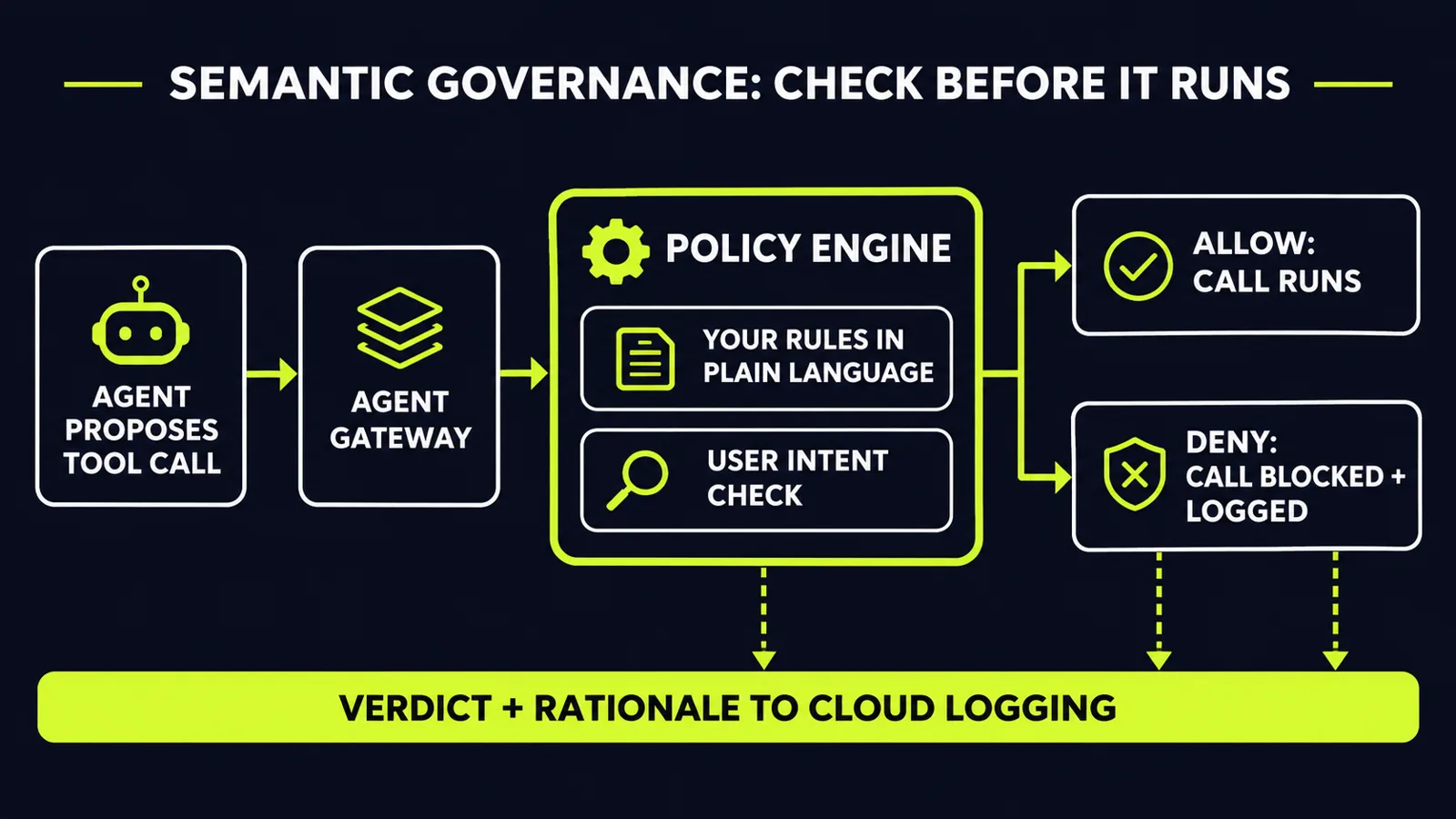
Permissions tell an agent what it is allowed to touch. They do not tell it whether a specific action should happen. An agent with file read and email send permissions will use both, even to send unreleased quarterly results to an outside investor who claims to be under NDA, with a copy to a personal inbox. That is the opening example in Google's November 20 announcement of Semantic governance policies, in Preview on the Gemini platform, per Check what your AI agents do before they do it, with Semantic governance policies. The feature inserts a check between the model proposing a tool call and the call actually running: every proposed call routed through Agent Gateway is judged against plain-language business rules and against what the user originally asked for. If it fails either check, it never executes.
Why permissions and system instructions are not enough
First, access controls are static: IAM and gateway policies decide which tools and MCP servers an agent can reach, not whether one call follows a disclosure rule, a spending limit, or an approvals process, per Check what your AI agents do before they do it, with Semantic governance policies. Second, instructions inside the agent can be talked around. A user with a plausible justification can persuade a model to ignore its system instructions, and a document the agent reads can carry hidden text telling it to do something nobody requested — the pattern called indirect prompt injection, per the same announcement. That is why the check sits outside the agent, in a separate policy engine, per Semantic governance policies: what's new in Gemini.
How the two checks work
Routing is the prerequisite. All outbound traffic must pass through Agent Gateway, the enforcement point supported today. When the model responds with a tool call, the gateway sends the proposal to the policy engine before it reaches the agent, per Check what your AI agents do before they do it, with Semantic governance policies. An LLM judge then evaluates the call against the conversation so far, the agent's system instructions and tool descriptions, and your policies.
The first check is your rules, written in plain language. A policy is a natural-language constraint attached to an agent; it can cover all tools or one tool, and it can name a tool's parameters, per Google previews Semantic governance policies to check AI agent tool calls. Google's examples are operational, not abstract: submit invoices only after all approvals are received, accept refunds only up to a set amount, and never let the agent send hiring decisions — a person makes those, per the announcement. The second check is user intent, on by default: has this call drifted from what the user actually asked for? That is the check that catches hijacked sessions and injected instructions, per Check what your AI agents do before they do it, with Semantic governance policies.
The verdict is binary and logged. A passing call reaches the agent unchanged. A failing call is replaced with a configurable denial message, so the action never runs. Either way, the verdict, the judge's rationale, and the tokens used go to Cloud Logging, per the same announcement. Text-only responses are not evaluated, because they take no action. The judge is also instructed to deny calls to tools with no description, so undocumented tools fail closed, per Google previews Semantic governance policies to check AI agent tool calls.
Three calls, three verdicts
Google's worked example is a finance agent that can search a shared drive, read files, send email, and delete drafts, governed by one earnings-disclosure policy, per Check what your AI agents do before they do it, with Semantic governance policies. Sending preliminary results to the controller for the month-end close is allowed: the user asked for it and the recipient is inside the allowed domain. Sending the same results to an investor, copying a personal inbox, is denied in full — not trimmed to remove the copy — because the policy rules out NDAs, urgency, and seniority as exceptions. Deleting a drafts folder because a planning document the agent read told it to is denied by the intent check: nobody asked for a deletion, per the same example, summarised in Semantic governance policies: what's new in Gemini.
The same week, Google extended the after-the-fact layer. Agent Anomaly Detection, in Private Preview, now monitors agents running outside its own cloud platform by reading traces and logs, flagging patterns such as systematic scraping, cascading loops, and oversized refunds that no single call would reveal, per Agent Anomaly Detection: Safeguarding agents across other clouds. One layer judges each action before it runs; the other reviews whole sessions after they happen.
Limits and unknowns
Google is direct about the weaknesses. The judge is an LLM, so verdicts are probabilistic and may vary; Google recommends starting in dry run mode, where the engine logs what it would deny without blocking anything, before enforcing, per Check what your AI agents do before they do it, with Semantic governance policies. Streamed model responses are not evaluated. Facts a policy depends on, such as a release date, must sit in the agent's system instructions, because the judge decides from the conversation, instructions, and policies — not from an external source of truth, per Google previews Semantic governance policies to check AI agent tool calls. The announcement states no pricing and no general-availability date, and Google says its next post will report how the feature performed against prompt injection on a public agent-security benchmark — until then, no effectiveness results have been published yet, per the same coverage.
Model lock-in is limited. The agent can call its model through the Gemini API, the Anthropic Messages API, Claude models on the Gemini platform, or OpenAI-compatible APIs, including self-hosted servers, per Check what your AI agents do before they do it, with Semantic governance policies. The gateway routing requirement is the real commitment: if a tool path bypasses the gateway, it bypasses the check.
What this means for your business
1. Write down the rules you currently expect agents to follow. Spending caps, approval steps, data that must not leave, decisions a person must make. If those rules exist only in a system prompt, they are suggestions. Turn the five highest-risk ones into plain-language policies first.
2. Start in dry run, and read the logs before you enforce. Review a week of verdicts with the workflow owner, fix the wording that misfires, and measure false positives, judge tokens, and added latency before you enforce. Skipping this step is how governance tools get switched off.
3. Treat tool descriptions as part of the control surface. The judge decides from descriptions, and undocumented tools are denied. Audit your catalogue: every tool needs a clear name, a plain description, and parameter names policies can reference.
4. Close the bypass paths. Inventory every route an agent can take to a tool — direct calls, alternate gateways, scheduled jobs — and route them all through the enforcement point, or accept that those paths are ungoverned.
5. Assign a policy owner. Name who writes, approves, and updates each policy, who reviews blocked calls, and how often the set is reviewed. A policy with no owner drifts out of date and gets bypassed.
6. Keep the other layers. This feature complements, rather than replaces, access controls, prompt screening, anomaly detection, and your own disclosure and compliance reviews, per Check what your AI agents do before they do it, with Semantic governance policies. Budget for it as one layer in a stack, not as the stack.
Agents are moving from answering questions to taking actions with real consequences: sending, paying, deleting, approving. The control question is no longer whether the agent was allowed to act, but whether this specific action, in this context, should have happened. If you want that question answered systematically across your own agent builds, start with our free AI audit — we will map where your agents act without a pre-execution check, and what to put in place first.
Sources
- https://developers.googleblog.com/check-what-your-ai-agents-do-before-they-do-it-with-semantic-governance-policies/developers.googleblog.com
- https://developers.googleblog.com/agent-anomaly-detection-safeguarding-agents-across-other-clouds/developers.googleblog.com
- https://letsdatascience.com/news/google-previews-semantic-governance-policies-to-check-ai-age-a9717cfaletsdatascience.com
- https://imasters.com/inteligencia-artificial/google-adds-semantic-governance-policies-for-ai-agents-in-geminiimasters.com
- https://yomu.fyi/post/check-what-your-ai-agents-do-before-they-do-it-with-semantic-governancyomu.fyi
Want to know what this means for your stack? A free AI audit maps your workflows and shows where automation pays off — in your numbers, not ours.