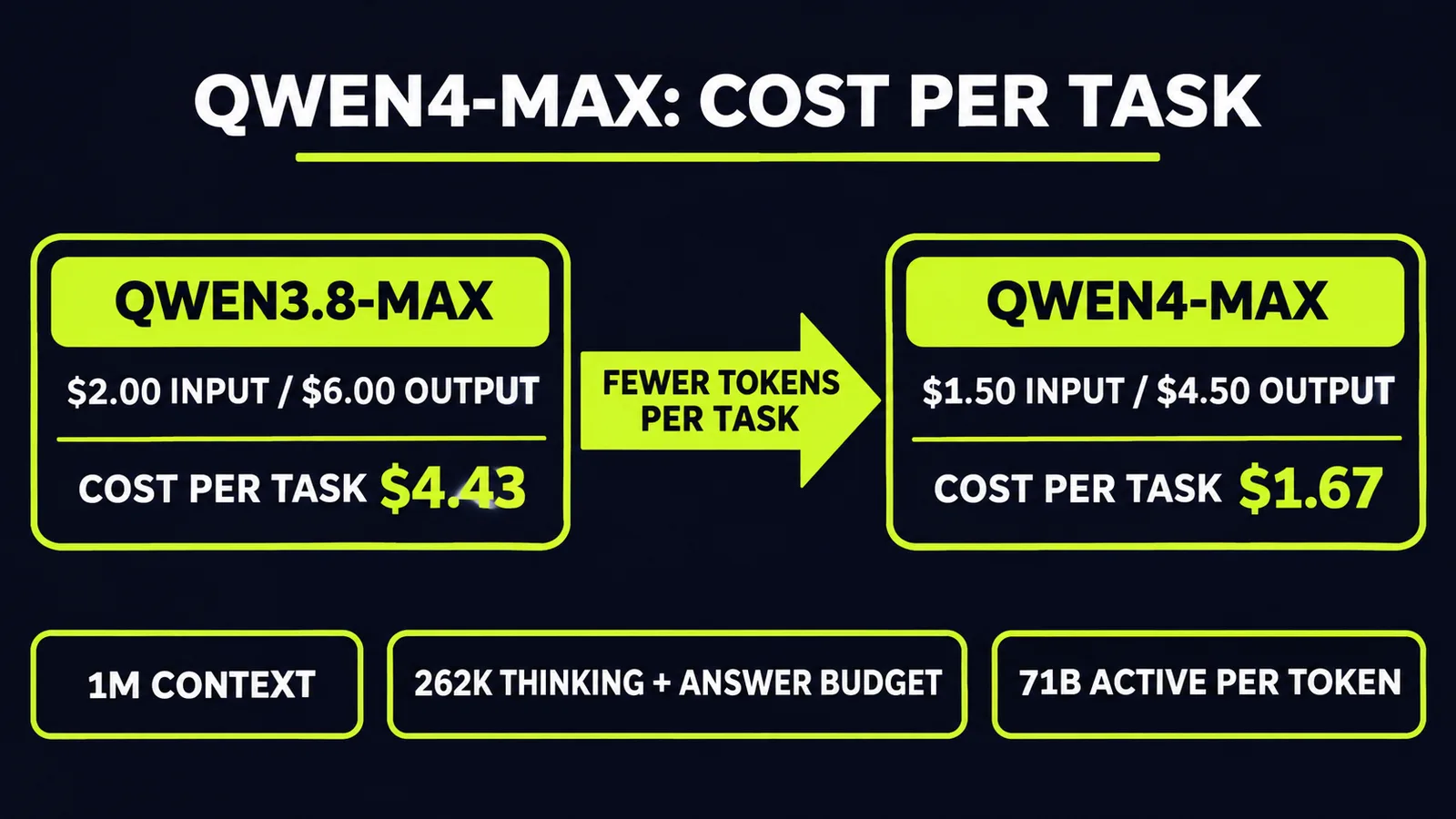
Alibaba unveiled Qwen4-Max on Sunday, November 15, saying the new flagship handles complex professional and scientific work better than its predecessor while strengthening protections against safety risks, per Alibaba unveils new flagship AI model with safety upgrades. The general release followed on November 16 with a public pay-per-token API, published prices and a full benchmark chart, per What Is Qwen4-Max? Alibaba's New Flagship Model. The headline is not raw scale. It is cost per completed task: Alibaba reports an average drop from $4.43 to $1.67 on its own professional-work benchmark, a cut of about 62%, per Alibaba Releases Qwen4-Max: 2.4T MoE, 71B Active, 1M Context. That number deserves attention — and scrutiny — because it is exactly the metric that decides whether long-running agents are affordable in production.
What shipped on November 15 and 16
Qwen4-Max is the first model of the Qwen4 generation and the new top tier of the family, per What Is Qwen4-Max? Alibaba's New Flagship Model. It is a reasoning model that takes text, image and video input and returns text, aimed at coding, office work, front-end design and long agentic tasks, per the same source. A Token Plan-only preview opened on November 11, and the general release added the model ID `qwen4-max`, a documented API and per-token pricing, per the same source.
The model is hosted only. There are no open weights for Qwen4-Max, so there is no self-hosting option at this tier, per Alibaba Releases Qwen4-Max: 2.4T MoE, 71B Active, 1M Context. Access runs through the QwenCloud API, the Token Plan subscription, Qwen Studio, QwenWork and Qoder, per the same source. The API works with OpenAI-compatible and Anthropic-compatible clients and supports function calling, structured outputs, context caching and web search, with a default rate limit of 5,000,000 tokens per minute, per the same source. One limit matters for production planning: the vendor's own documentation lists batch inference and fine-tuning as not supported for this model, per Qwen4-Max is out: price, benchmarks and how to try it.
Why the cost per task fell: price plus fewer tokens
Two effects stack. First, list prices fell 25%: input is $1.50 per million tokens, down from $2 for Qwen3.8-Max, and output is $4.50, down from $6, while implicit cache reads drop 70%, from $0.25 to $0.075, per Alibaba Releases Qwen4-Max: 2.4T MoE, 71B Active, 1M Context. Second, the model uses fewer tokens for the same work: on Work360, token use drops about 24% at the highest effort setting and 35% at high effort, and on Terminal-Bench 4.0 the drops are about 48% and 49%, per the same source.
The second effect matters more for agents. An agent resends context, tool definitions and file contents on almost every turn, so cached input and total token count dominate a long session's bill, per Qwen4-Max vs Qwen 3.8: Price, Context, Benchmarks and What Changed. That comparison works through a session with 10 million cached input tokens, 1 million fresh input tokens and 500,000 output tokens: $4.50 on Qwen4-Max against $7.50 on the previous model for identical token counts, before any token savings, per the same source.
Read the 62% headline with care. Work360 is Alibaba's own benchmark, covering 26 top-level domains and 721 specialized fields, and the launch chart mixes the vendor's own evaluations with scores attributed to external leaderboards, without an independently validated, like-for-like comparison, per Alibaba Releases Qwen4-Max: 2.4T MoE, 71B Active, 1M Context. A separate analysis makes a useful check: a 25% price cut combined with 35% fewer tokens gives a saving of roughly 51% under a simplified, constant token mix, per Qwen4-Max Launch: Alibaba Claims 60% Lower Task Costs. That does not disprove the 62% figure — a different token mix, caching or evaluation setup could close the gap — but the published headline numbers alone do not reconcile it, and the underlying billing breakdown has not been published. The saving also has not been established across independently tested workloads. The direction is credible. The exact percentage on your workload is not yet proven.
The architecture behind fewer tokens
Qwen4-Max has a 2.4-trillion-parameter backbone but activates only 71 billion parameters per token, plus 328 billion N-gram Embedding parameters — 25% fewer active parameters than its predecessor at the same overall scale, per Alibaba Releases Qwen4-Max: 2.4T MoE, 71B Active, 1M Context.
Three changes do the work. Gated DeltaNet layers paired with Qwen Sparse Attention compress history into fixed-size states and use a lightweight indexer to pick relevant context, lowering attention cost on long sequences. A Gated Residual design splits the residual stream into parallel branches with dynamic gates, aimed at training stability. N-gram Embedding adds lookups of local token patterns for extra capacity at low compute cost, per the same source. The practical specs suit long work: a 1-million-token context window, up to 983,616 tokens of input in thinking mode, and a combined budget of 262,144 tokens for thinking plus the final answer, per Qwen4-Max is out: price, benchmarks and how to try it. On Alibaba's chart, Qwen4-Max ranks first on 4 of 16 benchmarks, led by a legal-agent score of 21.3 against 11.7 for the next-best model, while trailing clearly on other coding and vision tests, including a ProgramBench score of 31.5 against 65.0 for the leading rival, per Alibaba Releases Qwen4-Max: 2.4T MoE, 71B Active, 1M Context. On Work360 itself, the score rises to 52.69 from 47.74, per the same source. Efficiency is not the same as success, either: on Terminal-Bench 4.0 the model scores 48.5 against 67.2 for the leading model on the same chart, so it uses fewer tokens while completing fewer of those tasks, per the same source. This is a strong professional-work model with uneven edges, not a clean sweep.
Safer code is part of the pitch — and the limits are visible
Alibaba said Qwen4-Max's training included security checks alongside coding tests, helping reduce vulnerabilities such as code injection, memory-safety flaws and broken access controls, and that safeguards against misuse in areas such as cybercrime and hazardous materials were strengthened, while internal testing found no evidence of significant high-risk capabilities, per Alibaba unveils new flagship AI model with safety upgrades.
The measured coding result is more useful than the broad claim. On Last Secure Code Bench, the function-level pass rate for code that is both working and secure rose from 22.0% to 31.8%, and the share of code secure at function, file and repository level rose from 8% to 14.7%, per Qwen4-Max vs Qwen 3.8: Price, Context, Benchmarks and What Changed. That is real progress — and it still means most generated code is not secure by that test. All of the safety results are self-reported, and the company did not name an independent assessor for them at launch. Treat them as a reason to test the model in your pipeline, not as a reason to remove review, scanning or approval gates.
What this means for your business
1. Budget agents by cost per completed task, not price per token. Qwen4-Max's strongest claim is fewer tokens per finished task. Measure any model the same way: total spend divided by tasks that pass acceptance, including retries, failed runs, tool-execution costs and human review time.
2. Run a head-to-head trial on your own workload. Use 20 to 30 real tasks from your backlog, fix prompts and acceptance tests in advance, and compare cost per passed task, token use and intervention count against your current model.
3. Do not budget around the 62% figure. It comes from the vendor's own benchmark and looks like a best-case mode, not a guaranteed average. Plan on the confirmed 25% list-price cut and let your trial produce the number you budget.
4. Test the cache pricing before you budget it. The $0.075 per million rate is an implicit cache-hit price: it applies only when requests actually hit the cache. Keep stable prompt parts cacheable, put changing parts at the end, and measure your real cache-hit rate before counting the saving.
5. Keep security gates exactly where they are. A 31.8% secure-coding pass rate improves the starting point; it does not make generated code safe to ship unreviewed. Keep static analysis, dependency checks and human approval in place.
6. Note the hosted-only trade-off. With no open weights at this tier, Qwen4-Max is a service dependency: availability, pricing and data-handling terms are the provider's to change. Keep the model ID in one configuration value and keep an alternative model tested.
Qwen4-Max is a credible efficiency release: lower list prices, fewer tokens on the vendor's tests, a larger output budget and better secure-coding scores, wrapped in an API most teams can call today. Its weakness is proof — the headline savings rest on the vendor's own benchmark. The teams that benefit will be the ones that verify cost per task on their own work before moving volume.
Ready to find where automation would cut cost or cycle time in your operation? Get a free AI audit — we'll map your highest-leverage automation opportunities in one session.
Sources
- https://kwsn.com/2026/11/15/alibaba-unveils-new-flagship-ai-model-with-safety-upgrades/kwsn.com
- https://apidog.com/blog/what-is-qwen-4-max/apidog.com
- https://www.marktechpost.com/2026/11/16/alibaba-qwen4-max-release/marktechpost.com
- https://apidog.com/blog/qwen-4-max-vs-qwen-3-8/apidog.com
- https://maliktimes.in/qwen4-max-alibaba-60-percent-lower-task-cost/maliktimes.in
- https://www.themodelatlas.com/blog/qwen4-max-preview-explained/themodelatlas.com
Want to know what this means for your stack? A free AI audit maps your workflows and shows where automation pays off — in your numbers, not ours.