

Mistral AI introduced its new flagship, Large 4, on October 6: a 1.05-trillion-parameter Mixture-of-Experts model whose downloadable weights are scheduled for later in October. The API can be evaluated now; the economics and practicality of self-hosting cannot.
Key takeaways
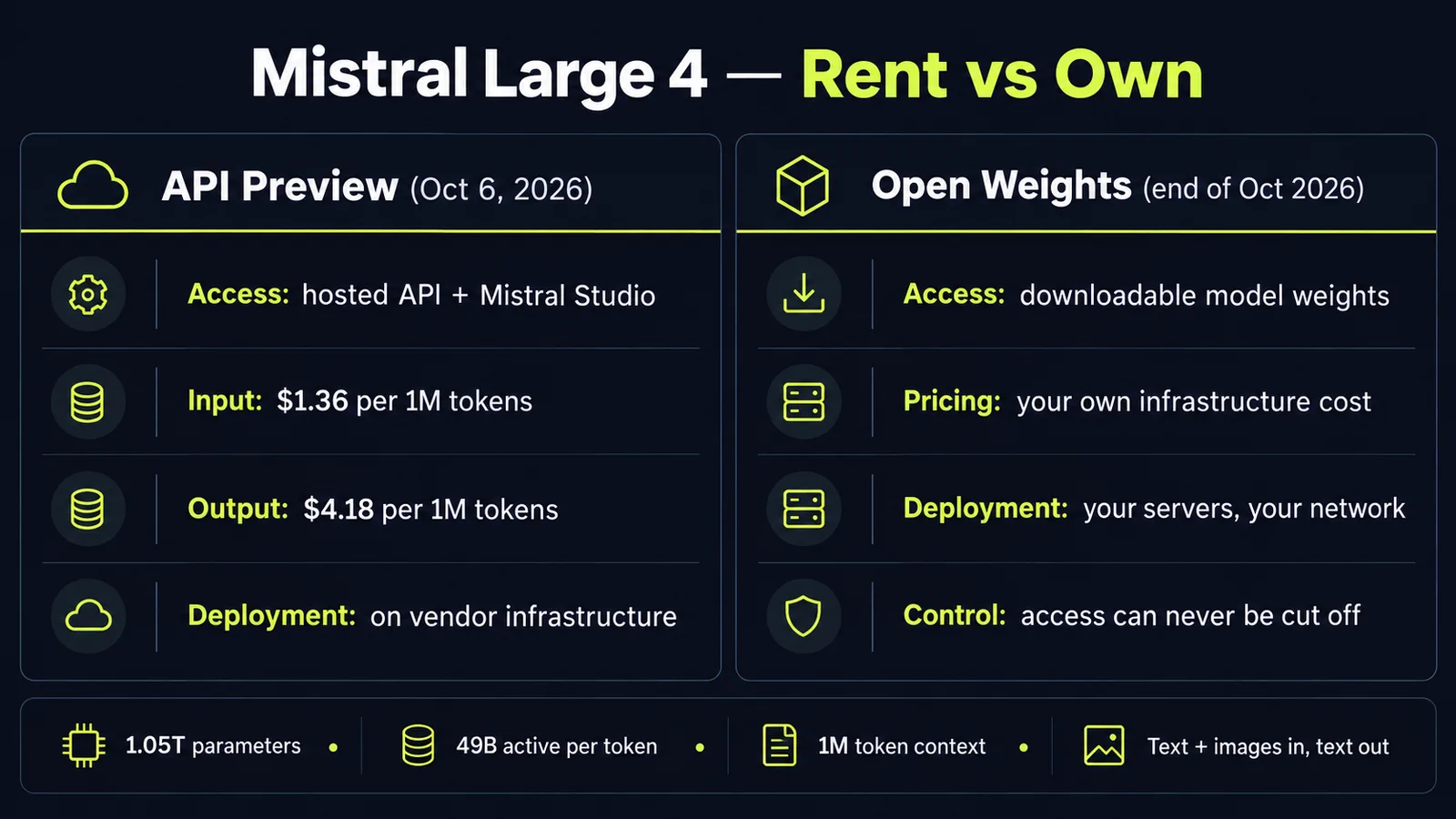
- Launched Oct 6, 2026 as a hosted public preview through Mistral's API, with usage-based pricing; the downloadable open weights are promised by the end of October (October 27, according to Reuters). Until then it is API-only.
- Spec sheet: 1.05 trillion-parameter mixture-of-experts, 49 billion active per token, 1-million-token context window (per Mistral's docs; some aggregators list a lower figure), native multimodal input via a 1.6-billion-parameter vision encoder, fluent in 160+ languages.
- Pricing: $1.36 per million input tokens / $4.18 per million output tokens at launch — while the model docs display lower preview figures ($0.68 in, $0.07 cached in, $2.09 out). Mistral has not clarified whether the lower prices are temporary, so production budgets should not assume they persist.
- Benchmarks: Mistral reports strong coding and cybersecurity results (63% on Deep SWE 1.1; 93% on Cybench and 82% on CyberGym-E2E), while Artificial Analysis independently scored the API preview at 38 on its Intelligence Index. Most headline figures remain company-presented.
- The deployment pitch: Mistral plans to release weights that customers can run on infrastructure they control. That proposition is real — but it cannot be evaluated until the weights, license, and deployment documentation arrive.
What actually shipped on October 6
Let's be precise, because the announcement is easy to misread. Mistral did not release downloadable model weights on October 6. It opened a public preview of Large 4 — nicknamed "Le Chonk" in Mistral's own launch announcement — through its hosted platform. Users can call it through the API and try it in Mistral Studio now. The downloadable weights are scheduled for the end of October; until then, Large 4 is available only through Mistral's hosted preview.
The architecture is a mixture-of-experts design: 1.05 trillion parameters total, with only 49 billion active on any given forward pass. The 49 billion active parameters do not define the model's full deployment footprint — practical memory requirements will depend on the released weights, precision, and serving architecture. The 1-million-token context window (per Mistral's documentation; some aggregators list a lower figure) covers long contracts, codebases, and multi-file financial reports. Input is text and images; output is text.
Mistral says Large 4 was trained from scratch on roughly 3,800 Grace Blackwell GPUs inside its own data centers rather than rented cloud capacity — after a €3 billion fundraising round announced in September. For buyers, this creates another deployment option to compare with API-only models.
The pricing needs a closer look
The launch pricing is straightforward: $1.36 per million input tokens and $4.18 per million output tokens. But Mistral's own documentation currently displays lower figures — $0.68 input, $0.07 cached input, $2.09 output — shown as discounted from the higher struck-through amounts. Mistral has not made clear whether the lower displayed prices are temporary, so production budgets should not assume they will persist.
The published rates make Large 4 worth including in workload-level cost comparisons, but token price alone does not establish lower production cost. If Large 4 performs consistently across both routine and demanding workloads, teams can test whether their existing multi-model routing still provides enough cost or quality benefit to justify its complexity.
One caution before you budget: the pricing presentation differs between the launch announcement and the model documentation, and the model is still in public preview. Check the live figures in Mistral Studio before committing a production workload to a spreadsheet.
Benchmarks: one independent score, the rest company-reported
Mistral reports results across coding, cybersecurity, and several enterprise-oriented evaluations. On Deep SWE 1.1, which measures long coding tasks, Large 4 scored 63% — on par with Z.AI's much-discussed GLM 5.3 and roughly 12th overall, with the top models at 74%. On cybersecurity, Mistral reports 93% on Cybench and 82% on CyberGym-E2E, noting that several closed frontier models score near zero on those benchmarks because they refuse offensive-security-style prompts outright.
The company also claims state-of-the-art results among open-weights models for finance (large spreadsheets), manufacturing, and cybersecurity, plus strength in geospatial analysis — identifying objects in satellite imagery to assess disaster damage — and in industrial design and production, where Mistral names customers such as Airbus and BMW.
Most workload-specific headline results remain company-presented; beyond Artificial Analysis's preview score, the downloadable checkpoint cannot be independently tested until the weights are released.
What enterprises should evaluate
For enterprises, the question is not whether this is the smartest model on the planet. It is whether greater control over model weights and deployment justifies the infrastructure and operational cost of running them. Three conditional points are already worth weighing:
1. Data control is conditional on the weight release. A self-hosted deployment could allow inference traffic and workload data to remain inside infrastructure the organization controls — but only once the weights ship, and only if you run them there yourself.
2. Possession, not promises, protects access. Once an organization holds usable model weights under the applicable license, continued access to that copy is not dependent on the availability of Mistral's hosted API. The final license and deployment terms accompanying the downloadable weights still need to be examined once the release is published.
3. Open weights are not open source. Le Monde describes the release as open source; other coverage calls it open weights. Until the license is published, use "open weights" — access to weights does not automatically tell you what modification, redistribution, or commercial-use rights apply.
And the honest unknowns: a trillion-total-parameter MoE should not be assumed to run practically on commodity hardware — exact requirements remain unknown until the weights and deployment details are published, and self-hosting is likely to require substantial infrastructure. Moving to a trillion-parameter system can also trade one dependency for another: accelerator infrastructure, serving frameworks, and specialized operations expertise. Finally, the preview is still a preview — evaluate version stability and whether preview behavior will match the final checkpoint before committing production workloads.
What to model before committing, in one checklist: API spend versus total self-hosting cost (hardware, utilization, networking, storage, inference software, observability, engineering labor, support); cost per completed task — not per token — measured on your own workloads; the workload volume at which self-hosting breaks even against usage-based pricing; who owns model isolation, patching, access controls, and audit logs in a self-hosted setup; and whether operating this model is a differentiating capability or infrastructure work better outsourced.
Teams with a relevant workload can run a bounded evaluation on the preview now; revisit infrastructure sizing when Mistral publishes the weights and deployment details.
If you want help figuring out whether an open-weights model like Large 4 fits your infrastructure and your compliance posture, that's exactly what our free AI audit is for — we map your workflows, estimate the real costs, and tell you what to pilot first. Get your free AI audit.
Sources
- https://www.lemonde.fr/en/economy/article/2026/10/06/mistral-ai-unveils-new-ai-model-aimed-at-narrowing-the-gap-with-top-chinese-competitors_6758318_19.htmllemonde.fr
- https://www.unite.ai/mistral-unveils-1-05t-parameter-le-chonk-moe-model-in-public-preview/unite.ai
- https://aidailypost.com/news/mistral-ai-releases-le-chonk-105aidailypost.com
- https://digitalpulsebrief.com/mistral-large-4-pricing-benchmarks-open-weights/digitalpulsebrief.com
Want to know what this means for your stack? A free AI audit maps your workflows and shows where automation pays off — in your numbers, not ours.