
The engine underneath many local AI apps came with no stability guarantee — until this week. On November 13, llama.cpp released version 1.0.0 together with ggml, the tensor library underneath it, replacing three and a half years of commit-number builds with semantic versioning: breaking changes to the public API will now arrive only as major-version bumps, per llama.cpp Just Hit 1.0 — Local AI Apps Finally Have a Stable Foundation. For any business weighing local AI inference — running models on its own machines instead of paying per token — that makes upgrades predictable instead of a gamble on the next commit.
What llama.cpp is, and why so much depends on it
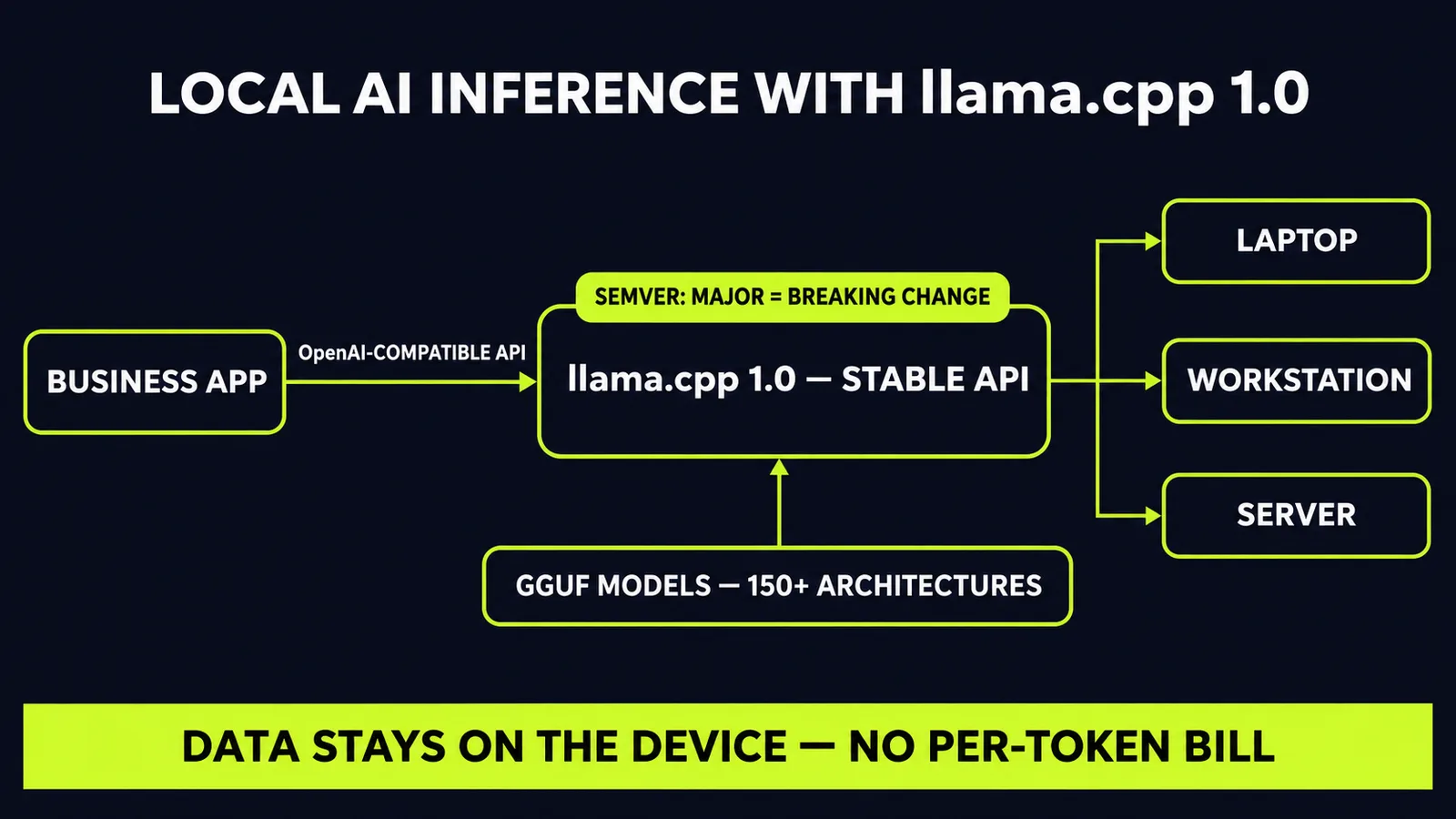
llama.cpp is not a model. It is an open-source inference engine written in C and C++, built on the ggml tensor library, that runs compatible models — usually packaged in GGUF format — on whatever hardware is at hand: a laptop CPU, a phone, a GPU or a server, per the DEV Community report linked above. It began in March 2023 as an experiment to run a model in pure C/C++ without Python and without requiring a GPU, per llama.cpp v1.0.0: Stable API for Local AI.
Since then it has become shared infrastructure. Ollama, LM Studio and a long tail of desktop apps, private chatbots, coding assistants and OpenAI-compatible inference servers build on it, per the DEV Community report linked above. When its interfaces moved without warning, every product on top felt it. Project creator Georgi Gerganov put the reason for 1.0 plainly in the announcement, as quoted in that report: "Every new integration means more developers depending on our library interfaces and therefore having a flexible but stable API is paramount."
The 1.0 contract: what the version number now tells you
The versioning rules are tied to the public C API in the project's include directory. A major bump means a breaking change to that API. A minor bump means a backward-compatible feature, backend update, model addition or API addition. A patch means a bug fix with no API change, per llama.cpp 1.0 Locks In a Stable C API. Both libllama and libggml follow the same rules, and the team says API and ABI incompatibilities will be reflected the same way.
Version 1.0 uses the milestone to clean house once. It removes 35 deprecated functions, the warmup setter `llama_set_warmup` and the defragmentation-threshold option, and it moves the NextN speculative-decoding API from an extension header into the main `llama.h` header, where the stability rules now cover it, per the AI Newsway report linked above. The practical warning follows from that pruning: 1.0 is a stable contract, but not a drop-in upgrade for code that still calls a removed function — that code breaks at compile time, per the DEV Community report linked above. Audit first, then upgrade once, and future breaks arrive labelled.
One limit deserves stating. The promise covers the public C API. A minor release can still ship a backend update that changes performance — faster, slower, or different memory use — without changing any function signature, per the iMasters report linked above. Stable does not mean untested: latency-sensitive services still benchmark before they bump a version.
What else shipped in the release
This is also a large feature release. It adds OCP FP8 KV-cache support through the `f8_e4m3` type, with optional static per-tensor scales, and a host-memory cache for mixture-of-experts models with a configurable CPU share, so large models run better on machines without large GPUs, per llama.cpp hits 1.0: the local AI engine finally gets a stable API. New model support includes Kimi-K3.1-Pro, Ripple and xing4_0, plus text-to-speech and vision models, taking the total past 150 architecture variants, per the AI Newsway report linked above.
The built-in llama-server — the OpenAI-compatible API server many products talk to — gets a security pass: fixes for server-side request forgery, CORS and DNS-rebinding issues, cancellation of MCP tool calls when a client disconnects, and a new `/v1/audio/speech` endpoint, per the AI Frontier Post report linked above. Distribution widens at the same time: pre-built artifacts cover Linux, macOS, Windows, Android and iOS, with packages through Docker, Debian, Homebrew, conda-forge, MacPorts, Winget and XCFramework, per the AI Newsway report linked above. The team also flagged desktop apps built on the engine, aimed at making local AI a few clicks instead of a build-from-source exercise, per the AI Frontier Post report linked above.
Why local inference is now a serious option
Local inference solves four problems a hosted API cannot. Privacy: in a correctly configured local deployment the data never leaves the device, which matters for legal, health and internal business documents — the guarantee holds only if the application itself does not sync or phone home. Cost: there is no per-token bill for every request an application makes. Offline use: the software keeps working behind a firewall or with no connection at all. Control: the model you ship is the model that keeps running — no provider can change its price or terms underneath a shipped product overnight, though updates and support become your job. Those four points are set out in the DEV Community report linked above, and together they explain why desktop applications, private chatbots, coding assistants and mobile apps are increasingly built on local models rather than rented ones.
The honest trade-off is capability and operations. A local model is limited by the hardware it runs on, and your team owns updates, capacity and support. What 1.0 changes is the maintenance side of that trade: keeping a local inference service running for months without constant supervision is now a planned activity with a readable version number, instead of a gamble on the next commit, per the iMasters report linked above.
What this means for your business
1. Re-run the local-versus-hosted decision for one workload. Pick a high-volume, low-variance job — document classification, internal search, support drafting on private data — and price it both ways: per-token hosted cost against local hardware you already own. The stability contract is what makes the local side of that comparison bankable now.
2. If you already embed llama.cpp, audit before you upgrade. Search your codebase and your bindings for the 35 removed functions, the warmup setter and the defragmentation option. Fix those calls once, pin 1.0, and set a simple rule from the versioning contract: patch bumps ship fast, minor bumps get a benchmark, major bumps get a review.
3. Treat llama-server's security fixes as a go-live checklist. If you expose the OpenAI-compatible server beyond one machine, the SSRF, CORS and DNS-rebinding fixes in this release are the minimum bar. Apply the upgrade, then test the server from outside its own network before any customer data touches it.
4. Use the breadth, do not fight it. With more than 150 architecture variants and backends that load at runtime, one integration can serve a laptop, a workstation and a server without separate builds per platform. Design for model swaps inside the engine, so a stronger open model next quarter is a configuration change, not a rewrite.
5. Check the model licence, not just the engine. The engine is open source, but each model you run carries its own licence and terms for commercial use. Clear the licence for the exact model build you ship, and record it alongside the version pin — a stable engine does not settle the rights to the weights running on it.
6. Keep the exit you already have. Because llama-server speaks the OpenAI-compatible API, client code written against it can point back at a hosted endpoint if a workload outgrows local hardware. Local-first no longer means local-only — but test that switch before you need it.
A 1.0 is not a finish line, and the reports note the open question plainly: whether maintainer capacity keeps pace with the promise, per the AI Frontier Post report linked above. But the contract itself is now public and testable — the next breaking change either arrives as 2.0.0 or the promise fails in the open. For businesses, that is enough to build on.
Ready to find where automation would cut cost or cycle time in your operation? Get a free AI audit — we'll map your highest-leverage automation opportunities in one session.
Sources
- https://dev.to/shakeelahmed/llamacpp-just-hit-10-local-ai-apps-finally-have-a-stable-foundation-2043dev.to
- https://ainewsway.com/news/llama-cpp-1-0-locks-in-a-stable-c-apiainewsway.com
- https://aifrontierpost.com/articles/llama-cpp-v1-0-release/aifrontierpost.com
- https://imasters.com/inteligencia-artificial/llama-cpp-library-reaches-version-1-0-0-and-locks-versioning-rules-for-apiimasters.com
Want to know what this means for your stack? A free AI audit maps your workflows and shows where automation pays off — in your numbers, not ours.