

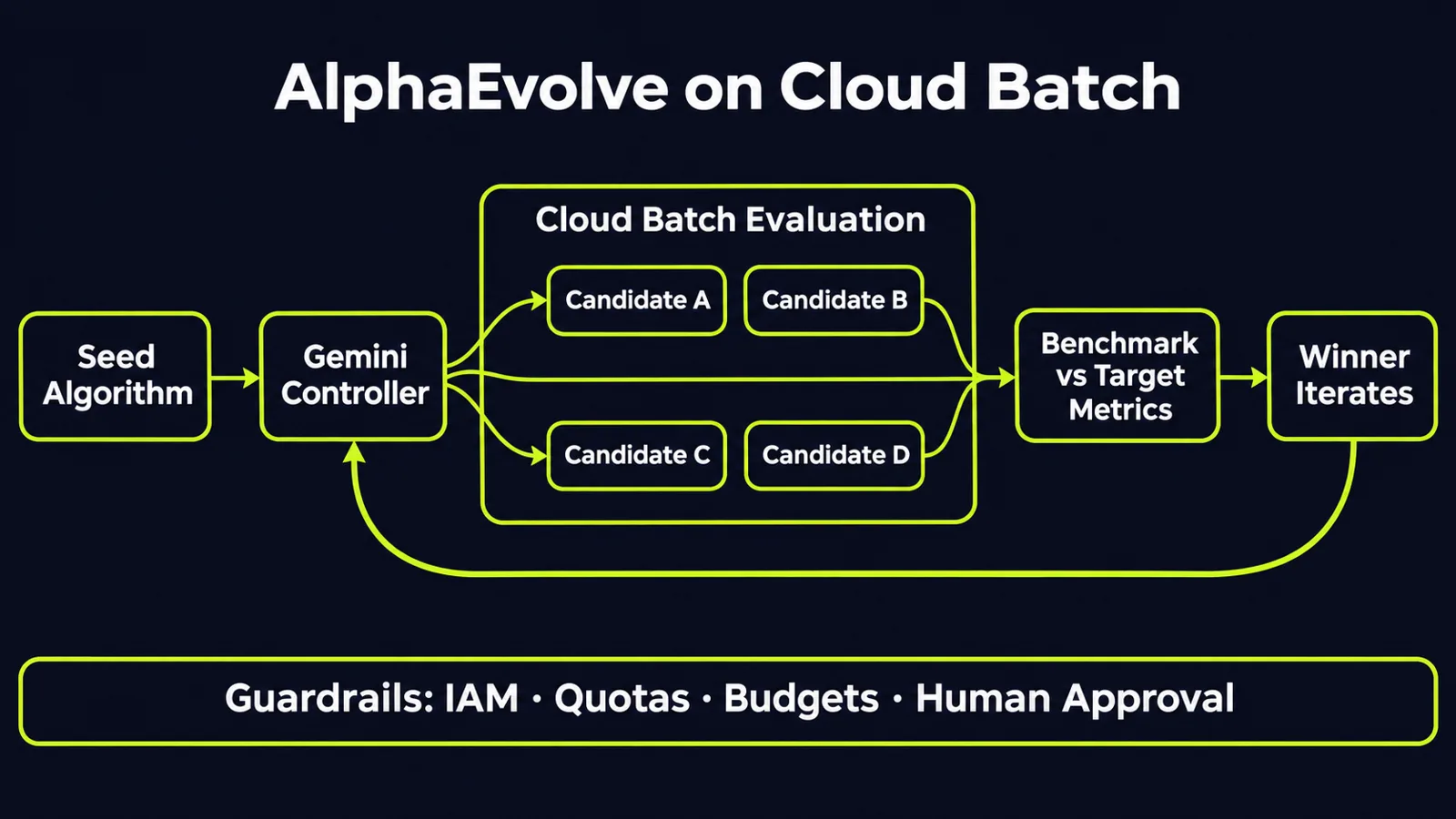
AlphaEvolve itself is not new: Google's Gemini-powered algorithm optimization agent became generally available on Google Cloud on July 9, 2026, per Google Releases AlphaEvolve for Evolutionary Code Optimization. What is new, as of November 13, is how much easier it is to run at scale. Google Cloud announced a Cloud Batch solution for AlphaEvolve alongside two agentic skill repositories for high-performance computing workflows, ahead of the SC26 conference running November 15–20, per Google Cloud Launches AlphaEvolve and Agentic HPC Skills. Instead of asking a model for one better version of your code, AlphaEvolve generates candidate variants, benchmarks them, keeps the winners and iterates — and the Batch solution distributes hundreds of those candidate evaluations across managed infrastructure, while the skills teach agents to stand up and run the clusters the loop needs.
What shipped on November 13
The release has three parts. First, a Cloud Batch deployment solution for AlphaEvolve that provisions a controller environment through a single gcluster blueprint and parallelizes candidate evaluations. Second, two skill repositories — Google Skills and DeepMind Science Skills — that pair with Cluster Toolkit's declarative YAML blueprints to automate how HPC environments are built and how workloads are configured. Third, broader SC26 infrastructure announcements, led by eighth-generation TPUs, per Google Cloud debuts agentic HPC skills, AlphaEvolve for SC26.
HPC product managers Megan Gawlik and Annie Ma-Weaver frame the direction as packaging expertise rather than shipping more cores, per the AI Weekly report linked above. The launch targets two persistent costs: the specialist time spent configuring infrastructure, and the compute spent evaluating code improvements one at a time.
How the evolutionary loop works at cloud scale
AlphaEvolve uses a Gemini-powered evolutionary loop to iteratively mutate, benchmark and optimize code and 3D engineering parameters against target metrics, per Where supercomputing meets agentic AI: What's new in Google Cloud HPC and AI at SC26. On Cloud Batch, a single blueprint provisions the controller environment, and Batch fans out hundreds of candidate evaluations concurrently — across single-VM sandboxes or multi-node MPI task groups — with Cloud RDMA and Google Cloud Managed Lustre underneath, per the Google Cloud post linked above.
Spot VMs and the Dynamic Workload Scheduler give teams options to manage evaluation cost and turnaround time, per the Google Cloud post linked above. Actual savings depend on workload duration, interruption handling, capacity availability and how many candidate evaluations a run needs — the options exist; the economics are yours to prove. Evaluation also happens at production scale, on real interconnects: code evolved on slow networking can look fast in the lab and disappoint in production, a failure mode the Batch design is built to avoid, per the same post. Researchers can steer runs and inspect candidate lineage through hosted Python notebooks, or drive them from the CLI and agent tooling they already use.
The track record behind the product is internal but concrete. Across Google, AlphaEvolve has already recovered roughly 0.7% of Google's worldwide compute resources via a custom Borg scheduling heuristic, optimized Gemini matrix multiplication and FlashAttention kernels, and improved Verilog arithmetic circuits for TPUs, per a Google Cloud post published via HPCwire, Accelerating Time to Insight: AI-Powered Development and Purpose-Built HPC on Google Cloud. Those are Google's own measurements, not independent benchmarks — but they explain why Google is productizing the loop.
Skills, not prompts: the other half of the launch
The skill repositories may be the more transferable idea. Infrastructure skills direct an agent to audit compute and storage quotas, run rapid canary checks for capacity, match the workload to a validated Cluster Toolkit blueprint, and wait for human approval before running the deploy command, per the Google Cloud post linked above. Workload skills then guide configuration for specific tools: OpenFOAM and Siemens STAR-CCM+ for fluid dynamics, GROMACS and AlphaFold 3 for life-sciences pipelines, and Devito and Open Porous Media for subsurface simulation, with browser-based 3D visualization, per the same post.
Google documents IAM controls, Kueue quota and budget guardrails, full provenance in Cloud Logging, and structured troubleshooting skills for routine failures such as stuck queues, per the Google Cloud post linked above. Your team still has to verify how those controls map to its own security and change-management requirements. As the authors put it, agentic HPC is not about turning unguided models loose on a terminal, per the AI Weekly report linked above. The pattern is deterministic, validated, end-to-end-tested skills around a probabilistic model.
The supporting infrastructure
Parallel evaluation is only useful if the infrastructure keeps up: hundreds of concurrent candidates need fast interconnects and parallel storage, or the loop spends its budget waiting. That is why the SC26 menu matters here specifically. TPU 8t targets large-scale pre-training, reinforcement learning and mathematical modeling, while TPU 8i targets high-throughput, low-latency reasoning and agentic inference, and Batch now supports jobs on single-host TPU slices, per the Google Cloud post linked above. H4D instances pair fifth-generation AMD EPYC processors with Cloud RDMA, including 3 TB high-memory shapes, and Managed Lustre is advertised at up to 10 TB/s of read throughput, per the AI Weekly report linked above. Google names financial services, electronic design automation, manufacturing, logistics, pharmaceuticals and AI training as the fields where the fastest underlying code is the competitive edge, per the Google Cloud post linked above.
What this means for your business
1. Pick workloads that can be scored, not just improved. AlphaEvolve fits problems with a measurable objective, repeatable evaluation and code that gets reused often — pricing engines, schedulers, solvers, inference kernels. If you cannot score a candidate automatically and fairly, evolutionary search has nothing to optimize against, and a conventional assistant is the better tool.
2. Budget the whole loop, not just the compute. The real cost of a run is model usage plus controller runtime plus candidate evaluation compute plus storage and networking plus your engineers' validation time. Spot VMs and dynamic scheduling can cut one line of that bill; they do not establish a return by themselves. Estimate payback from how often the optimized code will actually run.
3. Attack the compute bill where it compounds. A faster kernel or a better scheduling heuristic lowers the cost of each future run for as long as that code stays in production and keeps passing validation — the arithmetic behind Google's internal result: a scheduling improvement worth roughly 0.7% of a very large compute estate. Your estate is smaller, but the logic is identical: optimize the workloads you run most, first.
4. Use discounted capacity for search — with checkpointing. Candidate evaluation is a natural candidate for Spot capacity because the search can tolerate losing individual evaluations, provided runs are checkpointed and retries are handled; a long, expensive evaluation without checkpointing can lose real work. Keep production runs on stable capacity and let the search run cheap where the design allows it.
5. Apply the skills pattern beyond HPC. Validated, self-describing skills that check quotas, run canary tests and stop for human approval before deploying are a template for any agent you put near production infrastructure. Copy the shape: deterministic checks around the model, approval gates before irreversible actions, full logging of what the agent did and why.
6. Keep two separate human gates. Google's documented approval step covers cluster deployment — the gcluster deploy command. It does not approve the optimized code itself. Require separate sign-off for infrastructure deployment and for merging agent-generated code into production, and gate the second on correctness tests, not just speed: a faster result that changes behavior or numerical accuracy is not an improvement.
7. Run a fixed-budget pilot and publish the numbers internally. Pick one kernel or solver your team already profiles, set a spending cap, and report performance improvement, correctness-test pass rate, total search cost, wall-clock time and estimated payback against your hand-tuned baseline. If it cannot beat your specialists on your code at an acceptable cost, it is a demo, not a service.
Google's Cloud Batch solution makes it easier to evaluate AlphaEvolve-generated candidates at HPC scale, while the reusable agent skills address cluster setup and operations. The business opportunity is measurable performance improvement without building the entire evaluation infrastructure in-house. Whether it delivers savings depends on benchmark quality, evaluation costs and how often the optimized code is reused.
Ready to find where automation would cut cost or cycle time in your operation? Get a free AI audit — we'll map your highest-leverage automation opportunities in one session.
Sources
- https://gixtools.net/2026/11/where-supercomputing-meets-agentic-ai-whats-new-in-google-cloud-hpc-and-ai-at-sc26/gixtools.net
- https://emergent.sh/news/google-cloud-launches-alphaevolve-agentic-hpcemergent.sh
- https://aiweekly.co/alerts/google-cloud-debuts-agentic-hpc-skills-alphaevolve-for-sc26aiweekly.co
- https://www.hpcwire.com/2026/11/09/accelerating-time-to-insight-ai-powered-development-and-purpose-built-hpc-on-google-cloud/hpcwire.com
- https://letsdatascience.com/news/google-releases-alphaevolve-for-evolutionary-code-optimizati-e0cf4343letsdatascience.com
Want to know what this means for your stack? A free AI audit maps your workflows and shows where automation pays off — in your numbers, not ours.