
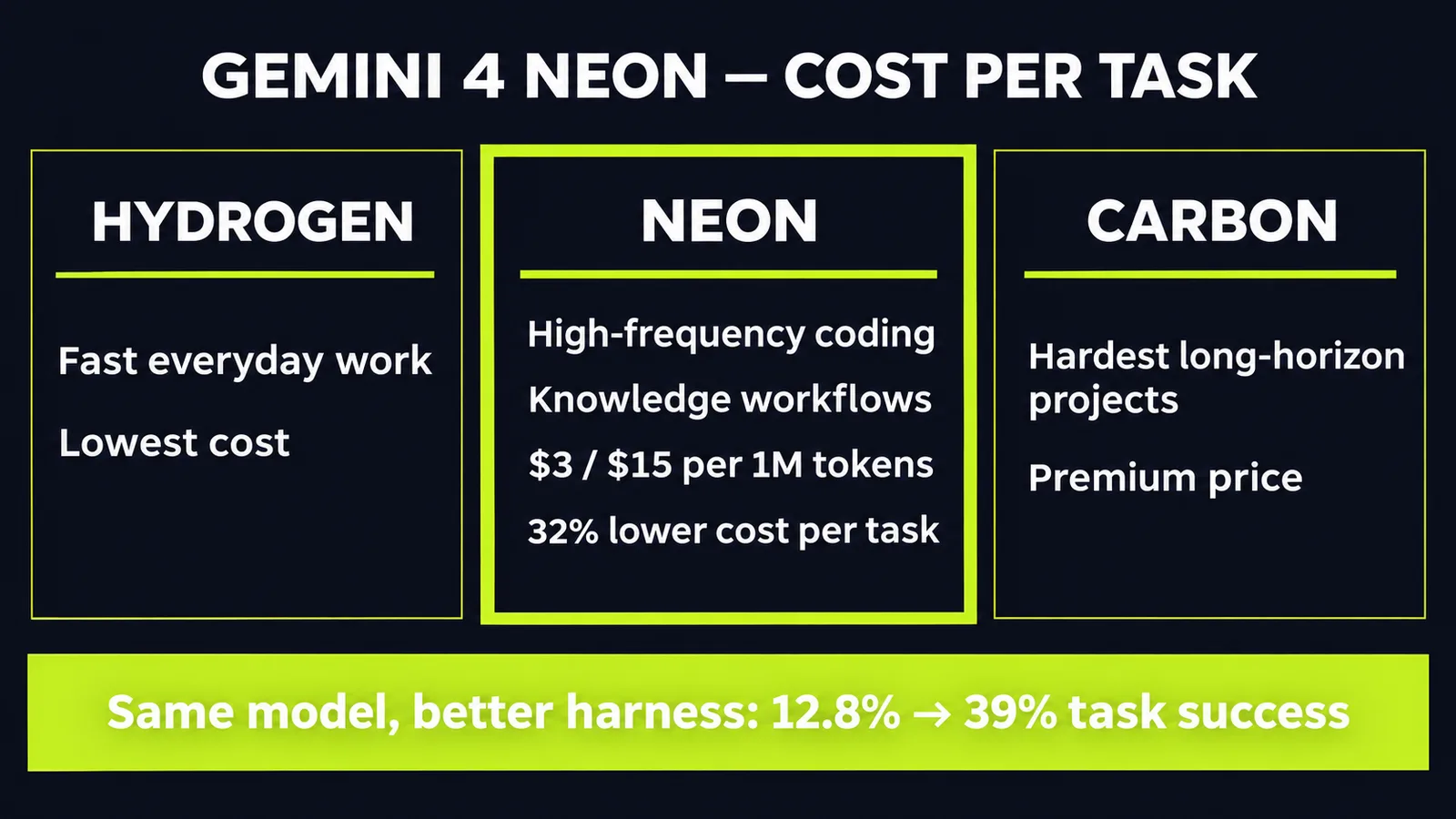
Google DeepMind released Gemini 4 Neon on November 18, and the positioning is precise: not the smartest model in the family, but the one built for work that runs all day. Neon sits between Hydrogen, the fast everyday tier, and Carbon, the flagship for the hardest long-horizon projects, per Introducing Gemini 4 Neon. It is adapted from Carbon and built for complex coding and enterprise workflows, per AI News Nov 19, 2026: Gemini 4 Neon & OpenAI Chip Design | SXF Brief. The real question is what a finished task costs — and how much of the result comes from the tooling around the model rather than the model itself.
The numbers that matter
Neon scores 61 on the Artificial Analysis Intelligence Index at its highest thinking level, third overall behind Claude Fable 5.2 at 65 and GPT-6.2 Astra at 62, per Introducing Gemini 4 Neon. At the default high level it scores 60 — the same as Carbon — per Gemini 4 Neon: Benchmarks, Pricing and Carbon Comparison.
The price is $3 per million input tokens and $15 per million output tokens, with cached input at $0.15 — a 95% discount — per Introducing Gemini 4 Neon. Batch and Flex modes halve that to $1.50 and $7.50, per the same pricing breakdown in Gemini 4 Neon: Benchmarks, Pricing and Carbon Comparison. The context window is one million tokens shared across input, reasoning and output, with 64,000 tokens of output in a standard response and a background mode for longer outputs, per AI News Nov 19, 2026: Gemini 4 Neon & OpenAI Chip Design | SXF Brief. The knowledge cutoff is March 2026, per Gemini 4 Neon Launches at $3 per Million Tokens.
On cost per task, Google says Neon at the default high level costs 32% less per task than Carbon, per Introducing Gemini 4 Neon. Independent calculation puts a task at $3.74 at high and $6.44 at xhigh, against $7.76 for Carbon at its December rate, per Gemini 4 Neon: Benchmarks, Pricing and Carbon Comparison. One timing caveat matters: Carbon is discounted to $2 and $10 until the end of November, which makes the same Carbon task about $3.88 today. From December 1, Carbon moves to $4 and $20 and Neon becomes the cheaper option on every tier, per the same source. If you benchmark this month, benchmark again next month.
Built for agents, not chat
The strongest results are in agent benchmarks, not conversation. Neon ranks first overall on the Artificial Analysis Coding Agent Index at 58.6, with 65.2% on Terminal-Bench 4.1 and 46.2% on FrontierCode 2.0 at its default setting, per Introducing Gemini 4 Neon. On AutomationBench, which tests business process automation through real business apps, Neon scored 56.3% — ahead of Carbon at 53.9% and GPT-6.2 Astra at 52.4% — per Gemini 4 Neon: Benchmarks, Pricing and Carbon Comparison.
In Antigravity, Google's agent environment, Neon can also work as an orchestrator: it drafts a plan, hands parts of the task to parallel Hydrogen subagents and reviews what they produce, per Introducing Gemini 4 Neon. A mid-tier model directing cheaper models is where the economics get interesting for high-volume workflows.
For knowledge work, Neon ranks second on the Vals Index at 70.9% and first on both its Legal Research Bench and Tax Agent Bench, per Introducing Gemini 4 Neon. A dedicated cyber variant scored 90.5% on SEC-bench Pro, a test of finding vulnerabilities in code, and is rolling out to vetted defenders in the coming days, per the same source.
The harness catch
Here is the detail that should shape your rollout plan. On SWE-sweep, the same Neon model solved 12.8% of tasks in a basic agent harness and 39% in Antigravity — the score more than tripled with better tooling around an identical model, per Introducing Gemini 4 Neon.
The thinking levels show the same discipline problem in pricing form. On CursorBench, Neon at high scored 63.7% at an average of $6.54 per task; moving to xhigh raised the score to 65.4% but lifted the cost 63% to $10.67, per Gemini 4 Neon: Benchmarks, Pricing and Carbon Comparison. On AutomationBench, dropping from xhigh to high nearly halved the cost per run, from $1.69 to $0.88, for a two-point score drop, per the same source. Read that as a rule: xhigh costs 92% more per run for two extra points — do not use it for routine automation. The default setting is usually the right setting. Extra reasoning is a budget line, not a free upgrade.
Where Carbon still wins, the gaps are specific: long autonomous tasks, where Carbon scores 77.4% on Agents' Last Exam against Neon's 75.8%, and factual questions without search, where Carbon invents an answer in 11.4% of cases when it does not know, against Neon's 13.9%, per Gemini 4 Neon: Benchmarks, Pricing and Carbon Comparison. Route those two job types up. Route everything else to Neon first.
What this means for your business
1. Make Neon your default for high-frequency agent work, and prove it on your own tasks. It is available now through the paid Gemini API, in Gemini for business, and for Pro and Ultra subscribers in the Gemini app and Antigravity, per Everything That Happened in AI Today Thursday, November 19. There is no free API tier, so budget a paid evaluation: 20 representative tasks from your backlog, scored on completed-and-passing, not on how the output reads.
2. Fix the harness before you blame the model. A 12.8%-to-39% swing from tooling alone means your agent environment — tool access, file handling, test feedback, retry rules — is worth more than a model upgrade. Audit that first. A harness that succeeds one time in eight wastes most of every dollar spent on tokens. It is also the part competitors cannot copy by switching APIs.
3. Set thinking level by task class, in writing. High for routine coding, document analysis and workflow automation. Xhigh only for the tasks where a two-point gain is worth roughly 60% more spend. Leave the setting on default everywhere else and review the bill monthly.
4. Exploit the cache. Agents resend the same instructions and codebase context on every step. At $0.15 per million cached tokens against $3 standard, prompt structure is a direct cost lever: keep stable context at the front of the prompt and let automatic caching do the rest.
5. Keep the December 1 price change in the plan. Any comparison you run this month is distorted by Carbon's introductory discount. If Carbon wins a bake-off in November by a small margin, re-run the cost maths at $4 and $20 before you commit a quarter's workload to it.
Neon is not a leap in raw intelligence — it is one point ahead of its own flagship sibling on the headline index. Its value is operational: near-frontier results on coding and business automation, at a cost per task a finance team can model, in a tier designed to run all day. That is the kind of release that changes budgets rather than leaderboards.
Ready to find where automation would cut cost or cycle time in your operation? Get a free AI audit — we'll map your highest-leverage automation opportunities in one session.
Sources
- https://blog.google/innovation-and-ai/models-and-research/gemini-models/introducing-gemini-4-neon/blog.google
- https://neurohive.io/en/news/gemini-4-neon-benchmarks-pricing-carbon-comparison/neurohive.io
- https://sxf.si/brief/sxf.si
- https://www.theneuron.ai/digest/everything-that-happened-in-ai-today-thursday-november-19-2026/theneuron.ai
- https://casrai.org/news/gemini-4-neon-launch-pricing-science-benchmarks-2026casrai.org
Want to know what this means for your stack? A free AI audit maps your workflows and shows where automation pays off — in your numbers, not ours.