On October 5, Cohere launched North 2, calling it the biggest upgrade yet to its enterprise agentic AI platform. It is not a new model: it is an upgrade centered on a redesigned orchestration harness, cross-session memory, and stronger administrative controls. VentureBeat and Unite.AI covered the launch in detail.
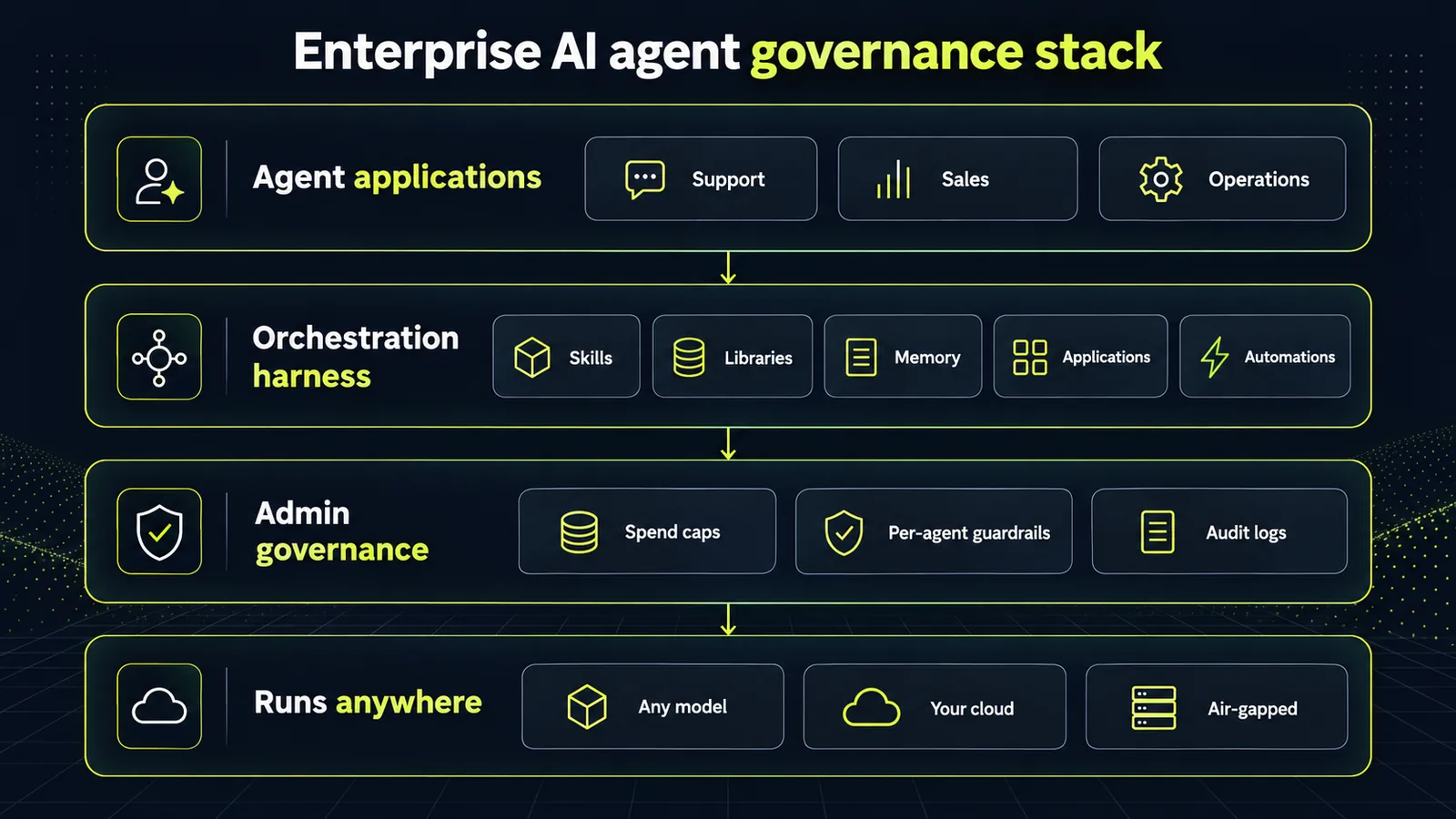
The release is about controlling how agents operate: what they spend, what context they use, what actions they can take, and where they run.
Cross-session memory and reusable workflow logic
The core of North 2 is what Cohere calls an advanced agent orchestration system, designed to run complex, multi-step processes with people in the loop where decisions need a human, Unite.AI reports.
Three additions stand out:
- Memory. Agents keep context across sessions instead of starting fresh. Teyssier told VentureBeat the memory lets context persist longer across sub-sessions and agents — though he gave no figure for how much longer, as VentureBeat and subagentic.ai note.
- Skills. These are reusable capabilities agents can call instead of rebuilding the same logic for each workflow. That gives teams a way to standardize reusable workflow logic instead of having each employee rebuild it independently.
- Libraries. Shared knowledge and assets that agents and users across the organization can draw from.
Cohere also bundles Applications, for prototyping decks, dashboards, documents, and apps from natural language inside chat, and Automations, with pre-built templates, a drag-and-drop workflow builder, and real-time monitoring. Reusable skills and shared libraries give administrators a clearer way to standardize workflow logic and organizational context.
North Admin: cost governance before the bill arrives
The most relevant feature for operations teams is cost governance. North Admin gives administrators cost controls, rate limits, user quotas, and organization-wide caps, VentureBeat reports. Token spend can be viewed per model, user, department, or agent, with alert thresholds that warn teams before limits are reached, and flow control defines consumption tiers by request and token rate.
VentureBeat's July trackers supply the context: 21% of surveyed enterprises had only reactive monitoring of agent spend, and 68% had traced a confidently wrong agent answer to missing or inconsistent business context in the prior six months, VentureBeat reports.
The statistics describe two different operational risks — weak cost controls and insufficient business context — and North 2 addresses them with separate governance and knowledge features.
One important gap, noted by VentureBeat: Cohere publishes no price for North — pricing depends on deployment scale, usage, support, and customization — and no performance benchmarks for North 2. The caps can govern usage, but buyers still need a vendor quote to model total cost.
Model-agnostic, and it runs where your data lives
North 2 is explicitly model-agnostic: organizations can run Cohere's models or bring their own, with the model, harness, search, and embedding components interchangeable — which Cohere positions as reducing lock-in, VentureBeat reports. It deploys in the cloud, on-premises, or fully air-gapped.
Cohere lists SOC 2 Type 2, ISO 27001, and ISO 42001 certifications, Unite.AI reports. North Admin can enforce guardrails at the individual agent level — filtering content, improving safety, and validating model responses — while autonomy policies restrict agents to authorized actions and send critical decisions to a person. The company says it runs continual security testing, including red-teaming and third-party vulnerability scanning, MobileSyrup reports.
New connectors link North to Slack, SharePoint, OneDrive, Outlook, Exchange, Jira, Linear, Notion, and GitHub. Financial data connectors (PitchBook, Crunchbase, Daloopa, FiscalAI, S&P Global, FactSet) are planned, not shipping — verify before designing a workflow around them.
On the same day, PwC and Cohere announced a global alliance pairing Cohere's North platform, models, and retrieval technology with PwC's risk, regulatory, and transformation practices, aimed at moving clients from AI pilots to measurable production outcomes, Unite.AI reports. It also underlines the work outside the platform itself: workflow redesign, governance, risk assessment and systems integration.
What the launch does not tell you
- No price. Nothing in the public materials says what a deployment costs. Evaluate any ROI claim only against a quoted price.
- No benchmarks. No independent performance figures for North 2 were published. Treat capability claims as vendor descriptions until third-party evaluations exist.
- No stated memory duration. "Context persists longer" is a direction, not a specification.
- Planned vs. shipping. The financial data connectors are planned, not available.
The result is enough public information to evaluate North 2's architecture and governance direction, but not to build a business case. Pricing, workload-specific performance, and several implementation details still require vendor validation.
The questions to ask before production
Beyond the feature list, the coverage leaves several operational questions that any serious deployment has to answer:
Memory governance. What gets persisted, how long is it retained, who can inspect or delete it, and how do source-system permissions carry through? Answer these before using persistent memory with sensitive workflows.
Visibility, alerting, or enforcement? A cap is only as real as its enforcement. Ask whether crossing an organization, user, or agent limit stops execution, throttles it, switches models, or merely alerts an administrator.
Usage governance is not total cost of ownership. A cap controls consumption. It does not set implementation, infrastructure, integration, support, administration, migration, or human-review costs. Buyers need the full model to calculate returns.
Portability of the workflow. "Bring your own model" and "low switching cost" are not synonymous. Ask how portable agents, skills, libraries, prompts, policies, and observability data remain when the model changes.
Connector depth. A connector is not a production integration. Validate permissions, write access, schema coverage, error behavior, and auditability before designing a workflow around a connector.
Approval mechanics. Ask which actions can require approval, who receives the request, what happens on timeout, and whether approvals are recorded.
Auditability. Ask whether you can reconstruct what an agent attempted, which tool it called, which data it accessed, what it cost, and where a human intervened.
What this means for your business
Three lessons apply to any AI agent project, with or without North 2:
1. Put enforceable limits on agent consumption. Someone must approve agent spend — and see it per user, per department, per agent, in real time. Without enforceable limits, usage can exceed the assumptions behind the business case.
2. Solve consistency before scaling. Standardize the tasks first: document the steps, fix the data sources, then give the agent the script. VentureBeat's tracker reinforces it: 68% of surveyed enterprises traced a confidently wrong agent answer to missing or inconsistent business context in the prior six months.
3. Make deployment location an explicit architecture decision. Require a documented data-flow and deployment architecture before production use.
North 2 pairs operational controls with agent capability: spend limits, security policies, persistent context, deployment choices and administrative visibility. Ask to see the limits, logs, data boundaries, approval controls and full pricing before moving an agent workflow into production.
Want agents that stay on budget? Take the free AI audit — a short assessment that maps where AI agents could create value in your business and what the governance, cost, and integration requirements would look like.
Sources
- https://venturebeat.com/orchestration/coheres-north-2-puts-ai-agents-on-a-budget-and-gives-them-a-memoryventurebeat.com
- https://www.unite.ai/cohere-launches-north-2-with-redesigned-agent-harness-and-memory/unite.ai
- https://subagentic.ai/posts/cohere-north-2-agent-platform/subagentic.ai
- https://mobilesyrup.com/2026/10/05/cohere-rolls-out-enterprise-ai-platform-north-2/mobilesyrup.com
- https://www.unite.ai/pwc-and-cohere-form-global-ai-alliance-launching-first-in-canada/unite.ai
Want to know what this means for your stack? A free AI audit maps your workflows and shows where automation pays off — in your numbers, not ours.