

Most warehouse AI agents can only reason over what a company already recorded about itself: pipeline stages, product usage, support history. They cannot see what changed outside the building — a new executive hire, a buying-intent spike. On October 30, ZoomInfo closed part of that gap: its ZoomInfo MCP connector and ZoomInfo API are now available inside Snowflake, so Cortex Agents and Snowflake CoWork can pull what ZoomInfo describes as verified company, contact and intent data into the same answer as first-party warehouse data, per ZoomInfo Launches New MCP Connector and API on Snowflake. The launch is narrow — one data vendor, one warehouse — but the pattern is the story: agents are moving from internal data alone to governed external context, with permissions attached.
What shipped on October 30
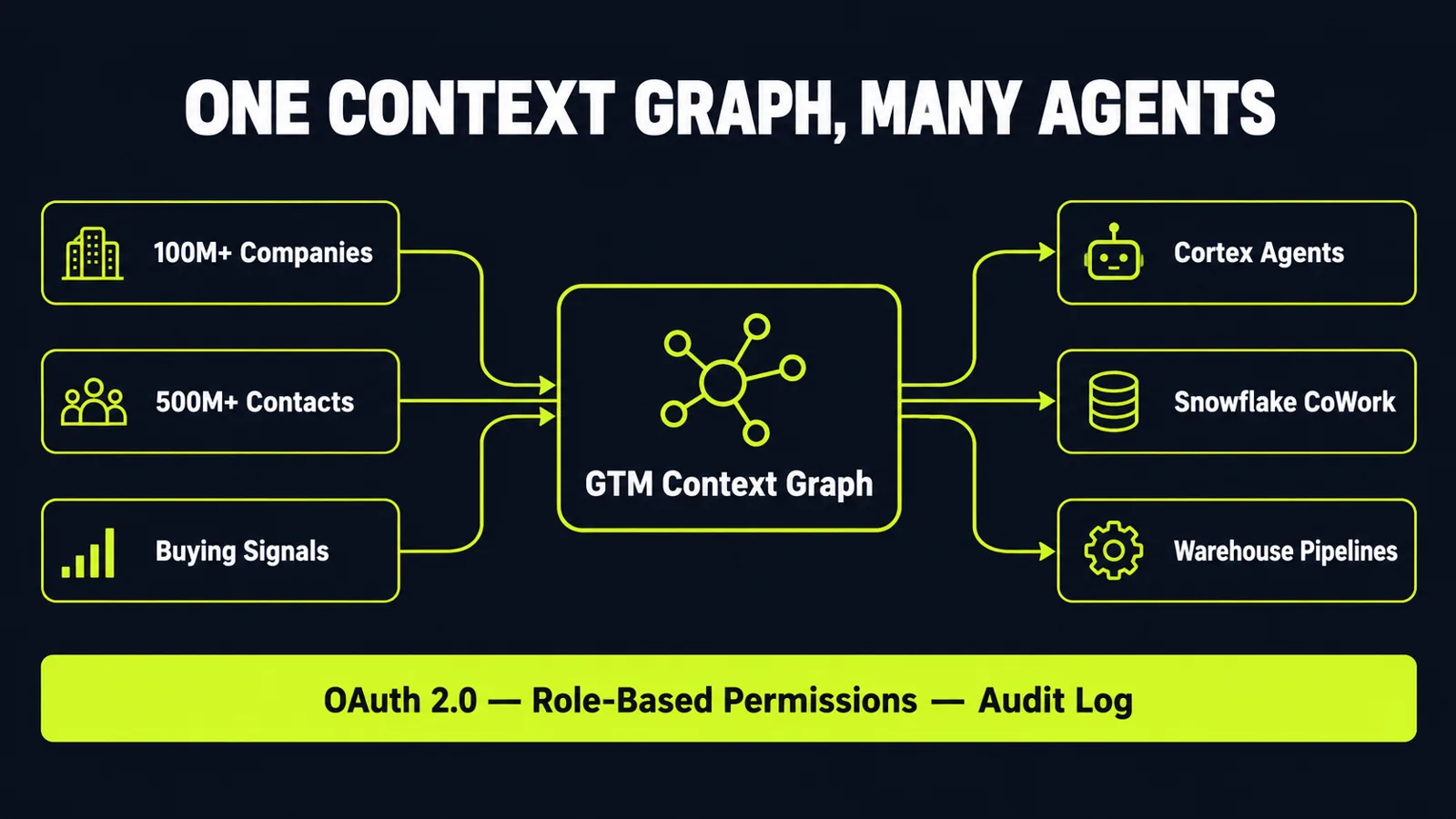
ZoomInfo MCP connects to Snowflake CoWork and Cortex Agents as a Model Context Protocol connector. Once connected, an agent can search, enrich and research companies and contacts from ZoomInfo's GTM Context Graph, which the company says covers more than 100 million companies, 500 million contacts and billions of signals, and returns that context alongside the customer's own Snowflake data in a single cited answer, per ZoomInfo launches New MCP Connector and API on Snowflake. Both connections run through GTM.AI, ZoomInfo's headless go-to-market context layer, per the same release.
The named use cases are practical, not experimental: account research that combines internal usage data with ZoomInfo Scoops and leadership-change signals; buying-committee mapping that finds missing stakeholders on open opportunities; real-time lead enrichment as records land; nightly bulk backfills that keep firmographic fields current; signal-driven scoring inside Snowpark; and change detection that refreshes only the rows whose underlying records changed, per ZoomInfo Launches New MCP Connector and API on Snowflake. None of these require a new interface for the sales team. The agent works where the data already lives. ZoomInfo says both the connector and the API are available now for Snowflake customers with a ZoomInfo subscription, per the same release.
Two doors: one for agents, one for pipelines
The release is really two products sharing one context graph. The MCP connector serves people and agents asking questions in natural language inside CoWork. The API serves data teams building pipelines: Search, Enrich, Lookup, Bulk and Monitoring endpoints callable from Snowflake Tasks, Streams, Snowpark pipelines and external functions, per ZoomInfo launches New MCP Connector and API on Snowflake. Bulk enrichment handles up to 10,000 records per request and 200,000 records per query, per ZoomInfo launches New MCP Connector and API on Snowflake | Morningstar.
That split matters for how you evaluate it. The connector is a productivity question: do cited, combined answers save reps research time? The API is a data-engineering question: does warehouse-level enrichment beat enriching the same record inside each separate sales tool, five ways, until it drifts? The two also extend ZoomInfo's existing Data Cubes on Snowflake Marketplace, which already deliver datasets into a Snowflake account on a schedule, per ZoomInfo Launches New MCP Connector and API on Snowflake. Scheduled delivery answered "is the data here?" The MCP layer answers "can an agent use it, live, in context?"
Permissions are the product
The governance design is the part worth copying, whatever vendor you buy from. ZoomInfo MCP and the API authenticate through OAuth 2.0, and every call inherits the user's existing role-based permissions — the agent sees what the person asking may see, not a superset. Only a Snowflake admin can expose ZoomInfo to Cortex Agents, and all usage is logged in ZoomInfo's audit framework, per ZoomInfo Launches New MCP Connector and API on Snowflake. What the release does not detail is the warehouse side of that story — retention, query history and export controls inside Snowflake itself. Ask for those before rollout, not after.
Independent coverage read the same pattern across the October 30 releases: proprietary data wired to agents through MCP, wrapped in access control, per Yesterday's Marketing Technology & AI News: October 31, 2026. That analysis also notes what the release does not contain: segmentation and campaign activation are not named use cases, pricing is undisclosed, both a Snowflake account and a ZoomInfo subscription are required, and no customers are named, per the same roundup. Treat those gaps as the evaluation agenda, not as footnotes.
Snowflake is not the only surface, either. It joins an existing list of GTM.AI integrations across CRM, sales-engagement and AI assistant platforms, every surface reading from the same context graph under the same governance, per ZoomInfo Launches New MCP Connector and API on Snowflake. One graph, many agents, one permission model — the architecture buyers should ask every data vendor for.
What this means for your business
1. Inventory agent data access before you buy another agent. For every agent you run or plan, list which systems it can read, whose credentials it acts under, what the audit trail captures — and who owns approving the connector, reviewing its permissions and revoking access. If a vendor cannot answer those questions in one paragraph, the agent is not enterprise-ready, whatever its demo does. The OAuth-inheritance pattern in this launch is the bar to hold others to.
2. Fix enrichment at the warehouse layer, not tool by tool. If your CRM, scoring model and outbound platform each enrich the same accounts separately, you pay repeatedly for data that still disagrees with itself. A warehouse-level path — bulk backfill plus change-only refresh — gives every downstream tool one version of the account. Measure duplicate enrichment spend and field-level disagreement before and after.
3. Pilot the cited answer, and score the citations — and the data underneath. The connector's promise is a single answer combining internal and external data, with citations. Pilot it on account research: take a sample of questions your reps actually ask, run them through the agent, and score how often the cited sources support the claim and how much research time disappears. Score the underlying records the same week: match rate against your accounts, stale contacts, duplicates, wrong titles. External data is only an advantage if it is current enough to act on.
4. Price the whole stack before the pilot, not after. This connector needs two subscriptions, and its own pricing is undisclosed — including whether connector use is bundled, seat-based or usage-based; the release does not say. Get the full cost — data subscription, warehouse compute for agent and bulk jobs, and the admin time to govern it — in writing before anyone builds a workflow that depends on it.
5. Keep a human owner on signal-driven actions. Intent spikes and leadership changes are good triggers for a rep's attention — not, on their own, a reason for an automated sequence to fire. Let agents surface and draft; let people approve outbound action.
The useful lesson is not that one vendor's data reached one warehouse. It is the shape of the next phase: agents get external context through standard connectors, and the vendors who win attach permissions, citations and audit trails to that context by default.
Want your sales and operations data ready for agents that can actually use it? Get a free AI audit — we'll map your highest-leverage automation opportunities in one session.
Sources
- https://www.zoominfo.com/newsroom/press-releases/zoominfo-mcp-api-launch-snowflakezoominfo.com
- https://www.businesswire.com/news/home/20261030229214/en/ZoomInfo-launches-New-MCP-Connector-and-API-on-Snowflakebusinesswire.com
- https://www.morningstar.com/news/business-wire/20261030229214/zoominfo-launches-new-mcp-connector-and-api-on-snowflakemorningstar.com
- https://agilebrandguide.com/yesterdays-marketing-technology-ai-news-october-31-2026/agilebrandguide.com
Want to know what this means for your stack? A free AI audit maps your workflows and shows where automation pays off — in your numbers, not ours.