

Most enterprise agent projects do not fail on the model. They fail on everything around it: connecting agents to real data, deciding what an agent may do without approval, and logging what it did. On November 10, IBM and Microsoft announced Imagine Enterprise, an enterprise AI agent platform for building, running and governing agents that execute industry-specific processes, seeded with more than 6,000 prebuilt agents and assets from IBM Consulting, per IBM and Microsoft announce a new AI agent platform designed for industry-specific transformation. The interesting part is not the catalogue size. It is the emphasis on governance and deployment help.
What shipped on November 10
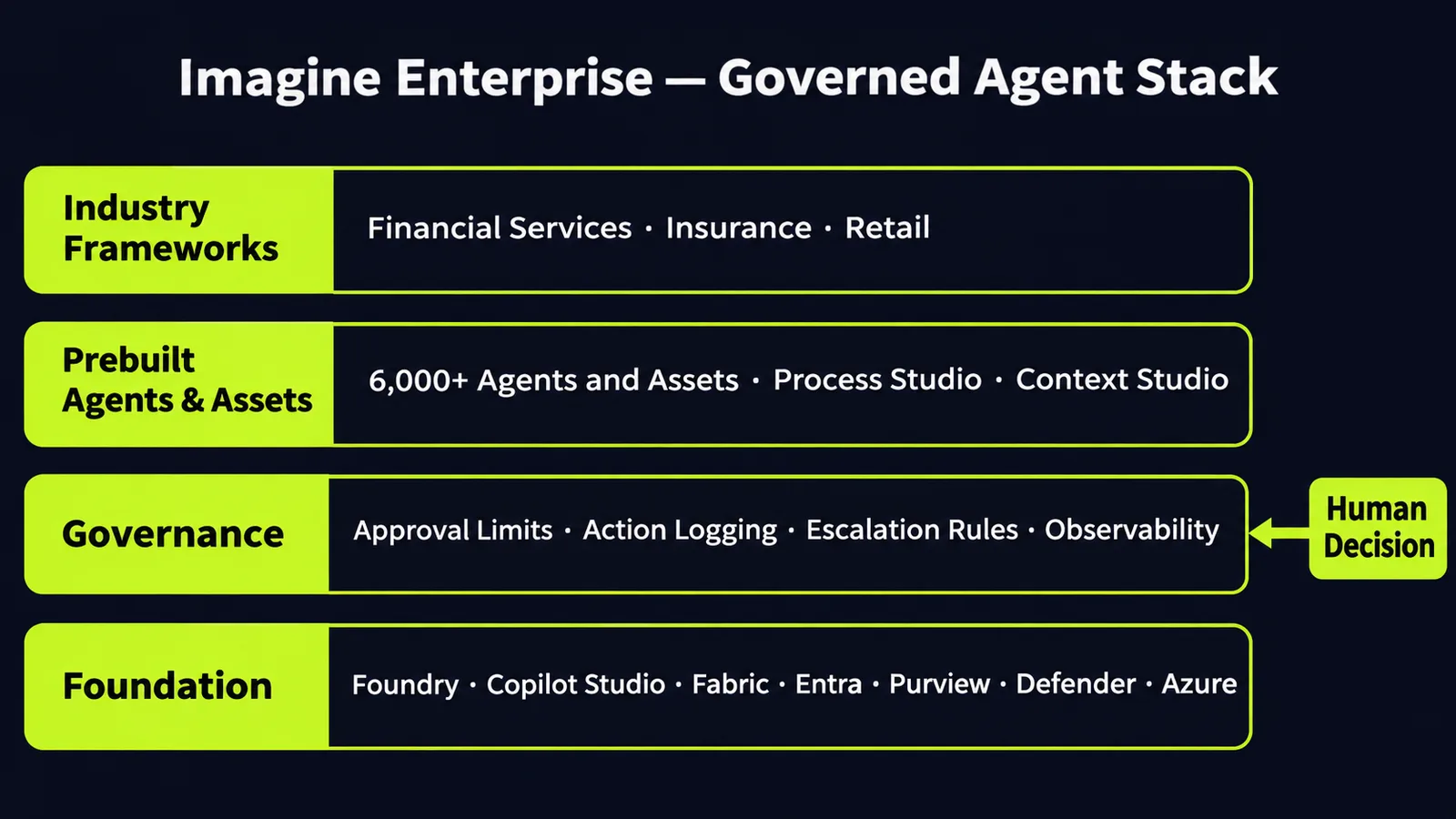
Imagine Enterprise combines IBM Consulting's delivery platform with the Microsoft stack the agents run on. IBM contributes the agent library and industry expertise, built on IBM Consulting Advantage, with its Process Studio, Context Studio and Advantage Core tooling. Microsoft describes the supporting stack as Foundry, GitHub Copilot and Copilot Studio coordinating agents and enterprise systems, with Fabric, Microsoft 365, Entra, Purview, Defender and Azure providing the data, identity, governance, security and cloud layers underneath, per the announcement linked above.
The announcement names financial services, insurance and retail as the first industry frameworks, with further sectors described only as potential future additions. Access is services-led: clients engage IBM Consulting to deploy and operate the platform, co-build an implementation, or self-manage, with forward-deployed engineers from both companies on qualifying engagements, per IBM and Microsoft Launch Imagine Enterprise for Industry AI Agents. Neither company published pricing or a general-availability date, per IBM and Microsoft Launch AI Agent Platform. The named launch example, SEI — a financial technology, operations and asset-management provider administering roughly $2 trillion in assets — is described as exploring the technology, with no quantified production results for Imagine Enterprise itself. Treat it as an exploratory reference, not proof of outcomes.
Plenty is still unstated, and buyers should keep the list visible: no pricing, no availability timing, no production metrics, no deployment timelines, no liability statement for agent errors in regulated processes, and no integration costing for estates not built on the Microsoft stack. That list defines what a serious evaluation has to ask.
Read the 6,000 figure correctly
The headline number needs one correction before it enters any internal business case: the 6,000 counts agents and other assets together, not 6,000 deployable agents, per the PYMNTS report linked above. That does not make the library worthless: prebuilt components and process templates can shorten the design phase — but only if they match your processes. You are still buying starting points that need configuration against your data, controls and approval rules, not finished workers you switch on.
The right evaluation question is therefore not "how many agents are included?" It is "how many of our ten highest-volume processes have a prebuilt starting point, and what does the adaptation work look like?" Ask for the inventory by process, and which assets are production-proven versus newly assembled.
Governance is the product, not the add-on
The most consequential part of the launch is the control layer. Every agent action, decision and escalation is logged, with live data on latency, cost, token usage and run history, and governance controls define which actions an agent may take alone, which need human approval, and when escalation is mandatory — with agents unable to bypass their defined authority limits, per the Unite.AI report linked above.
The worked example is insurance claims, from first notification of loss through settlement. A coordinating digital worker assesses complexity, flags fraud signals, checks coverage and routes each case by adjuster authority: simple claims to junior adjusters, coverage ambiguity to senior adjusters, complex cases to principal adjusters or investigation units. The human receives a prioritised queue explaining the routing and the recommended next action — and the claim decision stays with the human, per the Unite.AI report linked above. That is a defensible shape for regulated work: agents prepare, triage and follow through; people decide.
This emphasis matches what buyers report. PYMNTS Intelligence's November report, The Agentic Edge Index, found agentic AI in use at 89% of large enterprises surveyed — yet 78% would restrict agents to read-only access, 18% would allow tasks with human approval, and only 2% would permit independent execution, per the PYMNTS report linked above. The constraint on enterprise agents is not capability. It is permission.
The organisation is the bottleneck
Workforce readiness shows the same pattern. Only 4% of CIOs have implemented plans to adjust roles for a human-agent workforce, Gartner found, per Microsoft, IBM team up on AI agent platform. Prebuilt agents and forward-deployed engineers reduce the build and integration problems; neither removes the internal work of redesigning the process, assigning an owner for agent decisions, and preparing the people whose queues the agents will fill.
If other platforms follow the same emphasis, it would confirm where agent projects actually stall: not in the model, but in permission, ownership and process fit.
What this means for your business
1. Budget for governance before licences — regulated and document-heavy operations first. Approval boundaries, action logging and escalation rules are not phase two, and neither are the people who own the rules and review the logs. If your design does not specify, per process, what runs autonomously, what needs approval and what escalates, you do not have a deployment plan yet.
2. Discount every prebuilt-agent count until you see the process-level inventory. Ask any platform vendor which of your named processes have a proven starting point, what adaptation each one needs, and what evidence exists from production use. A library figure that mixes agents with other assets is marketing until it is itemised.
3. Copy the claims pattern, not the platform. The routing model in the insurance example — triage by complexity, evidence prepared in advance, decision left with an accountable human — transfers to invoice processing, support escalations, onboarding checks and dozens of other queues, on whatever stack you already run.
4. Get the services-led scope in writing — including what you own if you leave. With no public price list, every engagement is scoped: which processes, which integrations, which governance controls, what your team can operate without the vendor after handover, and who owns the agent configurations, templates and logs when the contract ends. Exit terms matter more than the launch discount.
5. Assign an owner for agent decisions now. With only a small minority of organisations planning role changes for human-agent work, the teams that name owners early — who approves agent authority limits, who reviews the logs, who retires a failing agent — are better positioned to move faster than teams that buy platforms first and govern later.
6. Pilot on one queue with a measurable baseline. Pick a single document-heavy workflow, record cycle time, error rate and escalation rate before the agent touches it, and judge the pilot against those numbers. The launch offers no production metrics yet — which is exactly why your pilot needs its own.
Evaluate any platform in this category the same way: on governance evidence and process-level detail, not on the size of the catalogue.
Ready to find where automation would cut cost or cycle time in your operation? Get a free AI audit — we'll map your highest-leverage automation opportunities in one session.
Sources
- https://news.microsoft.com/source/2026/11/10/ibm-and-microsoft-announce-a-new-ai-agent-platform-designed-for-industry-specific-transformation/news.microsoft.com
- https://www.pymnts.com/news/artificial-intelligence/2026/ibm-and-microsoft-launch-ai-agent-platform/pymnts.com
- https://www.unite.ai/ibm-and-microsoft-launch-imagine-enterprise-for-industry-ai-agents/unite.ai
- https://www.ciodive.com/news/microsoft-ibm-team-up-ai-agent-platform/874152/ciodive.com
Want to know what this means for your stack? A free AI audit maps your workflows and shows where automation pays off — in your numbers, not ours.