
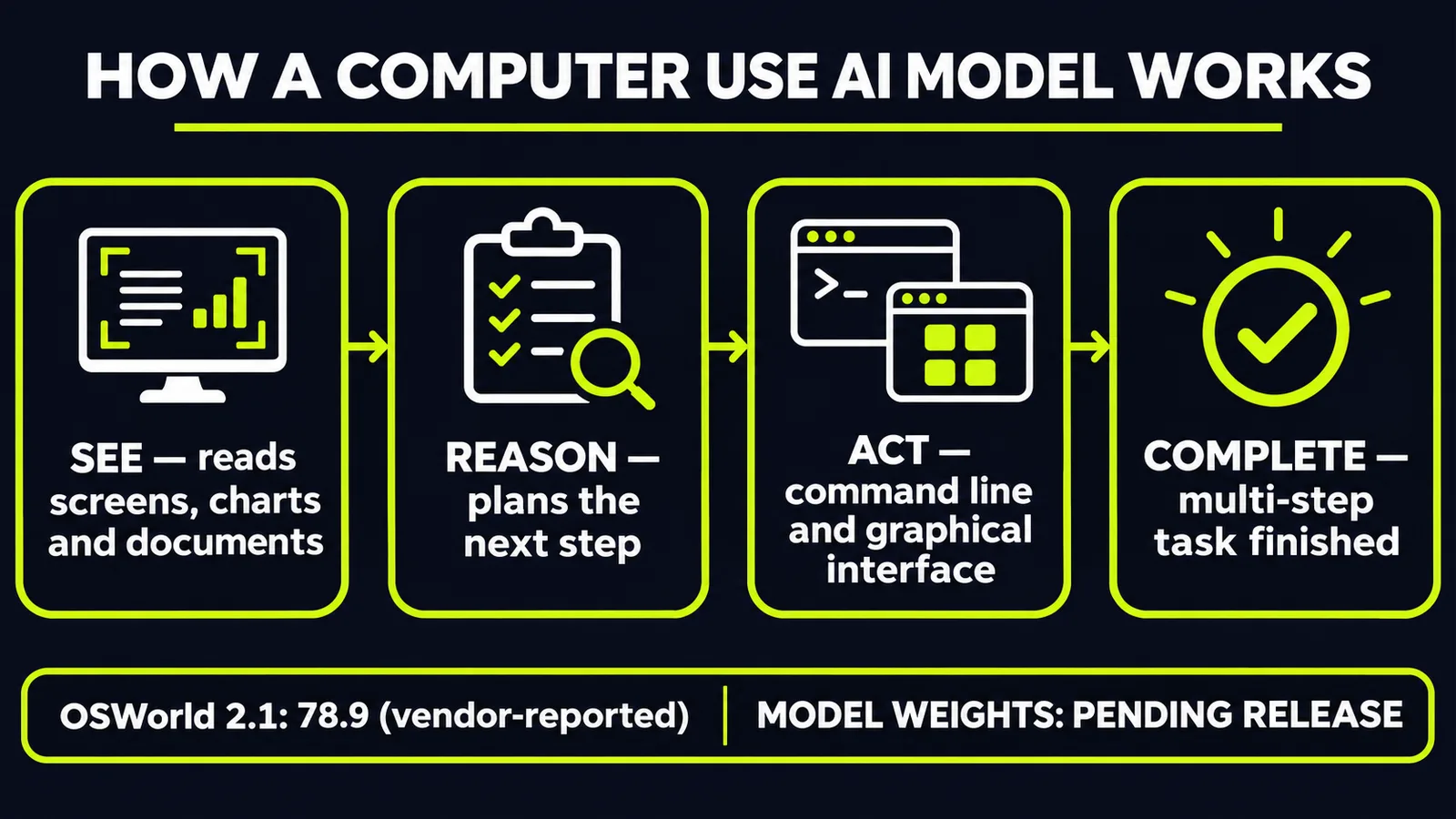
Most model launches add points on a benchmark chart. This one adds vision and computer use to a flagship line. On November 4, Tencent released Hy4, the full version of its flagship model, with visual understanding and computer-use capabilities for the first time in the line, per Tencent Unveils Flagship Hy4 With Computer-Use Capabilities for Professional Workflows. The model can read charts and documents, reason across multiple images, and operate both command-line tools and graphical interfaces to complete multi-step work. For any business evaluating a computer use AI model, the question that decides value is cost per completed task: what a model that can see a screen and act on it charges you, in tokens, retries and human corrections, for one finished workflow.
What actually shipped on November 4
Hy4 replaces a text-only preview released in August. The additions are specific: vision comes first to the line, with the model interpreting dense charts, parsing documents and analysing information across multiple images, and computer use follows from it — the model works across command-line environments and graphical interfaces, with targeted training on specialised software such as Blender and CAD applications and on long-horizon tasks that span multiple applications, per the Winbuzzer coverage linked above.
The scale figures need one caveat. The 770-billion-parameter mixture-of-experts design, with 49 billion active parameters and a one-million-token context window, comes from the preview's model card; the November announcement did not restate them, as Tencent Hy4 is out: it can use a computer but still trails Claude notes. Treat those as carried-over preview specifications until the full model's own documentation lands.
Availability is real but partial. Hy4 is live across Tencent's product portfolio and through third-party API platforms including OpenRouter, Hermes and OpenCode, per the Winbuzzer report. The downloadable weights are not out yet: Tencent says it will release them shortly, alongside a system card. Today this is an API model with an open-weight commitment, not one you can run on your own infrastructure.
The numbers, with the vendor label left on
Every performance figure published so far is Tencent-reported, and none has been independently reproduced — the weights are not public, so outside testers cannot yet run the model themselves.
On computer use, Tencent's own table puts Hy4 at 78.9 on OSWorld 2.1, close to Claude Opus 5.5 at 81.8 and Kimi K3.1 Pro at 79.6, and ahead of GPT-6.1 Sol at 75.2, per Tencent launches Hunyuan Hy4 with vision and the ability to click through apps. The gap widens sharply on terminal work: 44.4 on Terminal-Bench 4.0 against 66.4 for Claude Opus 5.5 in the same company-run table. That split is the most honest signal in the launch — screen operation is competitive, deep command-line execution is not yet at the frontier.
The professional-work evaluations are more encouraging. In a finance-focused blind evaluation of 579 tasks, judged by 213 experts — 153 of them from financial institutions outside Tencent — Hy4 ranked first among the open-weight models evaluated, per the Winbuzzer report. In a WorkBuddy-focused evaluation it scored 83.18 average quality with a 96.15% pass rate; the task set and scoring method are not disclosed, so treat that pair as directional. Tencent also says internal search evaluations showed the hallucination rate falling from 15.76% in the preview to 5.45%, per Tencent launches Hunyuan Hy4 with vision and the ability to click through apps. And one planning point: 78.9 on OSWorld also means roughly one task in five did not complete in that test. Budget human review and rollback for the failures, not just capacity for the successes.
Price is the real headline
Tencent held the preview's pricing despite the capability jump: $0.834 per million input tokens, $2.501 per million output tokens and $0.042 per million tokens on cache hits, per the Winbuzzer report. Hy4 is also billed at 50% of list price on Tencent Cloud TokenHub through December 31, 2026, and WorkBuddy and CodeBuddy carry a limited free usage quota until November 15. A lower-cost Hy4 Flash is also announced, designed to retain the model's capabilities at a substantially lower cost per task — with no price or date given.
For computer-use workloads, price matters more than it does for chat. An agent that operates a screen takes many steps per task — screenshots in, actions out, retries when an interface changes. Token volume per completed task is high, so a low per-token price compounds into a materially lower cost per finished task. Run that calculation, not the price per million tokens in isolation: cost per successfully completed workflow, against the model you use today.
Safety work shipped with the launch
Computer use raises the stakes of a model release, because the model does not just answer — it acts. Tencent says Hy4's cybersecurity training used only defensive material, with offensive material on exploitation, reverse engineering and penetration testing deliberately left out, and that its in-house security labs audited the model and found no notable offensive-capability risk, per the Winbuzzer report. Tencent Targets Financial Analysis With Hy4 AI Model likewise highlights the defensive-only training and the model's limited experimental-design capability in biosafety testing. These are the vendor's own assessments, no independent audit has been published, and the full system card is still to come — but publishing the approach at launch is the right order of operations.
What this means for your business
1. Pilot it on visual, repetitive screen work. The strongest fit combines reading and clicking: extracting data from chart-heavy reports, reconciling documents across applications, updating records in software with no clean API. Run one workflow in parallel with your current process and measure completion rate and correction effort — not demo quality.
2. Do not route terminal-heavy engineering work to it yet. Tencent's own table shows a wide gap on Terminal-Bench. Until independent results appear, keep command-line-heavy automation on the model that already proves itself in your stack, and re-test when the weights and third-party benchmarks land.
3. Model the cost per task, not per token. Count tokens in, tokens out and retries per completed task, then compare the all-in cost against your current agent stack. The list price and promotional discount make Hy4 cheap to evaluate, and the free quota window in WorkBuddy and CodeBuddy closes November 15 — a short, scoped test now costs little.
4. Treat the open-weight promise as a roadmap item, not a feature. If your compliance or data-handling requirements demand self-hosting, Hy4 does not meet them today — the weights and system card are announced, not released, with no date given. Before building on the API, get clear answers on where your data is processed, what the usage terms allow, and what switching models later would cost in rework. Structure the evaluation so you can swap models, rather than committing architecture to a promise.
5. Keep the guardrails you would apply to any acting agent. Scoped permissions, logged actions, approval gates on irreversible steps and a sandbox for first runs. None of those controls ship with the model — they sit in your stack, and your team builds and runs them, so budget that engineering honestly.
Hy4's launch does not settle the contest for the best computer use AI model. It does something more useful for buyers: it puts vision, screen operation and long-horizon task execution into a low-priced package you can test this week, with the vendor's own numbers honestly showing where it still trails. Run the test, keep your own scores, and let those make the decision.
Ready to find where a computer use AI model will actually pay back in your operation? Get a free AI audit — we'll map your highest-leverage automation opportunities in one session.
Sources
- https://winbuzzer.com/2026/11/05/tencent-unveils-flagship-hy4-with-computer-use-capabilities-for-professional-workflows-xcxwbn/winbuzzer.com
- https://www.pymnts.com/news/artificial-intelligence/2026/tencent-targets-financial-analysis-with-hy4-ai-model/pymnts.com
- https://startupfortune.com/tencent-launches-hunyuan-hy4-with-vision-and-the-ability-to-click-through-apps/startupfortune.com
- https://madrobot.blog/2026/11/04/tencent-hy4-release-computer-use-open-weight/madrobot.blog
- https://www.depthgrid.in/2026/11/tencent-hy4-770b-moe-1m-context-pricing-benchmarks.htmldepthgrid.in
Want to know what this means for your stack? A free AI audit maps your workflows and shows where automation pays off — in your numbers, not ours.