

Voice remains one of the harder service channels to automate because callers interrupt, change direction, and often need both an answer and an action during the same conversation. On November 2, Salesforce signed a definitive agreement to acquire Cresta, which Salesforce describes as a voice-first operating system for customer experience, per Salesforce Signs Definitive Agreement to Acquire Cresta. Cresta's voice AI agents are designed to handle complex calls from start to finish. The platform also provides real-time guidance to human agents and analyses customer interactions. Salesforce expects the deal to close in the first quarter of its fiscal 2028, subject to customary closing conditions and regulatory approvals, per Salesforce Agrees to Buy Cresta for Voice-Led Customer Service AI. Salesforce did not disclose the terms. Silicon Report, citing The Information, reported a price of $2.7 billion; that figure has not been confirmed by Salesforce or Cresta, per Salesforce agrees to acquire voice AI platform Cresta.
What was announced
Salesforce has agreed to buy Cresta; it has not launched a new integrated product. Signing the agreement does not itself change the service customers use today. Salesforce is acquiring Cresta's voice technology, which supports real-time conversations, handles interruptions, and is used by enterprise customers including Marriott and Comcast, per Salesforce Signs Definitive Agreement to Acquire Cresta. After closing, Salesforce plans to integrate Cresta with Service Cloud and Agentforce. Salesforce presents the rationale as connecting every conversation to the customer and to the outcome it drives — resolution, retention and revenue — per Salesforce to Acquire Cresta to Expand AI Voice Capabilities. That is a thesis to test, not a demonstrated result.
Salesforce said that, after closing, Cresta would continue to support the contact-centre and telephony platforms its customers already use, per Salesforce Agrees to Buy Cresta for Voice-Led Customer Service AI. Treat that as a continuity assurance, not a permanent guarantee: CXM notes that Salesforce has not said how long that support will continue, per Salesforce Cresta Acquisition: Voice AI Deal Explained.
Why voice is the hard channel
Text agents can rely on orderly turns. Voice conversations are less predictable. A caller may interrupt, change direction, and still expect the agent to retain context, follow compliance rules, and complete the task. Kishan Chetan, EVP and GM of Agentforce and Service Cloud at Salesforce, put it directly: voice is where service is hardest to get right, and where it matters most to customers, per Salesforce Signs Definitive Agreement to Acquire Cresta.
For buyers, the key distinction is between understanding a call and acting on it. Cresta's agents can connect to CRM, billing, scheduling and other systems to retrieve information and complete tasks, using function calling and tool access, per Salesforce Agrees to Buy Cresta for Voice-Led Customer Service AI. A voice agent that can only talk is a better phone menu. One that can retrieve account data, update records and complete an authorised transaction is automating part of the service workflow.
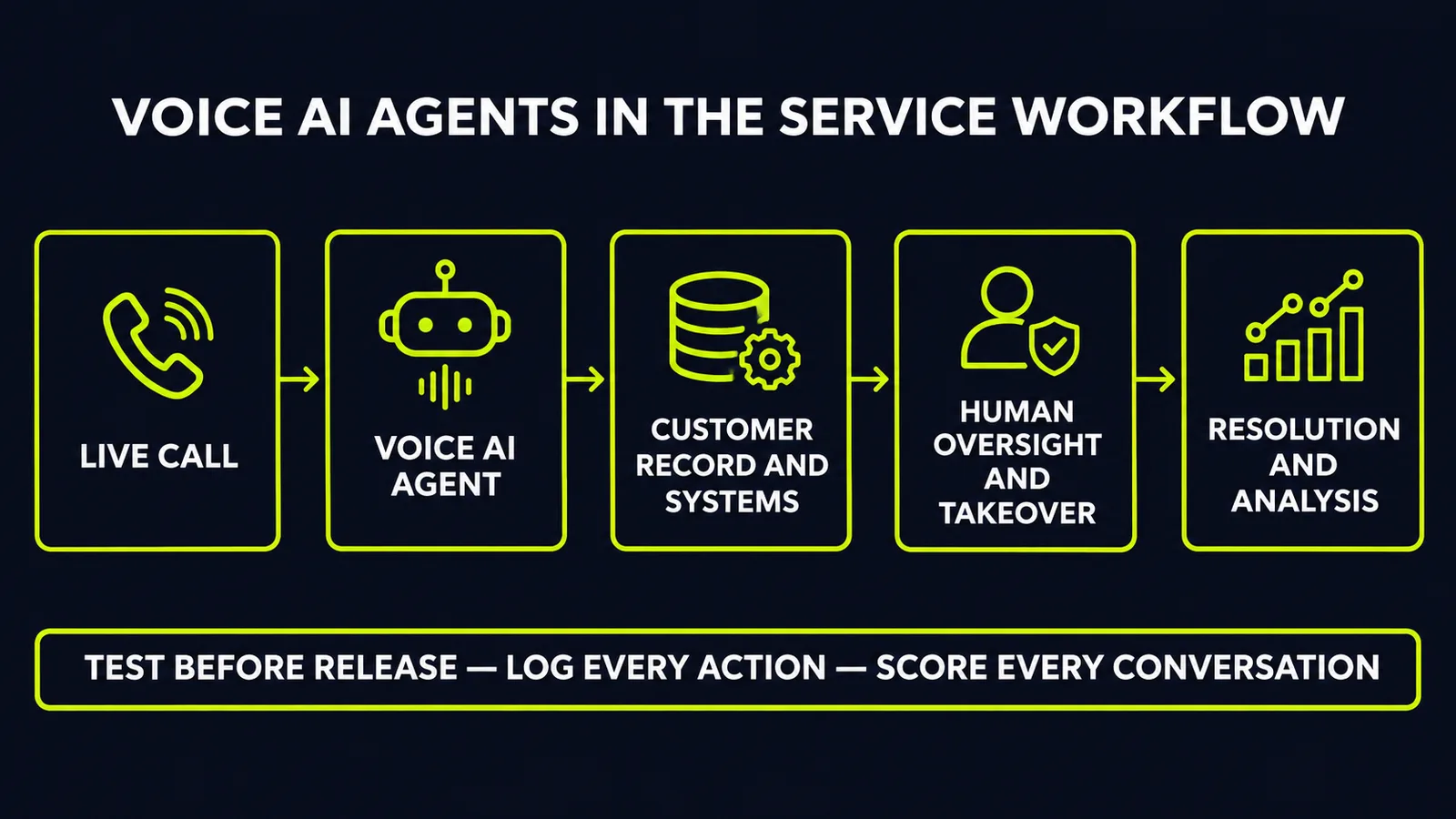
Three functions: automation, assistance and control
Automation. For autonomous handling, Cresta assesses existing conversations by topic frequency, complexity and resolution outcome to identify which call types are suitable for an agent, per Salesforce Agrees to Buy Cresta for Voice-Led Customer Service AI. That sequencing is the part to copy: automate by evidence from your own call history, not by ambition.
Assistance. During live calls, human agents receive real-time hints, reminders and workflow guidance, and structured summaries are intended to reduce after-call work, per Salesforce agrees to acquire voice AI platform Cresta. This mixed model is usually where the first return sits: the human agent stays accountable, while repetitive guidance and documentation move to the system.
Analysis and control. Conversation intelligence analyses interactions handled by human and AI agents, tracks topics and outcomes, and auto-scores defined behaviours across conversations, per Salesforce Agrees to Buy Cresta for Voice-Led Customer Service AI. The control features require closer scrutiny. According to the cited coverage, the design combines reasoning with deterministic code that tracks conversation state and enforces required workflow steps, supervisors can monitor and take over conversations, and changes can be tested against synthetic customers and through controlled experiments before wider release, per Salesforce agrees to acquire voice AI platform Cresta. That control layer, not the voice quality, is what makes a system deployable on consequential calls.
The open questions
Three material points remain unresolved. First, overlap: CXM notes that Salesforce has not explained how Cresta will sit alongside its existing Agentforce and Service Cloud agent offerings, per Salesforce Cresta Acquisition: Voice AI Deal Explained. Second, evidence: neither Salesforce's announcement nor the cited coverage provides new figures for resolution, accuracy, customer satisfaction or cost per contact. Third, commercial terms: no pricing, packaging or licensing implications have been disclosed — whether voice agents are included, sold separately, or priced per conversation is unanswered. Integration effort is also unpriced: connecting identity checks, billing, scheduling and exception handling is project work — the licence is not the project cost. Do not pause an active procurement solely for this announcement: the deal has not closed, and the integration is not a completed product today.
What this means for your business
1. Start with call data, not a vendor demo. Rank call types by volume, complexity, resolution outcome and failure reasons. Automate the frequent, bounded, system-backed calls first. Leave ambiguous or high-value calls with people, assisted by the same platform.
2. Control system access. Specify which records an agent may read, which actions it may perform, which transactions require approval, and what must be logged. Require those permission limits for every system action before deployment — and test them, because voice fails in public, in real time.
3. Evaluate the controls, not just the conversation. Test workflow enforcement, supervisor takeover, pre-release testing against realistic callers, release management and rollback under realistic failure conditions. Turn production failures into test cases. Your testing and rollback process is the product.
4. Measure human assistance separately from automation. Track handle time, after-call work, first-contact resolution, compliance errors and agent experience for assisted calls, with their own baseline. Do not merge assisted results with fully automated journeys, and judge automation on completed resolution — not deflection, which can simply mean the customer gave up.
5. Set governance before go-live, and put continuity in the contract. Agree what an agent may say and do, when it must transfer, and who owns the outcome when it errs — covering authentication, consent, payment data and audit. If you run an acquired platform on telephony you do not plan to replace, seek written commitments on support duration, notice periods and migration support. Announcements change; contracts survive them.
Salesforce's decision to acquire Cresta, rather than rely only on partnerships or internal development, shows it regards voice as a core part of the service platform. Teams that treat voice as a workflow problem — data-led scoping, bounded system access, tested controls — will get value from whichever vendor they choose.
Ready to find where voice and workflow automation will actually pay back in your service operation? Get a free AI audit — we'll map your highest-leverage automation opportunities in one session.
Sources
- https://www.salesforce.com/news/stories/salesforce-signs-definitive-agreement-to-acquire-cresta/salesforce.com
- https://www.unite.ai/salesforce-agrees-to-buy-cresta-for-voice-led-customer-service-ai/unite.ai
- https://www.siliconreport.com/salesforce-agrees-to-acquire-voice-ai-platform-crestasiliconreport.com
- https://cxm.world/customer-experience/salesforce-cresta-acquisition/cxm.world
- https://www.callcentrehelper.com/salesforce-to-acquire-cresta-278503.htmcallcentrehelper.com
Want to know what this means for your stack? A free AI audit maps your workflows and shows where automation pays off — in your numbers, not ours.