Returns are difficult to automate because item condition, packaging and assortment vary, while conventional automation is built for known products presented predictably. On October 28, 2026, Otto Group and robotics company Sereact announced a two-phase deployment of AI-controlled dual-arm robots to inspect and sort returned orders, per Otto Group and Sereact Bring NVIDIA-Powered Physical AI to Returns Processing. The proposition behind physical AI returns automation is direct: a robot that can handle an item it has never seen before, without product-specific teaching, could take on a highly variable warehouse task that fixed automation could not.
What was announced on October 28
Ten AI-controlled dual-arm systems go in first. If the initial results hold, 15 more follow, taking the programme to 25 systems in total, per Otto Group and Sereact Bring NVIDIA-Powered Physical AI to Returns Processing | Things Of Business. A broader rollout across the wider logistics network is a separate decision, evaluated only if the second phase succeeds, per the same report. The announcement gives no threshold, date or results for either gate.
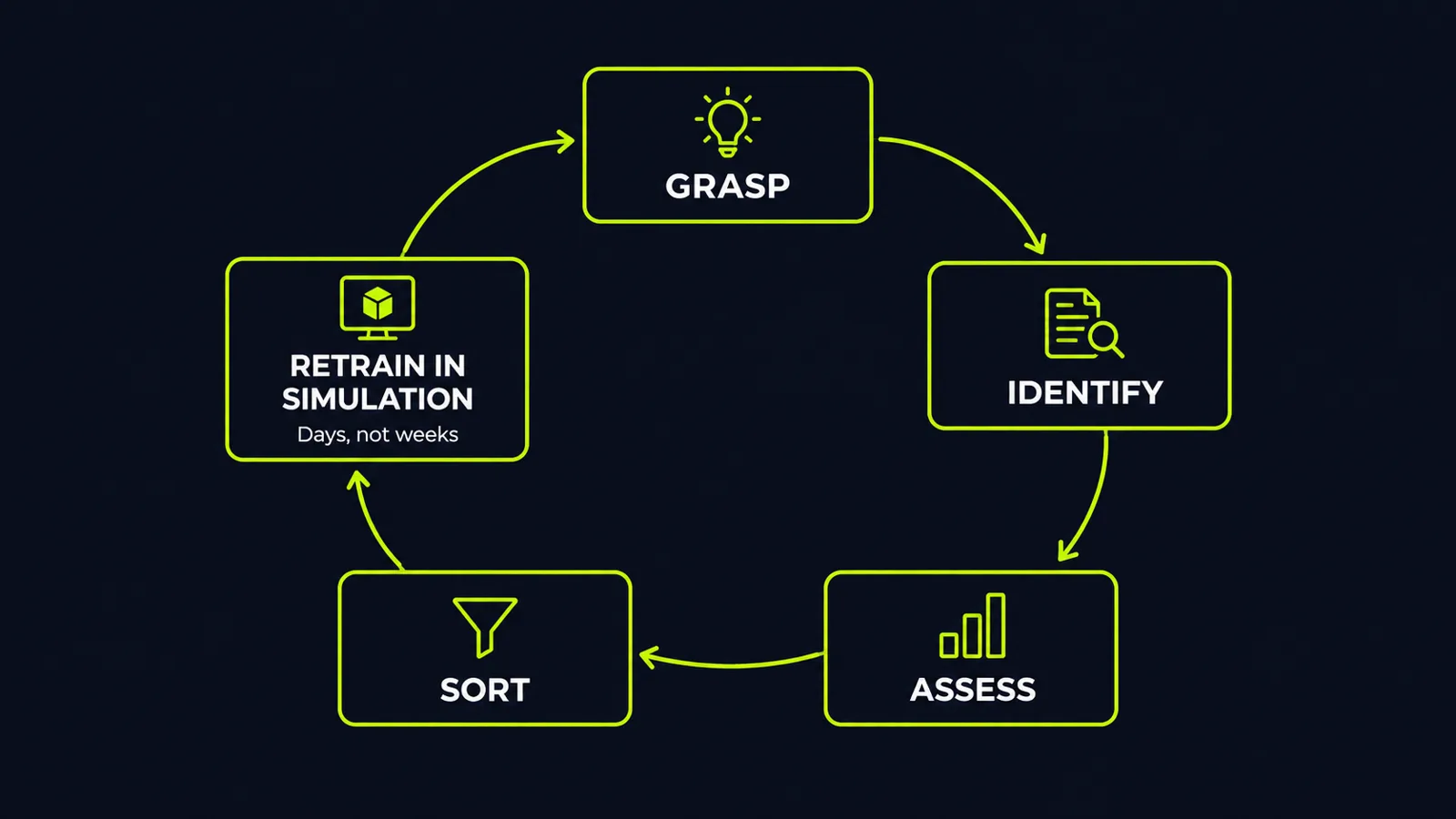
The robots are intended to grasp, identify, assess and sort returns. They run on Cortex, Sereact's Physical AI model, which the companies describe as recognising and handling items it has never encountered, with no product-specific teaching and no fixed item catalogue, per Otto Group and Sereact Bring NVIDIA-Powered Physical AI to Returns Processing. That is a vendor capability claim, not a measured result: the announcement reports no throughput, accuracy, damage or cost figures. Read it as a test at real scale, with the evidence still to come.
Why returns are hard for traditional automation
Traditional automation depends on known products and predictable presentation. Returns offer neither. Items come back folded, crumpled and repackaged, and the assortment of a multi-category retailer changes continually, per Otto Group and Sereact Bring NVIDIA-Powered Physical AI to Returns Processing. A week earlier, the same problem was described from live returns work: each item arrives refolded or crumpled, in its packaging or loose, with or without tags, while the assortment changes every season, per Sereact, NVIDIA, Nebius, CEVA Logistics and Zalando Close the Training Loop for Robotic Returns Handling.
Sereact says Cortex is built for the opposite assumption: it generalises to objects it has never encountered and decides in real time how to grasp an item, assess its condition and route it, per Otto Group and Sereact Bring NVIDIA-Powered Physical AI to Returns Processing. The claim is not only a laboratory one. Dual-arm systems running Cortex now autonomously process returned fashion items at fulfilment sites operated with a logistics partner, per How Teradyne, NVIDIA & Sereact Automate Retail Returns. Note the limit in that evidence: fashion items, not a multi-category assortment. Demand results by item category, not a single blended rate.
The training loop: a tested fix in days, not weeks
The most useful part of the announcement is not the arm. It is the loop behind it. Cortex is trained and validated with NVIDIA Isaac Sim, NVIDIA Isaac Lab and NVIDIA Cosmos. Real picks from the returns line are turned into thousands of simulated variants, re-rendered across garment states, packaging, materials and lighting, and new policies are post-trained on NVIDIA Blackwell GPUs and tested against held-out cases before they reach the robots, per Otto Group and Sereact Bring NVIDIA-Powered Physical AI to Returns Processing.
The loop's gate matters as much as its speed. In the fuller version detailed a week earlier, an updated policy is scored against a threshold: a policy that passes goes to the stations for a real-world test, and one that fails triggers targeted variants for the cases it missed, per Sereact, NVIDIA, Nebius, CEVA Logistics and Zalando Close the Training Loop for Robotic Returns Handling. An independent summary puts the payoff narrowly: a fix for an error can return as a tested update within days, rather than the weeks the previous pipeline took, per Sereact, Nvidia, Nebius build closed training loop for robot brain.
Hardware depreciates. A system that converts a failed grasp into training data, tests the fix before deployment and keeps a gate between a new policy and a live line gets better at the exact mix of work a business actually receives.
Robotics as a service, and the staff roles that remain
The deployment runs under a Robotics-as-a-Service model: Sereact operates and maintains the systems, per Otto Group and Sereact Bring NVIDIA-Powered Physical AI to Returns Processing. The buyer is not purchasing robots and then hiring the expertise to keep a learning system current. It is buying a maintained service — although the announcement discloses no fee basis, term or uptime commitment, so there is nothing to price against yet.
People do not disappear from the process. Under the plan, employees hand over repetitive grasping and lifting and take on supervision, exception handling and final quality decisions, per the same announcement. That leaves an accountability question every operator should settle early: if the robot assesses condition and a person makes the final quality call, who owns a wrong assessment, and how are grading standards set and audited?
What this means for your business
1. Start with a bounded, high-variance category. The value case is strongest where items, packaging and condition change constantly and fixed automation needed endless re-teaching. If your process is already stable and predictable, this announcement changes little for you. Agree the phase-gate measures and threshold before the first system starts.
2. Judge the pilot in phases, against a baseline. Ten systems first, 15 more only if initial results hold, and any rollout beyond that as a separate decision. As a recommendation, measure items per hour, correct condition assessments, exception rate, damage rate and cost per processed return — against the current process on the same item mix. Without a before-and-after baseline, the numbers prove nothing.
3. Ask who owns the learning loop — and the data. How fast does a failure become a tested fix, who approves a new policy before it reaches a live line, and what held-out testing must it pass? Then the ownership questions: who owns the recorded episodes and the updated policies, can learning from your returns be reused for other customers, and what can you keep if you leave?
4. Price the service model against the full in-house cost — once terms exist. Robotics as a service shifts maintenance and model updates to the vendor. Ask what operation and maintenance actually include, who pays for downtime and damage, and what happens at exit. Compare the answers against complete ownership cost: hardware, integration, retraining, downtime and specialist staff.
5. Design the human exception role before you automate. Decide which returns route to a person, what decision that person is making, and how their judgment feeds back into training. Supervision and quality checks are where costly errors get caught; understaffing them quietly cancels the saving the robots created.
Physical AI does not make returns simple. It makes a previously unteachable job testable at real scale, with a training loop measured in days and expansion gated on results that have not been published yet. That discipline — start with the messiest high-volume process, measure it honestly, expand only on evidence — is the part worth copying, whatever hardware you eventually buy.
Want to know which of your high-variance processes are worth automating first, and what a phased pilot should measure? Get a free AI audit — we'll map your highest-leverage automation opportunities in one session.
Sources
- https://www.globenewswire.com/news-release/2026/10/28/3389884/0/en/otto-group-and-sereact-bring-nvidia-powered-physical-ai-to-returns-processing.htmlglobenewswire.com
- https://www.thingsofbusiness.com/news/0947009648/otto-group-and-sereact-bring-nvidia-powered-physical-ai-to-returns-processingthingsofbusiness.com
- https://www.globenewswire.com/news-release/2026/10/21/3385409/0/en/sereact-nvidia-nebius-ceva-logistics-and-zalando-close-the-training-loop-for-robotic-returns-handling.htmlglobenewswire.com
- https://www.financial-news.co.uk/sereact-nvidia-nebius-build-closed-training-loop-for-robot-brain/financial-news.co.uk
- https://supplychaindigital.com/news/how-teradyne-nvidia-sereact-automate-retail-returnssupplychaindigital.com
Want to know what this means for your stack? A free AI audit maps your workflows and shows where automation pays off — in your numbers, not ours.