
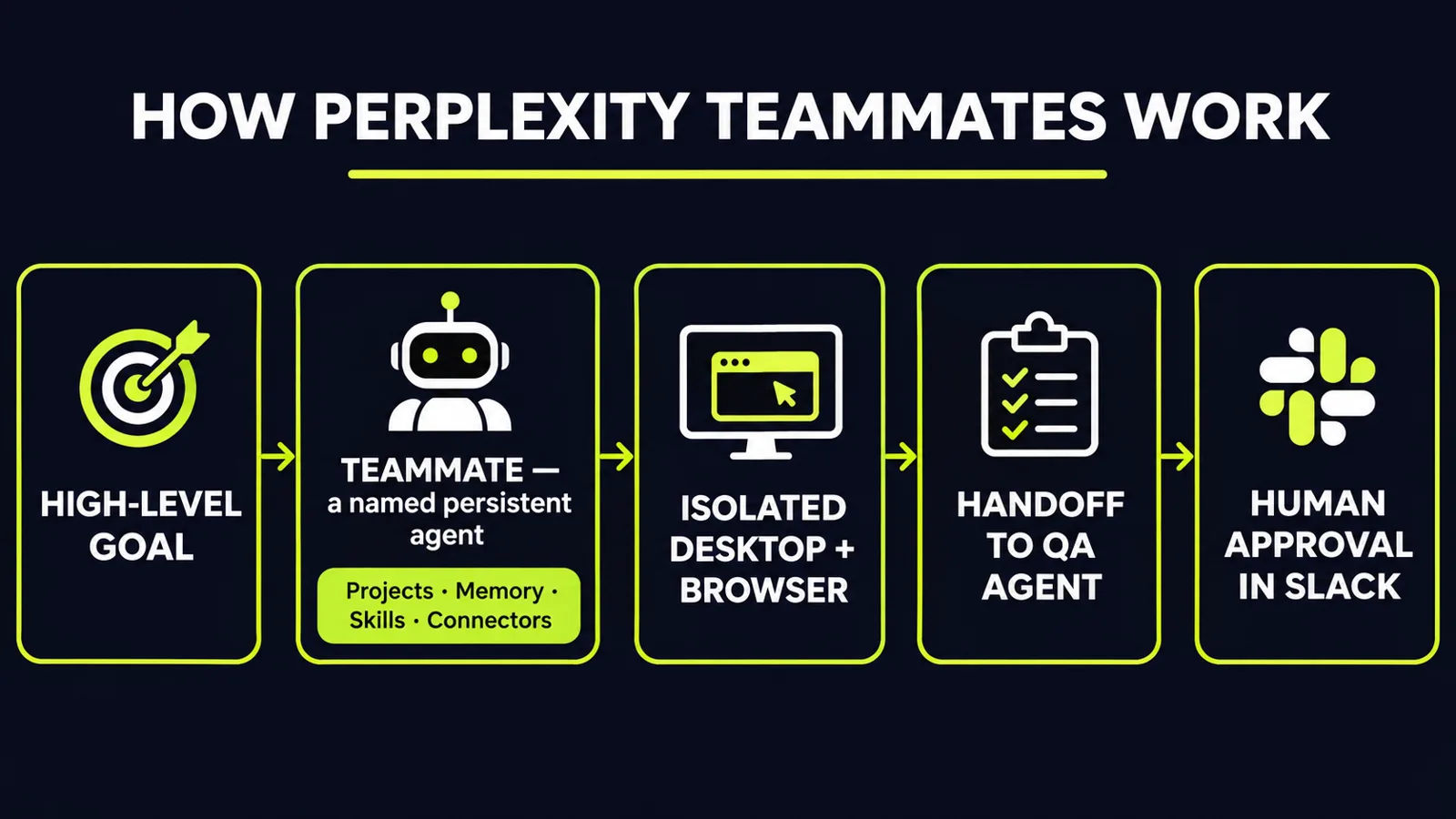
On November 5, Perplexity launched Teammates, a system of persistent AI agents designed to hold a job instead of answering a prompt. Each agent takes a role, inherits the projects, memory and tools already inside your workspace, and keeps working toward a high-level goal until the result is ready for review, per Perplexity's new AI coworkers can take over your workload, but they don't come cheap - Digital Trends. For buyers, the launch is useful because the design is specific enough to evaluate — and the gaps in the launch details are exactly the questions to ask before spending.
What shipped on November 5
Teammates are personal agents for work, announced by chief executive Aravind Srinivas on November 5 as a shift from writing prompts in a session to giving high-level goals, per the Digital Trends report linked above. The agents are built on Perplexity Computer, the orchestration system the company launched in February, which breaks work into subtasks and routes them across 19 different AI models, per Perplexity's Teammates Gives AI Agents Persistent Roles and Memory.
Earlier Computer sessions ran in temporary sandboxes that disappeared when a job ended. Teammates persist: each one keeps a continuing thread, retains its goal, task history and shared files across runs, and starts from the projects, skills, memory, connectors and past sessions already in the account rather than from an empty conversation, per Perplexity launches Teammates agents for ongoing work. A user assigns each teammate a role, standing instructions, tools and escalation rules. Perplexity's suggested roles include an on-call engineer, a legal research assistant and a storefront manager, and its examples span marketing, sales, support and operations work: triaging bugs, running QA loops, monitoring security, analysing data and managing A/B tests.
The company is running the product internally at a scale worth noting, with the vendor label attached: Srinivas said Perplexity's own workspace had used about 10,000 teammates in the 30 days before launch — a count he described as 20 times headcount — with about 1,000 active on November 4, per the AI Affairs report. That is a usage claim from the seller, not an outcome study. It shows the system can be operated at volume; it does not show what the work was worth.
How the agents actually work together
Three mechanics distinguish Teammates from a saved prompt: isolation, handoffs, and escalation. First, isolation: each teammate runs in its own environment, with a separate desktop, browser session and cookie store, so an agent can stay signed in to one tool while a second agent works in another without sessions colliding, per the AlphaSignal breakdown. Second, handoffs: teammates can pass work to each other. In one company demo, an engineering agent fixed a password-reset crash and passed the pull request to a QA agent, which tested on desktop and mobile and returned the results for review. Third, escalation: teammates can message people in Slack, watch assigned channels for new requests, and ask for approval or clarification instead of guessing. In Perplexity's on-call demo, the agent's escalation rules paged a human when a proposed fix needed approval, or when it could not isolate a cause within 15 minutes.
Read those demos as vendor demonstrations, not production evidence — they show the intended workflow, not a measured reliability rate. Humans keep operational control throughout: work can be inspected in the agent's thread, redirected mid-task, or taken over at the desktop. Perplexity also says the agents learn from mistakes and feedback; in one demo, after an ads teammate prepared a larger campaign and sent a contract extension to the legal team, the instruction it received back was to do the same thing every time without asking. Whether that learning holds up over weeks of real work is one of the things a pilot has to establish.
Price and availability: read the fine print
Treat the headline price as the cost of an evaluation seat, not a production rollout. Access is narrow at launch: Teammates is a research preview rolling out to individual Max subscribers on the web, with native mobile and desktop apps promised as coming soon, per Perplexity takes on OpenAI and Anthropic with work-focused AI agents. Max costs $200 a month, or $167 a month billed annually, and includes 10,000 monthly credits for Computer, which teammates draw against; a launch promotion adds a usage grant before standard credits are charged, with its size and expiry undisclosed, per the AlphaSignal and AI Affairs reports. Team accounts are not the launch audience: Enterprise Pro and Enterprise Max accounts are not included by default.
The $200 subscription is fixed; the real cost is credits. Always-on monitoring, browser sessions, retries and agent-to-agent handoffs all consume the monthly pool, and Perplexity has not published how quickly a realistic workload burns through it. Perplexity launches Teammates AI agents as Wall Street doubts AI payoffs also notes what the announcement does not specify: how many agents a user can run, and which tasks they can reliably complete. Until those numbers exist, nobody can quote you a cost per completed task — you have to measure your own.
The competitive frame
Perplexity is entering a crowded category late, with a specific angle. OpenAI's workspace agents and Dots, Anthropic's Claude Duet and Claude Cowork, and Microsoft's Copilot Cowork are all chasing the same shift from chat to delegated work, per the Digital Trends and Silicon Report coverage. Perplexity's differentiation is the combination it already owned: a workspace where projects, memory and research context already live, an orchestrator that routes subtasks across 19 models instead of betting on one, and agents sold to individual subscribers first rather than through enterprise procurement. Srinivas has set the ambition plainly: "Over time, we envision every org having hundreds of teammates working for each person," per the Silicon Report report.
What this means for your business
1. Pilot one standing responsibility, not a department. Pick a recurring job with a clear done state — monitoring a request channel, maintaining a research brief, running a weekly reporting task — and run it like an experiment: a named owner, written success and stop criteria, a weekly review of the agent's thread, and a hard credit ceiling. Measure completion rate, intervention rate and credits consumed. Those three numbers tell you more than any demo.
2. Write the escalation rules before you grant the tools — and plan the failure case. Teammates inherit the permissions already configured in your workspace, so the access review happens at setup, not after the first incident. Define which actions an agent may take alone, which need approval, and the time limit after which it must stop and ask. Then answer the harder question in advance: when an agent makes a wrong change, sends a wrong message or acts on stale data, what rolls it back, and who owns the call? Approval gates on irreversible actions are the containment.
3. Budget in credits, not seats — and price the completed task. The $200 subscription is the floor. Track credits per completed task across the pilot; if a finished task costs more, in credits plus review time, than the human time it saves, stop and re-scope. Set the ceiling per agent before you scale the count, because parallel agents and handoffs multiply consumption.
4. Keep a human review surface you actually check. The product's controls — persistent threads, desktop takeover, mid-task redirection — only work if someone reads them. Assign an owner per teammate, review its thread on a schedule, and feed corrections back as standing instructions. Apply one blunt test: if reviewing the agent's work takes longer than doing the task yourself, the agent is not saving time yet.
5. Do not rebuild your stack around a research preview. Availability is individual and web-only at launch, team plans are excluded by default, and key limits are unpublished. Keep the portable assets portable: document each role's standing instructions, escalation rules and tool list outside the product, so the workflow design survives a switch. Evaluate Teammates alongside the agent tools you already have access to, and let measured results decide where it earns a permanent role.
Teammates does not prove persistent agents can run a business function unsupervised. It does show the major platforms shifting from selling answers to selling standing capacity: named roles, retained memory, parallel work and escalation paths. The open work is operational — reliability over weeks, permission precision, audit quality and predictable cost — and it will be settled in pilots like yours, not in announcements.
Ready to find where persistent AI agents will actually pay back in your operation? Get a free AI audit — we'll map your highest-leverage automation opportunities in one session.
Sources
- https://www.digitaltrends.com/cool-tech/perplexitys-new-ai-coworkers-can-take-over-your-workload-but-they-dont-come-cheap/digitaltrends.com
- https://www.aiaffairs.com/technology/perplexity-launches-teammates-agents-for-work/aiaffairs.com
- https://www.siliconreport.com/perplexity-takes-on-openai-and-anthropic-with-work-focused-ai-agentssiliconreport.com
- https://alphasignal.ai/news/perplexity-s-teammates-gives-ai-agents-persistent-roles-and-memoryalphasignal.ai
- https://startupfortune.com/perplexity-launches-teammates-ai-agents-as-wall-street-doubts-ai-payoffs/startupfortune.com
Want to know what this means for your stack? A free AI audit maps your workflows and shows where automation pays off — in your numbers, not ours.