
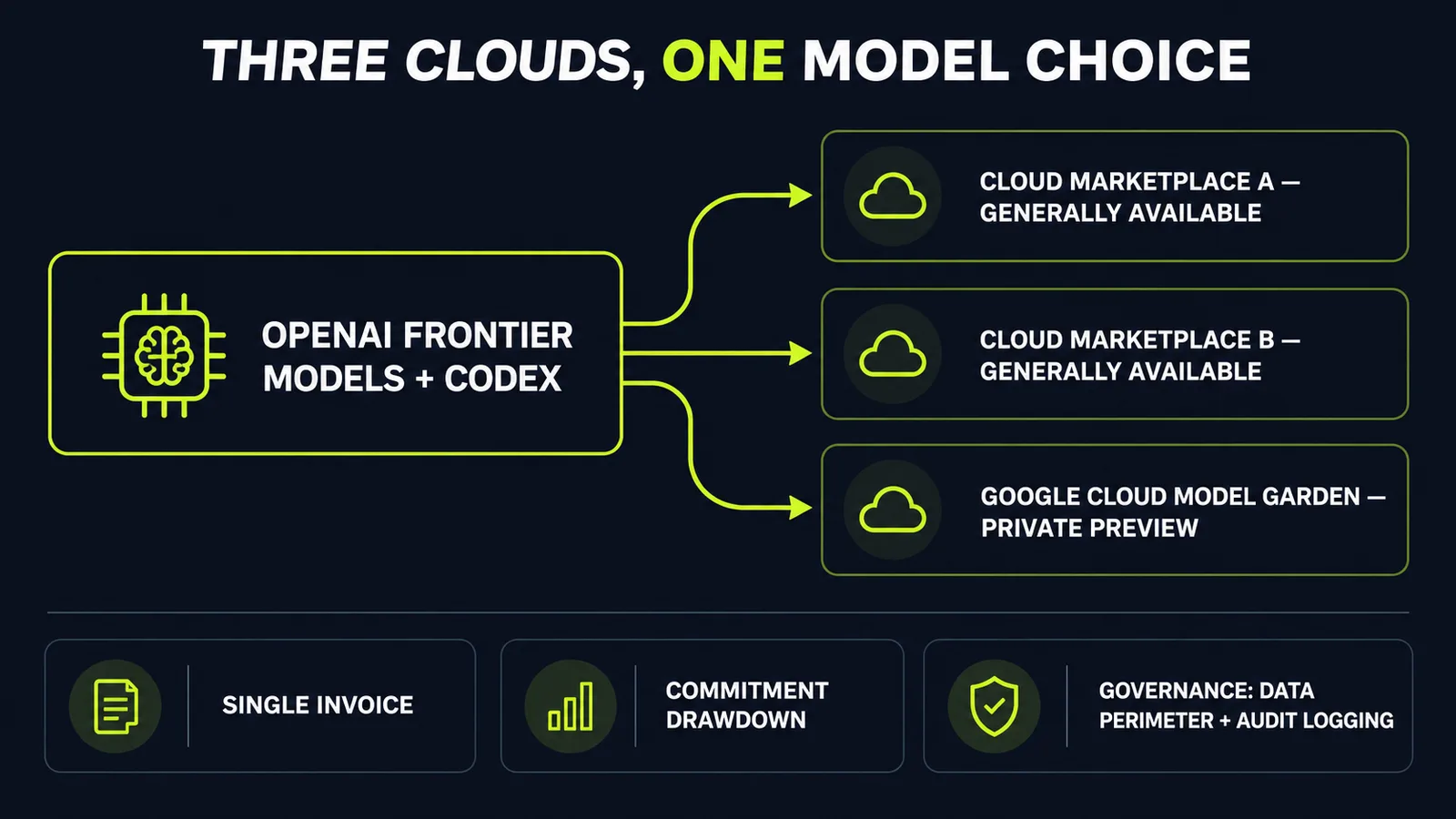
On Wednesday, October 21, 2026, OpenAI and Google Cloud announced that OpenAI's frontier models and Codex agentic workflows are coming to Google Cloud's Model Garden — in private preview first, with general availability planned in the coming weeks. This is not a new model launch. It is a distribution change that completes OpenAI's presence across all three major hyperscale clouds, and for teams already committed to Google Cloud, distribution was the blocker.
Key takeaways
- The announcement is a preview, not a general release. Google Cloud says GPT-6 Astra, GPT-6.1 Sol and GPT-6 Luna are rolling out in private preview to select enterprise customers, with more coming soon, per OpenAI Models Come to Google Cloud: What Is in Preview.
- Buying runs through Google, not a separate OpenAI contract. Customers will purchase through Google Cloud Marketplace, apply existing spend commitments to the purchase, and see usage on a single Google Cloud invoice, per OpenAI to sell its top models on Google Cloud in latest enterprise push.
- Codex is part of the package, not an add-on. The deal covers Codex agentic workflows alongside the frontier models, with availability in Google Antigravity and the Gemini Agent to follow, per OpenAI Brings Its Frontier AI Models to Google Cloud.
- Microsoft remains the primary partner. OpenAI states that directly, even as it expands distribution, per OpenAI models and Codex coming to Google Cloud Model Garden.
What was actually announced
OpenAI describes the partnership as bringing its frontier models and Codex agentic workflows to Model Garden so enterprises can use the technology where they already build, per OpenAI partners with Google Cloud to offer AI models, codex workflows. Google Cloud's own post is more specific: it names the three models, describes Astra for demanding work across coding, computer use, professional tasks and scientific research, 6.1 Sol as near-Astra intelligence at lower cost, and Luna as the fast, cost-efficient option for everyday work at scale, per OpenAI Models Come to Google Cloud: What Is in Preview.
Two quotes frame the intent. OpenAI president Greg Brockman called it "an important step in making our most capable models and Codex available where customers are already building," per OpenAI models and Codex coming to Google Cloud Model Garden. Google Cloud chief executive Thomas Kurian said the company is "focused on giving customers a broad selection of models, including those from OpenAI," per the same report. Read those together: OpenAI wants distribution without forcing a platform move, and Google Cloud wants to be the neutral shelf where competing models sit side by side.
That shelf is now crowded. Google Cloud says it is the only hyperscale provider offering access to all three leading closed models alongside more than 200 first-party, third-party and open models on one platform, per OpenAI Models Come to Google Cloud: What Is in Preview. The qualification matters: on the other two clouds the same GPT-6 family has been generally available since September, while on Google Cloud it starts in private preview. Access to all three is real. Production parity on day one is not.
Why the sequence matters more than the headline
This is the third cloud route to GPT-6, not the first. Reuters notes that OpenAI's exclusive distribution arrangement with Microsoft expired in April, after which OpenAI expanded distribution to a second major cloud and now to Google Cloud, per OpenAI to sell its top models on Google Cloud in latest enterprise push. The detailed timeline puts Microsoft's general availability on September 3 and the second cloud's on September 8, with Sol and Luna following later in September, per OpenAI Models Come to Google Cloud: What Is in Preview.
The practical lesson is about launch order. If your team needs a new OpenAI capability on the day it ships, history now suggests it will land elsewhere first. If your team needs OpenAI models governed, billed and audited inside the cloud you already run, this announcement removes the reason to maintain a separate direct account just for model access. Those are different needs, and they point to different buying decisions.
Billing is where the announcement is most concrete. Because the models are transacted through Google Cloud Marketplace, usage appears on a single invoice, draws down existing commitments and counts toward Flexible Savings Plans across model providers, per OpenAI Models Come to Google Cloud: What Is in Preview. Note the limit in that same analysis: drawdown is not a discount. No price per token for the Google Cloud route has been published, so any cost comparison against your current route has to wait for the rate card.
Codex inside Google Cloud changes the engineering workflow
The most operational part of the deal is Codex. Google Cloud says customers can connect local Codex CLI and Desktop workflows directly to its platform for inference, so model calls are billed and governed inside a Google Cloud project rather than through a separate account, per OpenAI Models Come to Google Cloud: What Is in Preview. For an engineering organisation with a defined cloud perimeter, that is the difference between an approved tool and a shadow expense.
OpenAI models will also soon be available in Google Antigravity and the Gemini Agent, giving teams more options to select a model based on the specific task, per OpenAI partners with Google Cloud to offer AI models, codex workflows. "Soon" has no date attached. Treat Antigravity and Gemini Agent integration as a roadmap item to verify, not a capability to plan a sprint around today.
Governance claims split the same way. Present today, per Google Cloud's post as summarised in the preview analysis: prompts, context and outputs remain within a designated data perimeter and are never used to train foundation models, queries route through hardened gateways, and interactions run under an authenticated identity with VPC Service Controls and unified audit logging. Coming soon: zero data retention options and Confidential Compute. Reuters adds that customers in regulated industries will be able to access the models through Google Cloud's access controls, data governance tools and infrastructure to build agentic workflows, per OpenAI to sell its top models on Google Cloud in latest enterprise push. If your policy requires zero retention today, the Google Cloud route does not yet meet it — ask for the scope and date in writing before you commit a regulated workload.
What this means for your business
1. Use the preview for evaluation, not production. A private preview means an interest form and a sales conversation, not a console toggle. Request access now if you have a Google Cloud commitment and no GPT-6 workloads yet, run a bounded evaluation against real tasks, and do not move a production workflow until the catalogue entry, pricing and availability details are published.
2. Price the drawdown honestly. Drawing down an existing commitment feels like free capacity. It is not. With no published rate card for this route, you cannot yet compare cost per task against the route you use today. Wait for pricing before migrating working workloads for billing convenience alone, and measure cost per completed task — not cost per token in isolation — once numbers exist.
3. Route models by task, now that the shelf allows it. With Gemini, Claude and GPT families available through one platform, the sensible architecture is routing: a fast, cost-efficient model for high-volume everyday work, a stronger model for demanding coding and reasoning, and explicit fallbacks when one provider degrades. Build the routing layer once, with logging, so switching models is a configuration change rather than a rewrite.
4. Start Codex governance with one team. The Codex route works from the start of the preview. Pick one engineering team, route its Codex usage through your cloud project, and measure spend, acceptance rate and review time before widening access. That gives you a governed pattern for agentic coding instead of individual accounts scattered across the organisation.
5. Write down the gaps before you sign anything. Six buyer questions are still unanswered in the public posts: price, availability details, model identifiers and quotas, a firm general availability date, whether earlier GPT-6 variants will be offered, and the terms that govern the preview period. None of that makes the announcement weak — it makes it a preview. Get answers in writing, especially on data retention, before regulated or customer-facing work depends on it.
The broader shift is straightforward. Frontier models are becoming multi-cloud inventory. The competitive question for a business is no longer only which model is smartest this month. It is where the model runs, how it is billed, what governs it, and how quickly your team can switch when the ranking changes. Teams that build that routing and governance layer now will treat every future model launch as a configuration decision. Teams that hard-wire one provider into every workflow will renegotiate from scratch each time.
Want an independent review of where multi-cloud model routing, Codex and agentic workflows belong in your operation? Get a free AI audit — we'll map your highest-leverage automation opportunities in one session.
Sources
- https://www.reuters.com/business/retail-consumer/openai-sell-its-top-models-google-cloud-latest-enterprise-push-2026-10-21/reuters.com
- https://www.digitalapplied.com/blog/openai-models-google-cloud-model-garden-previewdigitalapplied.com
- https://www.pymnts.com/news/artificial-intelligence/2026/openai-brings-its-frontier-ai-models-to-google-cloud/pymnts.com
- https://teslanewswire.com/articles/openai-models-codex-google-cloud-model-garden-antigravity-gemini-agent-oct-21-2026teslanewswire.com
- https://www.thehindubusinessline.com/news/openai-partners-with-google-cloud-to-offer-ai-models-codex-workflows/article71610243.ecethehindubusinessline.com
Want to know what this means for your stack? A free AI audit maps your workflows and shows where automation pays off — in your numbers, not ours.