
Robotics development involves more than selecting an AI model and motor hardware. Sensing, motion control, networking and safety logic must work together before a system can be evaluated for its intended application, and integrating those subsystems can consume substantial engineering time. On November 9, NXP Semiconductors announced a unified robotics platform designed to reduce that work, per NXP Unveils Unified Robotics Platform to Speed Trusted Physical AI Deployment. NXP claims its pre-integrated software and validated subsystems can reduce integration and validation work from months to days or weeks, and that its first reference designs deliver initial drone functionality within 30 minutes out of the box. The announcement provides no comparative benchmark for either figure — they are company claims, and this article treats them that way.
What shipped on November 9
The platform combines a modular, open-source Robotics SDK with prototype-ready reference designs, per NXP Unveils Unified Robotics Platform to Speed Trusted Physical AI Deployment. The SDK supplies supported drivers, middleware integration, reference applications, configuration tools and reusable components. NXP confirms integrations with ROS 2, PX4 and Zephyr; additional documentation summarised by Unite.AI lists ROS 2 Jazzy, CogniPilot Cerebri, NuttX and AM32 firmware, with eIQ Toolkit and Ara SDK for edge-AI work, per NXP Launches Modular Robotics Platform for Physical AI Development. Verify supported versions for your hardware combination rather than assuming every listed tool carries equal support.
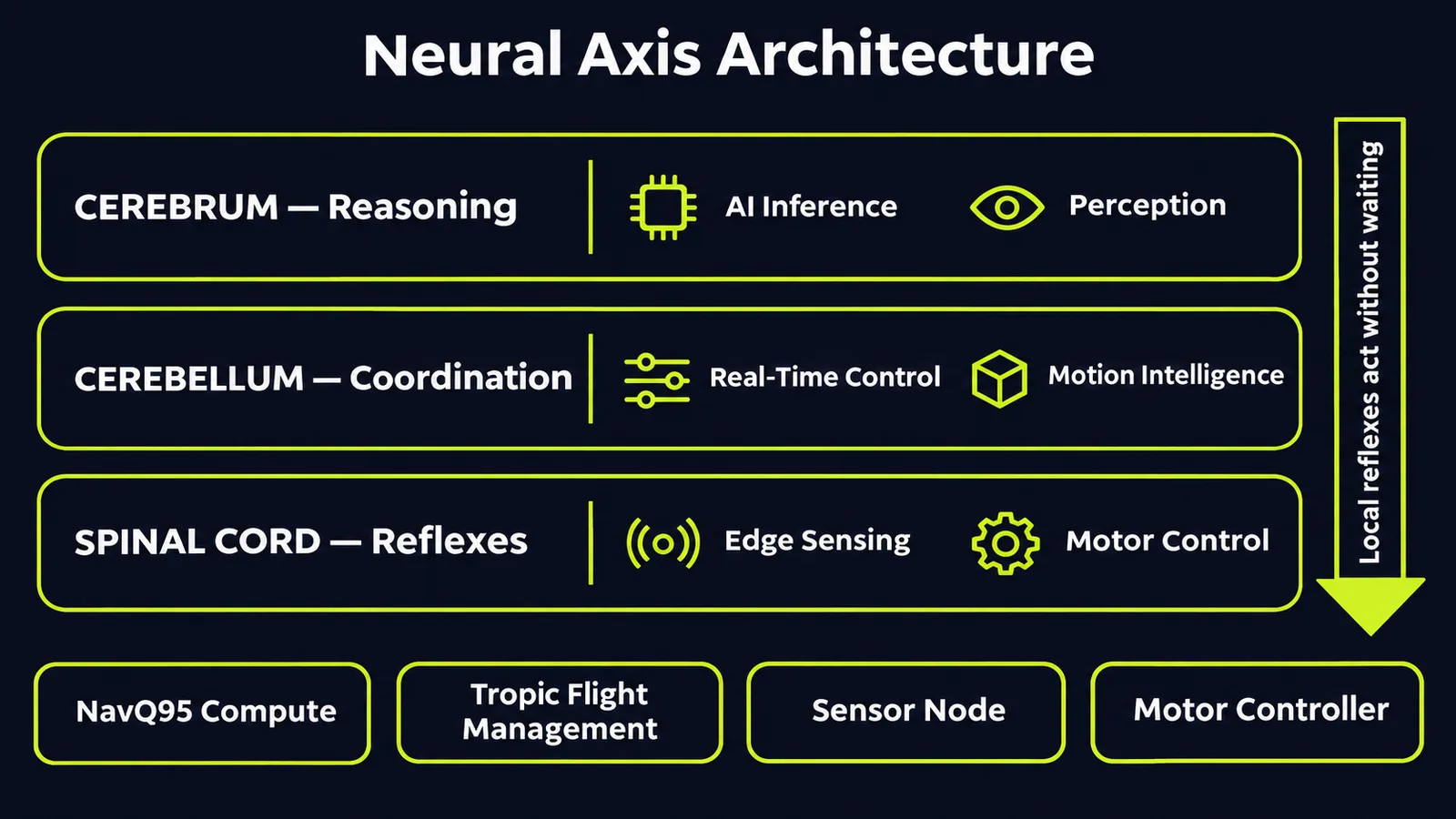
The first hardware is a drone stack across four designs that separate higher-level autonomy computing from time-critical flight management. The NavQ95 is the companion compute module (i.MX 95 applications processor) for AI perception and vehicle management. The Tropic VMU/FMU (i.MX RT1064 crossover microcontroller) manages deterministic real-time flight control. Sensor networking runs on a 100Base-T1 Sensor Node (MCX N947), and motor control on an AM32-compliant electronic speed controller (MCX A13), per NXP Unwaps Unified Robotics Platform for Trusted Physical AI Designs. Each design carries the safety and security enablement of its primary processor, enabled independently of the robotics functions. Note what that is and is not: processor-level capabilities, not evidence that a completed robot has passed a system-level functional-safety assessment.
A developer can start with one subsystem — motor control is NXP's example — already tested with the SDK, then add perception, flight control and navigation in the same environment. NXP says the supplied combinations are prevalidated; how far that extends when a developer changes a sensor or firmware version is where integration cost tends to return.
The Neural Axis: reasoning, coordination and reflexes as separate layers
The platform is organised around the Neural Axis Architecture, a distributed foundation connecting sensing, real-time control, AI processing and communications. Coverage of the launch breaks it into three layers, per the All About Circuits article linked above: a Cerebrum reasoning layer for high-level processing and AI inference, a Cerebellum coordination layer for real-time coordination, safety-protected control and motion intelligence, and a Spinal Cord reflexive layer for edge sensing, deterministic networking and direct motor control.
One design principle deserves attention: local processors may act immediately on sensory data instead of waiting on the central compute, described as the spine bypassing the brain. That matters for time-critical control. Higher-level planning may tolerate variable execution time; flight stabilisation and actuator control require bounded response times. Local control reduces dependence on central compute for those actions — a useful foundation for predictable behaviour, not proof of it. Safety still depends on validated timing, fault handling and hazard analysis.
Security and lifecycle responsibility are the other half of the pitch. NXP's robotics lead Jerome Legros frames security, functional safety, real-time control and lifecycle reliability as non-negotiable as robots move into spaces where people live and work, per the GlobeNewswire release linked above. The purchasing question extends beyond whether a demonstration works: who owns certification, patching, vulnerability management and update testing over the machine's working life? Safety-capable processors are not a substitute for those responsibilities.
The fine print worth pricing in
Four limits are visible in the launch material itself. First, status: NXP says the SDK and drone reference designs are available now, but documentation reviewed by Unite.AI identifies the Modular Drone Platform and its boards as preproduction, with specifications subject to change. Second, scope: the 30-minute figure concerns initial drone functionality, not a finished system, and the days-or-weeks estimate concerns subsystem integration, not the full deployment cycle. Third, the roadmap: additional enablement for other autonomous systems is expected in the second half of 2027, with service robots and autonomous mobile robots named as targets — no per-category delivery date is established. Fourth, the missing numbers: no platform pricing, production bill of materials, support terms or independently measured performance is disclosed. Those are open evaluation questions, not established benefits.
What this means for your business
1. Budget integration as a line item, and measure platforms against it. Hardware and model costs are visible early; integration and compatibility work are harder to estimate, and recur after every component update. Ask which combinations are validated together, what test coverage is documented, what the compatibility policy is when versions change, and what total cost looks like across components, labour, testing, support and maintenance. A faster prototype can still carry unfavourable production economics.
2. Separate reflexes from reasoning in your own architecture, whatever you buy. The three-layer split is a sound pattern beyond this one vendor: deterministic, local control for anything time-critical; higher-level AI where execution time can vary. If time-critical control depends on a central processor or communication path, verify its worst-case latency, fault behaviour and recovery mechanisms. Faster inference alone does not establish deterministic operation.
3. Treat preproduction status as a scheduling fact, not a footnote. Reference hardware that can still change is right for prototyping and design-in work. Preproduction components introduce specification and availability risks that belong explicitly in production schedules and customer commitments — and a fallback component path should stay open until final hardware lands.
4. Use the 30-minute claim as a test, not a headline. NXP's claim creates a measurable evaluation target. Run it, timed, from a documented starting configuration: time to first functioning output, time to add one of your own sensors or behaviours, and where the documentation stops answering questions. Follow those measurements with integration testing, reliability assessment and lifecycle-cost analysis before concluding anything about total savings.
5. Plan the category you are in, not the roadmap you like. Today this is a drone platform. If you are developing a service robot or an autonomous mobile robot, NXP currently provides drone-focused reference designs, with additional enablement targeted for the second half of 2027. Prototype against the architecture if it fits, but do not treat future capabilities as available today.
The clearest signal here is that a major silicon vendor is making prevalidated interoperability itself the reason to choose its robotics ecosystem, rather than asking developers to evaluate components in isolation. Whether that delivers value depends on how much integration work it actually removes, how the validated components perform after customisation, and what costs remain with the developer. Those are measurable questions — and the right ones to put to any platform vendor, starting with this one.
Ready to find where automation would cut cost or cycle time in your operation? Get a free AI audit — we'll map your highest-leverage automation opportunities in one session.
Sources
- https://www.nxp.com/company/about-nxp/newsroom/NW-NXP-UNVEILS-ROBOTICS-PHYSICAL-AInxp.com
- https://www.globenewswire.com/news-release/2026/11/09/3398092/0/en/nxp-unveils-unified-robotics-platform-to-speed-trusted-physical-ai-deployment.htmlglobenewswire.com
- https://www.unite.ai/nxp-launches-modular-robotics-platform-for-physical-ai-development/unite.ai
- https://www.allaboutcircuits.com/news/nxp-unwaps-unified-robotics-platform-for-trusted-physical-ai-designs/allaboutcircuits.com
Want to know what this means for your stack? A free AI audit maps your workflows and shows where automation pays off — in your numbers, not ours.