
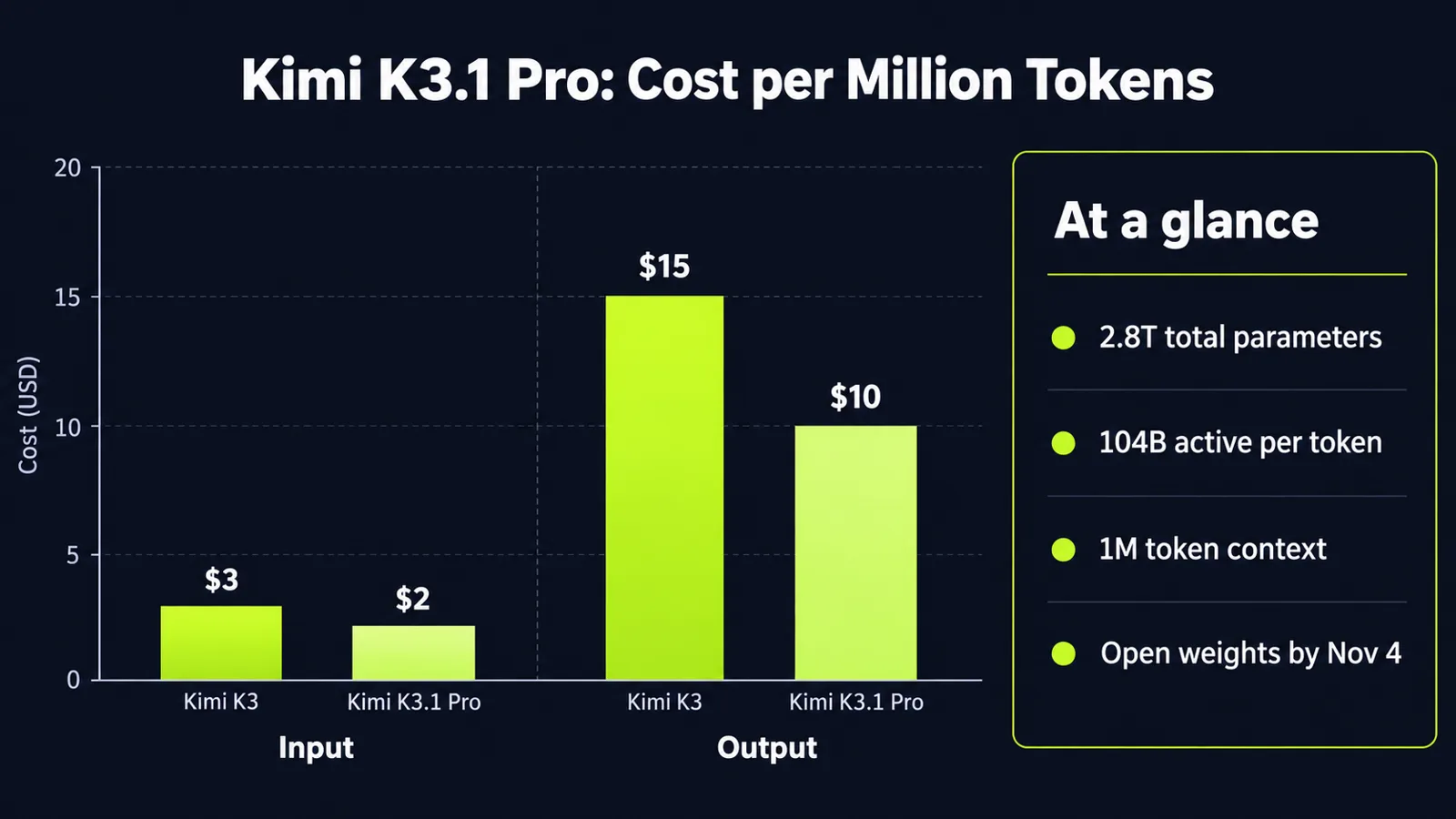
Moonshot AI put Kimi K3.1 Pro on its API on October 24, 2026, at $2 per million input tokens and $10 per million output tokens, with full model weights promised by November 4, 2026. Independent scoring places it close to the strongest closed models. Strip away the launch framing and one business question remains: what does a frontier-class option at this price do to the cost of the agent workloads you already run — and what would it cost to run the model yourself?
Key takeaways
- The price is the headline. At $2/$10 per million tokens, K3.1 Pro matches one frontier rival and costs half as much as another, per Moonshot AI Releases Kimi K3.1 Pro on API, Pledges Open Weights by November.
- The scores are close to the frontier, not above it. An independent index scores the model at 55 — ahead of three named rivals at 53, behind the leader at 58 — per the same report.
- Open weights are an option, not a saving by themselves. A model of this size needs serious serving infrastructure. The API price and the self-hosting bill are different conversations.
What shipped on October 24
K3.1 Pro is a heavily post-trained upgrade of the earlier K3. It carries 2.8 trillion total parameters with 104 billion active per token, and a context window of 1 million tokens, per Moonshot AI Launches Kimi K3.1 Pro With 3T Parameters. The pricing is $2 per million input tokens, $10 per million output tokens, and $0.20 per million cache-hit input tokens — a third lower than K3 on all three rates, per the same report.
Alongside the standard tier sits a Highspeed variant that runs two to three times faster at twice the price, with cache hits priced the same, per Moonshot AI Releases Kimi K3.1 Pro on API, Pledges Open Weights by November. Batch and background agent runs rarely need the fast tier; interactive tools might. Paying double for speed everywhere is a choice, not a default.
The weights matter for a different reason. A full release by November 4 would make this the most capable model available as open weights, per the same report. Until the files are actually published, that is a dated promise to verify, not a capability to plan around.
The scores, with their limits
The independent number is the one to weight most. Artificial Analysis scored K3.1 Pro at 55 on its Intelligence Index — ahead of three frontier rivals scored at 53 each, and behind only the top closed model at 58, per Moonshot AI Releases Kimi K3.1 Pro on API, Pledges Open Weights by November. Moonshot's own benchmarks show the model roughly level with its two main closed rivals, ahead on some tests and near on others, per the same report.
On agentic coding work specifically, the model scored 65.7% on Terminal-Bench 4.0, ahead of one rival at 58.2% and close to another at 66.4%, per Moonshot AI Launches Kimi K3.1 Pro With 3T Parameters. Treat vendor-adjacent benchmark tables as a shortlist signal, not a purchasing decision. The gap between 55 and 58 on a composite index will not decide your workload. Your own tasks will.
One deliberate trade-off deserves attention. Moonshot removed cybersecurity-related data from post-training, and the model trails its rivals on cybersecurity benchmarks as a result, per Moonshot AI Launches Kimi K3.1 Pro With 3T Parameters. For most business automation that is an acceptable, even welcome, trade. For security tooling it is a hard filter: this is not the model for that work.
A final caution on the launch itself. Screenshots described as a promotional brief instructing creators not to label paid partnerships circulated after release; the document has not been independently authenticated, and no confirmed response from Moonshot had surfaced as of October 25, per Moonshot Kimi K3.1 Pro Tops Benchmarks Amid Influencer Allegations. The allegation does not change the independent scores. It is a reminder to weight independent evaluation over launch-week enthusiasm.
Open weights are not free compute
The phrase "open weights" invites a simple misreading: that a free download replaces an API bill. The serving arithmetic says otherwise. A worked example for the earlier K3, at roughly 3 trillion parameters, distributes the model across 59 wafer-scale chips — 35 for its linear-attention layers and 24 for its dense layers — using 4-bit weight quantization to reach 1,000 to 2,000 or more tokens per second, per How Cerebras deploys trillion-parameter AI models on wafer-scale chips.
Your infrastructure will differ from that example. The scale will not. A 2.8-trillion-parameter model is a fleet decision, not a workstation decision. For most teams the weights release matters as leverage and as an exit option — proof that a second source exists if API terms change — rather than as a deployment plan for this quarter.
That leaves the API as the practical story, and there the arithmetic is straightforward. Agent workloads burn output tokens: reasoning traces, tool calls, retries, drafts. A model at half the output price, scoring within a few points of the leader, changes the unit economics of every long-running workflow — provided it completes your tasks at the same rate. Completion rate, not token price, is the multiplier that matters.
What this means for your business
1. Re-price your agent workloads on cost per completed task. Take your three highest-volume agent workflows. Run each on K3.1 Pro and on your current model with identical inputs, and compare cost per successful completion — tokens consumed, retries, and human corrections included. A cheaper model that needs two attempts is not cheaper.
2. Set reasoning effort deliberately. The model offers multiple reasoning levels, and higher effort burns more output tokens per task. Defaulting every workload to maximum effort quietly returns much of the price advantage. Match effort to task value: low for extraction and routing, high for work a person would otherwise bill hours against.
3. Use the two tiers on purpose. Put interactive, latency-sensitive work on the Highspeed tier and everything else on the standard tier. Review the split monthly. Tier drift — fast tier becoming the default for batch jobs — is a common and invisible cost leak.
4. Treat November 4 as a verification date, not a plan. If the weights ship on schedule and your team has a genuine data-control reason to self-host, scope the serving infrastructure honestly before committing. If the date slips, nothing in your API evaluation changes. Keep the two decisions separate.
Frontier capability is getting cheaper faster than most budgets assumed. The advantage goes to teams that re-measure their workloads each time the price floor moves, instead of renewing last quarter's choice by habit.
Want an independent review of which model should run each of your workloads, priced on completed tasks rather than tokens? Get a free AI audit — we'll map your highest-leverage automation opportunities in one session.
Sources
- https://zot.news/article/moonshot-ai-launches-kimi-k3-1-pro-matching-frontier-models-a2q8lzot.news
- https://theoutpost.ai/news-story/moonshot-ai-launches-kimi-k3-1-pro-with-3t-parameters-outperforms-gpt-6-astra-and-claude-fable-5-1-32608/theoutpost.ai
- https://aiweekly.co/alerts/moonshot-kimi-k31-pro-tops-benchmarks-amid-influencer-allegationsaiweekly.co
- https://news.lavx.hu/article/how-cerebras-deploys-trillion-parameter-ai-models-on-wafer-scale-chipsnews.lavx.hu
- https://www.kucoin.com/news/flash/moonshot-launches-open-source-flagship-model-kimi-k3-1-pro-with-2-8t-parameterskucoin.com
Want to know what this means for your stack? A free AI audit maps your workflows and shows where automation pays off — in your numbers, not ours.