

Many production workflows still use a generative model for decisions that need only a label, a score or a yes-or-no answer. The model writes a paragraph, and your code then has to parse and validate that paragraph before it can act on it. On November 6, Kakao released a model built to skip the paragraph entirely. Kanana-2-v-decide does not generate text. It reads text and images and returns a decision — a probability, a choice or a score — in a format software can consume directly, per kakaocorp/kanana-2-v-decide-3b-2611 · Hugging Face. For teams automating high-volume judgment calls, that is a design worth studying.
What shipped on November 6
Kanana-2-v-decide was published on Hugging Face on November 6 under the Kanana Open License, which Kakao describes as permitting research and commercial use, per Kakao Unveils AI Model for Text and Image-Based Decision-Making. It is built on Kanana-2-v-3b, Kakao's own multimodal model, and totals 3.67 billion parameters — a 3.18 billion-parameter language model paired with a 0.49 billion-parameter vision encoder. The input, which Kakao calls the state, can be plain text, a JSON object or a chat history, accompanied by up to 10 images and up to 20,480 tokens, per the Hugging Face model card linked above.
Against that state, you ask typed questions, and the model answers each with a probability distribution — not a sentence. There are three question types. A choice question selects one option from a set you define and returns the probability of each. A yes-or-no question returns the probability that a condition is true. A score question rates the input on an ordered scale of two to ten levels that you describe. Any number of questions can be sent in a single request; choice and score answers also carry a confidence value, defined on the model card as the top probability minus the mean of the remaining probabilities.
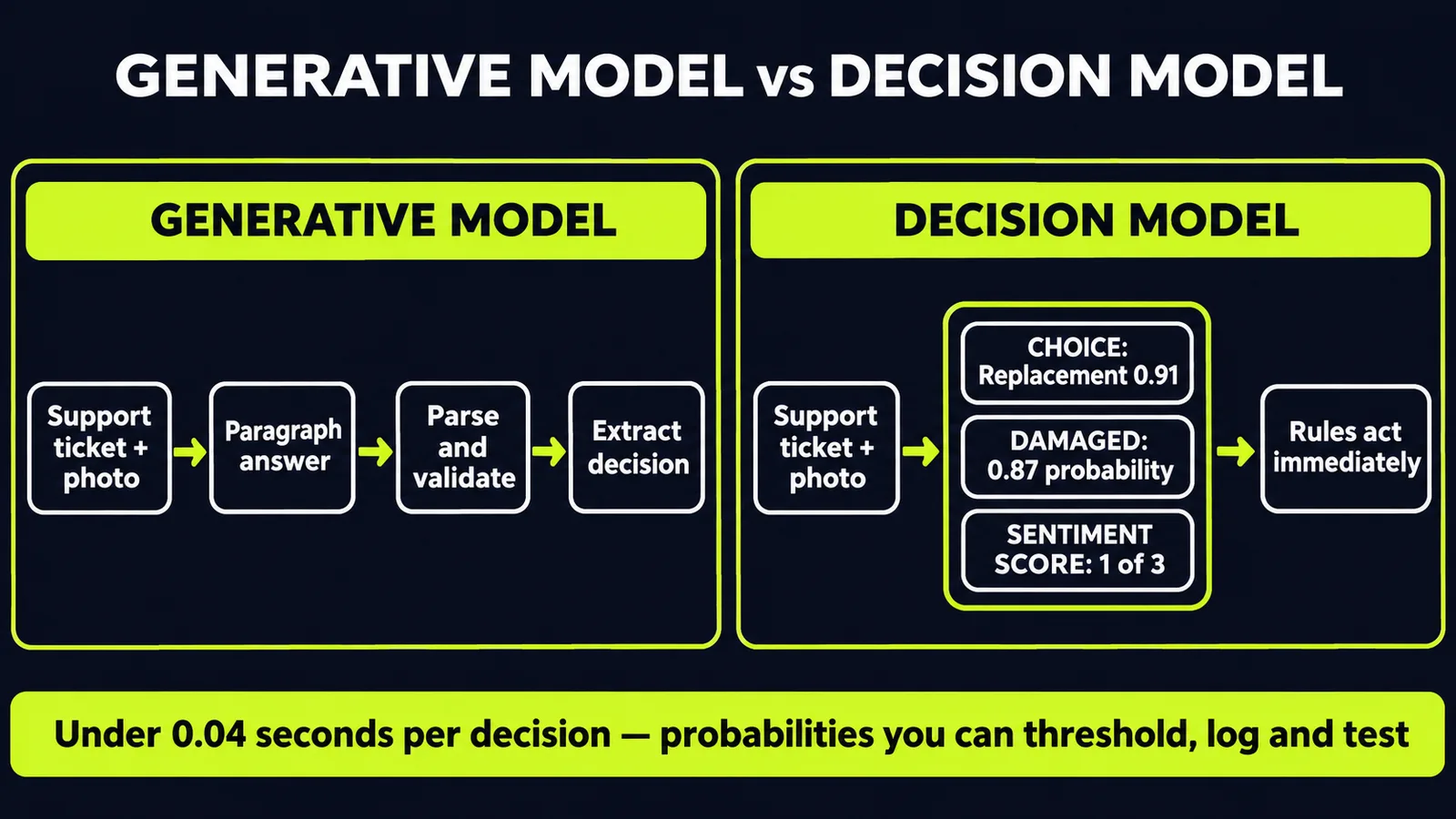
The worked example in Kakao's own documentation is a support workflow, and it is the right one to study. A customer writes in about a damaged item and attaches a photo. In one call, the model classifies the inquiry type, returns the probability that the item is actually damaged based on the image and the message together, and scores the customer's sentiment. Your existing rules, validation and exception handling then do the rest: route the case, trigger the replacement flow, or escalate to a person. The model judges; your system decides what the judgment is allowed to cause.
How the decision architecture works
Kanana-2-v-decide does not generate tokens one by one. Each question is encoded together with the state into a single embedding, each candidate answer is encoded into another, and a softmax over the similarity between those embeddings produces the answer distribution, per the Hugging Face model card. That has two practical consequences. First, speed: Kakao reports an average response time under 0.04 seconds on a single NVIDIA H200 GPU — by Kakao's own internal measurement, roughly 43 times faster than GPT-6 Luna on the same decision task, per Kakao Releases AI Decision Model for Faster Agent Judgments. Second, reuse: embeddings for candidate answers are cached across calls, so a workflow that asks the same classification questions thousands of times a day does not pay full price for every repetition, per Kakao Unveils Multimodal Model 'Kanana-2-v-Decide' to Assist AI Decision-Making.
On benchmarks, treat the numbers as vendor-reported and directional. The model card reports the highest average, 61.23, across the public Decision Index and Decision Index Vision benchmarks among the models compared, and 72.50 on Kakao's own in-house, text-only decision benchmark of 15,909 questions — a set the company built, on which it finished well ahead of the next model compared. Those results say the category is real and this entry is competitive within it. They do not say how it will perform on your tickets, your product photos or your routing rules. No vendor benchmark can.
Deployment needs the same honesty. Kakao provides integration with standard model tooling and a reference HTTP server exposing its decision API; the model card notes the server processes requests one at a time, so treat it as a starting point for evaluation, not a production pattern to scale unchanged. Kakao says it will deploy the model first in its own services — web search and automated product category classification — per Kakao Releases Kanana-2-v-decide, a Sub-0.04-Second Multimodal Model for AI Agent Decisions. That sequence is worth copying: internal, measurable workloads first.
The category underneath the release
The deeper point is architectural. Agent systems spend a large share of their model calls not on writing but on judging: which tool to call next, whether a condition holds, how urgent a case is, whether to proceed or stop. Routing every one of those calls through a full generative model adds latency and cost, and produces prose that must be interpreted before it can be logged, thresholded or tested. A decision model returns numbers with a defined meaning: you can threshold a probability, log a distribution for later review, and replay historical cases to measure how a routing change would have shifted outcomes.
None of this makes the alternatives disappear. Rules engines, conventional classifiers and smaller fine-tuned models already handle plenty of these jobs. The honest question is comparative: for a given judgment call, which option is most accurate on your data, cheapest at your volume, and easiest to audit? Kanana-2-v-decide earns a place in that comparison because it is multimodal, fast by design, and downloadable. Nor does it make generative models redundant — customers still need explanations and replies written. The pattern to consider is a split: a fast decision layer that routes, classifies and scores, and a generative layer that handles language only where language is the product.
What this means for your business
1. Audit your agent workflows for hidden judgment calls. List every place a generative model currently answers a question your code then has to interpret — triage, routing, approval checks, tool selection, quality scoring. Those are decision-layer workloads. They are usually your highest-volume, lowest-variance calls, which makes them the cheapest to move and the easiest to measure.
2. Automate by confidence band — after calibration, not before. A probability output lets you act automatically above a high threshold, queue for human review in the middle band, and escalate below it. But the confidence value is a measure of spread between options, not proof an answer is correct. Set the bands by replaying resolved cases and measuring error rates per decision type, weighted by error cost: a misrouted ticket is cheap, a wrongly approved refund is not, and consequential actions keep a human gate regardless of score.
3. Validate on your own cases before believing any benchmark. The headline scores come from the vendor's comparisons, including a benchmark the vendor built. Take a few hundred real, already-resolved cases from your operation, run the model against the outcomes your team actually reached, and measure agreement — then run the same test against your current approach and any simpler classifier. That afternoon of testing tells you more than any leaderboard.
4. Keep the decision layer separate from the writing layer. Let the decision layer classify, score and route; let your generative model write the customer-facing reply once the decision is made. The split keeps each part testable, keeps the fast path fast, and means a failure in tone never corrupts a routing decision — and a routing change never requires re-prompting a writer.
5. Price the whole system, and read the license. Self-hosting can remove per-call API fees and give you direct control over where your data is processed. It also adds infrastructure, maintenance and integration costs: defining question types, setting thresholds, building the review queue, and scaling past a reference server. And before any commercial deployment, read the Kanana Open License terms against your specific use case rather than relying on a summary — including ours.
Kanana-2-v-decide will not be the last decision model, and it may not be the one you deploy. Its importance is the signal: a major platform company has shipped, as downloadable weights, a model whose entire job is to judge rather than write — because that is where a large share of production AI calls actually goes. If your automation budget is mostly buying paragraphs you then parse back into decisions, evaluate whether a dedicated decision layer improves that workflow.
Ready to find where a decision layer would cut cost and errors in your operation? Get a free AI audit — we'll map your highest-leverage automation opportunities in one session.
Sources
- https://huggingface.co/kakaocorp/kanana-2-v-decide-3b-2611huggingface.co
- https://www.thelec.net/news/articleView.html?idxno=15364thelec.net
- https://en.sedaily.com/technology/2026/11/06/kakao-releases-ai-decision-model-for-faster-agent-judgmentsen.sedaily.com
- https://www.ajupress.com/view/20261106150470821ajupress.com
- https://finance.biggo.com/news/8fe2d36b-951a-4a5d-8e9e-f854245c5b5cfinance.biggo.com
Want to know what this means for your stack? A free AI audit maps your workflows and shows where automation pays off — in your numbers, not ours.