
Mainframes still run many mission-critical transaction workloads — and in many estates, operations still depend on scarce specialists and manual, alert-led intervention: wait for the alert, find the expert, fix the fault. On November 2, HCLTech launched AI-Powered Operations, an offering built on specialised mainframe skill agents and conversational AI assistants, designed to support system administration, monitoring, optimisation and operational workflows under human oversight, per HCLTech launches AI agents to automate enterprise mainframe operations and HCLTech Launches AI-Powered Mainframe Operations. This is not a modernisation-by-migration pitch. It is automation applied to the estate as it stands. That also limits the claim: it addresses operations, not application modernisation or platform cost. And one caveat belongs up front — the launch coverage publishes no independent outcome figures, so what follows is a capability claim to test, not a proven result.
What was announced
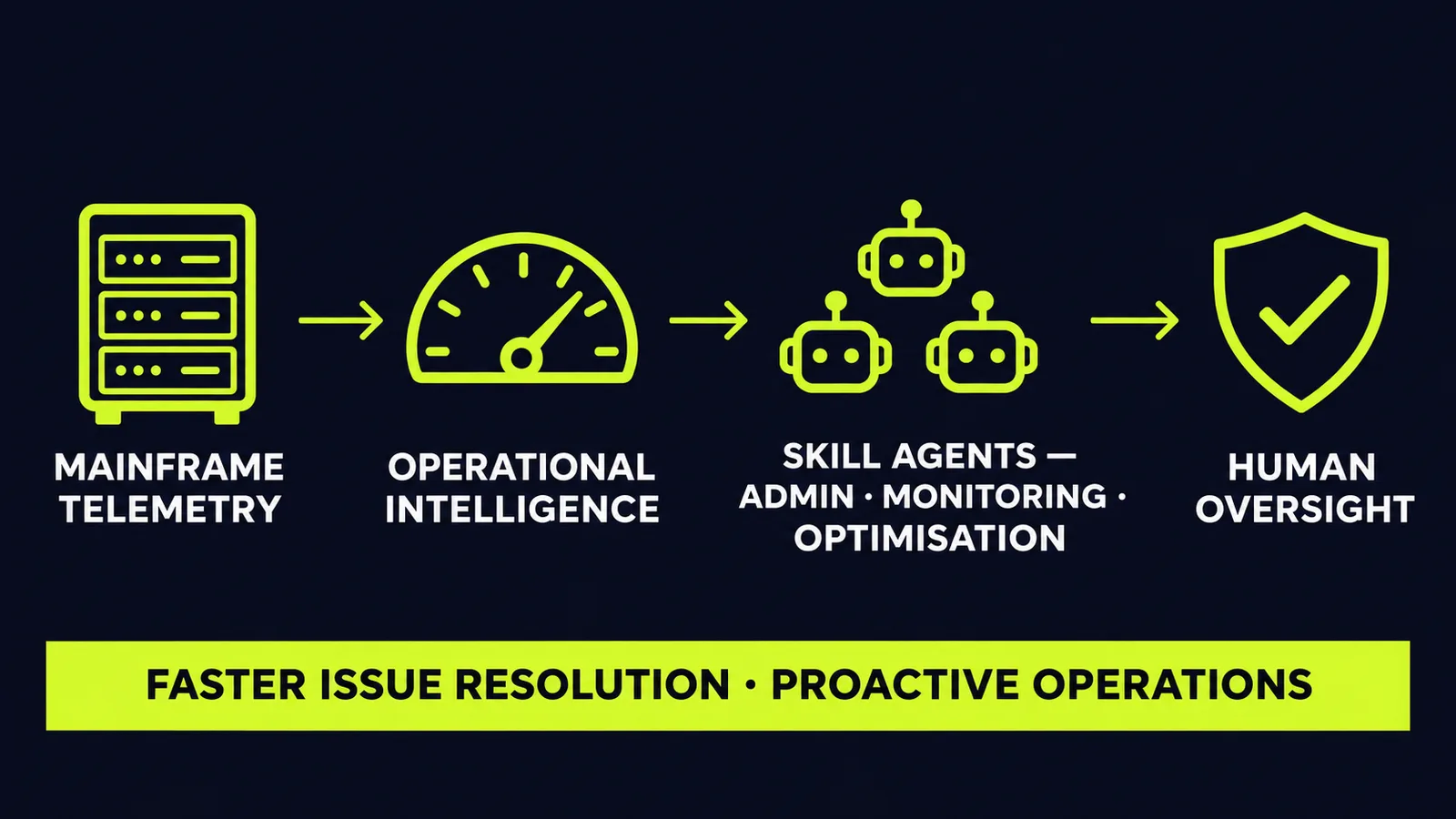
HCLTech describes three components. First, specialised skill agents scoped to mainframe work rather than a general-purpose assistant. Second, conversational AI assistants that give operators a chat interface to those capabilities. Third, operational intelligence — the company's term for the monitoring and analysis layer — embedded into the mainframe environment, per HCLTech launches AI-powered operations for mainframe environments. The company's own framing is explicit about the embedding: intelligent agents and operational intelligence placed directly into mainframe environments, per HCLTech launches AI agents to automate enterprise mainframe operations.
The stated aims are directional: improve operational efficiency, accelerate issue resolution, and move teams from reactive management to proactive, insight-driven operations, per HCLTech launches AI agents to automate enterprise mainframe operations – Daily PRABHAT. The offering is supported by HCLTech's dedicated Mainframe Center of Excellence, which provides the domain expertise, industry practices and continued innovation behind it, per HCLTech Launches AI-Powered Mainframe Operations. That support matters: an agent is only as good as the operational knowledge encoded in it, and mainframe knowledge is precisely the asset that is hardest to hire. What the launch coverage does not specify is the commercial packaging — pricing, deployment model and supported configurations are all unstated, and buyers should treat those as open questions, not details.
Why the mainframe, why now
Mainframes persist because, in practice, they handle high-volume, mission-critical workloads well — and because replacing them is risky and expensive. What has changed is the operating model around them. Enterprises running these systems face growing pressure to modernise operations and improve efficiency without compromising reliability or control, per HCLTech launches AI agents to automate enterprise mainframe operations. Market analysis of the launch makes the same point in cost terms: mainframes continue to host mission-critical transaction engines while operating costs remain high, and the specialist workforce that runs them is in short supply, per HCLTech Introduces AI-Driven Operations Service For Mainframes To Boost Operational Efficiency.
That combination — critical, costly, understaffed — is the ideal profile for automation. Not automation of the workload itself, which already runs well, but automation of the human work wrapped around it: watching consoles, triaging incidents, running routine administration, tuning performance. HCLTech's hybrid cloud lead framed the launch as a response to exactly that pressure: simplify operations and reduce risk while extracting more value from existing mainframe investments, per HCLTech launches AI agents to automate enterprise mainframe operations.
Skill agents, not a general chatbot
The design choice worth copying is specialisation. The launch describes skill agents — agents scoped to defined mainframe tasks — paired with conversational assistants for the operator interface, per HCLTech Introduces AI-Driven Operations Service For Mainframes To Boost Operational Efficiency. That split matters in production. A narrow agent with a defined task, defined tools and defined limits has a smaller failure surface and is easier to test. A general assistant asked to "help run the mainframe" offers neither property.
The conversational layer matters for a different reason: adoption. In practice, operators who have run consoles for years will not rebuild their habits around a new automation console. Asking a question in plain language and getting a system-aware answer is a lower-friction route into the same underlying automation — and it doubles as a knowledge-transfer mechanism, capturing specialist practice in a form newer team members can actually use.
The control layer is the claim to test
Launch coverage repeatedly stresses the same qualifiers: human oversight stays in place, and the offering is designed to preserve the security, resilience and governance these platforms demand, per HCLTech launches AI agents to automate enterprise mainframe operations – Daily PRABHAT. HCLTech's AI ecosystems lead made the same pairing explicit — proactive, insight-driven operations while preserving security, resilience and governance, per HCLTech launches AI agents to automate enterprise mainframe operations.
Read those qualifiers as claims to verify, not features to assume. On a mission-critical estate, the questions that decide whether an agent deployment is credible are concrete: which actions can an agent execute alone, which need approval, how is every action logged, how is an agent stopped mid-task, and who owns rollback when an agent makes a bad change. The credible risks are also plain: analysis of the launch flags slower adoption in risk-sensitive environments because of compliance checks, and integration friction across customised mainframe configurations, per HCLTech Introduces AI-Driven Operations Service For Mainframes To Boost Operational Efficiency. Neither risk is answered by a better model. Both are answered by scoping, logging and approval design.
What this means for your business
1. Automate the operations layer before you debate replacing the platform. If a legacy estate runs reliably but costs too much to operate, the first return is in administration, monitoring and incident handling — not in a migration programme. Inventory the manual operational work around your core systems and price that before pricing a replacement.
2. Buy skill agents, not general assistants, for critical work. Scope each agent to a named task with named tools and a named owner. Require the vendor — or your own team — to state what the agent cannot do. If the limits are vague, the deployment will be too.
3. Treat oversight as a feature to test, not a promise to accept. Ask which agent actions are execute-alone, which are approval-gated and which are recommendation-only. Ask how actions are logged, how an agent is stopped mid-task, and who owns rollback and the audit trail when an agent makes a bad change. Run those controls in the pilot, on your own configuration, because custom estates are exactly where integration friction shows up.
4. Use conversational access to capture scarce expertise. Every resolved incident handled through an assistant is operational knowledge made reusable. Prioritise the workflows where one or two specialists are a single point of failure — that is where the risk reduction is worth more than the time saving.
5. Measure resolution time and prevention, not agent activity. The claims here are efficiency and faster issue resolution, and — as noted at the top — no independent outcome figures have been published with the launch. Set your baseline first — mean time to resolution, repeat incidents, change-failure rate, operator hours per week — and judge any pilot against it. A sensible sequence: read-only agents first, measured on recommendation accuracy, then bounded remediation.
The mainframe did not need rescuing. It needs an operating model that matches its importance: specialised agents doing the routine work, continuous monitoring underneath, and humans holding authority over anything consequential. For buyers, the test is narrow: can task-scoped agents cut resolution time on your estate without weakening change control? Until deployment evidence is published, that remains the open question — and the right one to put to any vendor selling automation for a critical estate.
Ready to find the automation opportunities hiding in your core operations? Get a free AI audit — we'll map your highest-leverage automation opportunities in one session.
Sources
- https://www.thehindubusinessline.com/info-tech/hcltech-launches-ai-agents-to-automate-enterprise-mainframe-operations/article71656011.ecethehindubusinessline.com
- https://hdfcsky.com/news/hcltech-launches-ai-powered-offering-for-mainframe-environmentshdfcsky.com
- https://www.sahi.com/news/hcltech-introduces-ai-driven-operations-service-for-mainframes-to-boost-operational-efficiencysahi.com
- https://scanx.trade/stock-market-news/technology/hcltech-launches-ai-powered-operations-mainframe-environments/55147886scanx.trade
- https://www.dailyprabhat.com/hcltech-launches-ai-agents-to-automate-enterprise-mainframe-operations/dailyprabhat.com
Want to know what this means for your stack? A free AI audit maps your workflows and shows where automation pays off — in your numbers, not ours.