

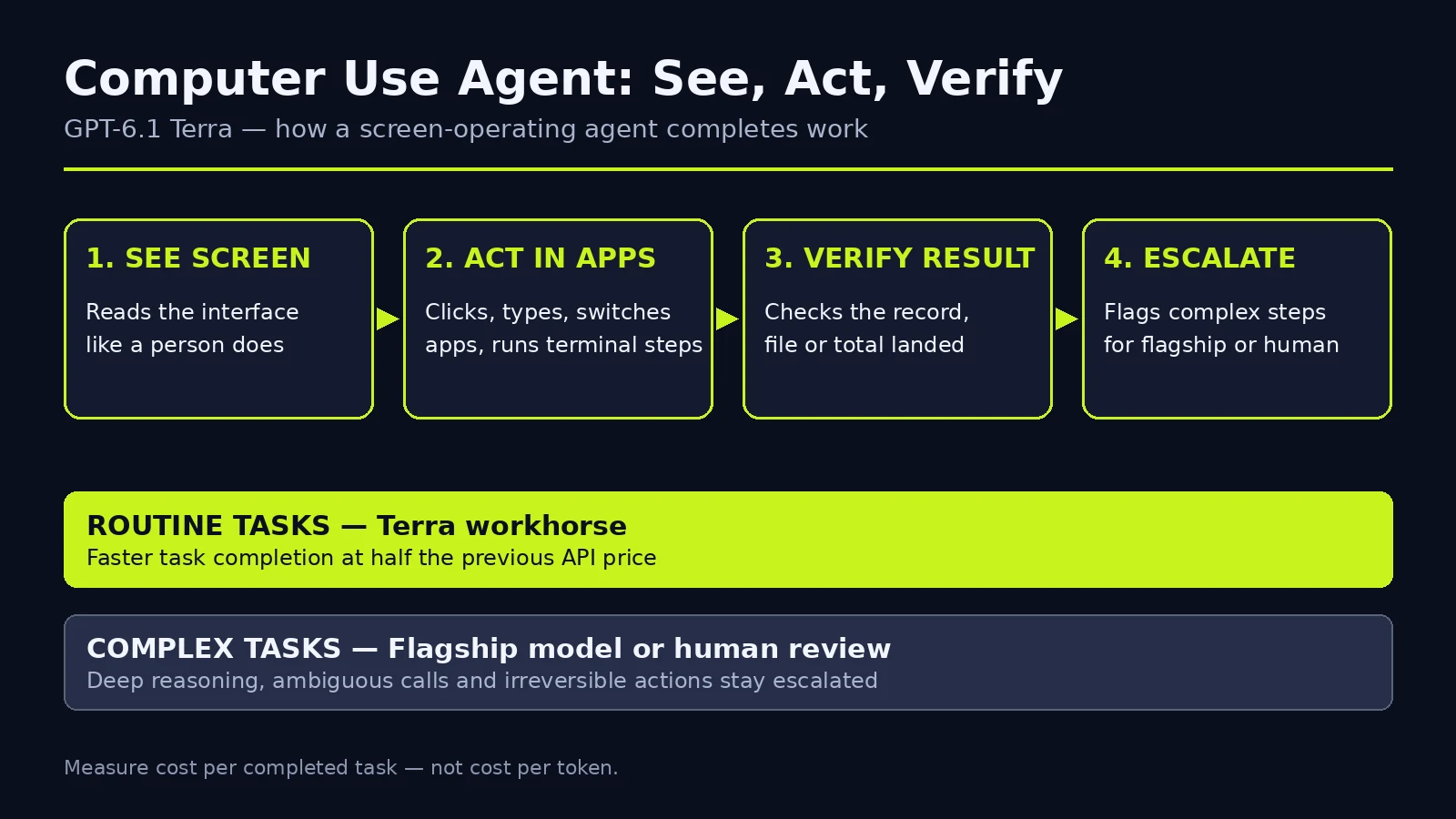
OpenAI launched GPT-6.1 Terra on October 26, 2026, and the headline is not reasoning. It is hands. Terra is built to see a screen, click buttons, type into fields and move between applications to finish multi-step work, per OpenAI GPT-6.1 Terra Launches with App Control and Faster AI Workflows. That makes the computer use AI agent — an agent that operates software the way a person does, instead of waiting for a clean API — cheaper and faster to run at volume. For teams already automating form filling, data movement and terminal work, that changes which workflows are worth automating at all.
What shipped on October 26
Terra is available to Plus, Pro, Enterprise and Edu users in ChatGPT Work and Codex, and to developers through the API as gpt-6.1-terra, per OpenAI says GPT-6.1 Terra meets Critical cybersecurity threshold, at half GPT-5.6 Terra's price. It has also reached general availability in GitHub Copilot for agentic coding and terminal work, per GPT-6.1 Terra Debuts with 3x Faster Speeds and Critical Cybersecurity Rating.
The capacity is built for long tasks. Terra carries a 1.05-million-token context window and a 128,000-token output limit, per the same report. In plain terms, it can hold a large codebase or a long task history in a single pass, instead of chopping the workflow into pieces that lose context at every handoff.
OpenAI chief executive Sam Altman framed the release around computer use, writing that the team is "especially excited for this new era of computer use," per OpenAI GPT-6.1 Terra Launches with App Control and Faster AI Workflows. The competition is no longer only about who answers best, but about who completes work inside the tools a business already uses.
Why speed and price matter more than another benchmark point
Standard API pricing is $1 per million input tokens, $0.05 per million cached input tokens and $5 per million output tokens — 50% below GPT-5.6 Terra, per OpenAI says GPT-6.1 Terra meets Critical cybersecurity threshold, at half GPT-5.6 Terra's price. OpenAI also says Terra finishes tasks more than three times faster on average than GPT-6 Astra and GPT-6.1 Sol, per GPT-6.1 Terra Debuts with 3x Faster Speeds and Critical Cybersecurity Rating.
Both figures are OpenAI's own, until your tasks confirm them. Even so, the direction matters. Computer-use agents burn tokens on screenshots, retries and long action sequences. A workflow that was too slow or too expensive per completed task becomes viable when cost and time per completed task fall together. That is the test: measure completed tasks, not tokens, on the same ten real workflows.
There is also a routing lesson. OpenAI says GPT-6.1 Sol and GPT-6 Astra remain the better choice for the most complex coding tasks, per OpenAI says GPT-6.1 Terra meets Critical cybersecurity threshold, at half GPT-5.6 Terra's price. Terra is the workhorse tier, not the flagship replacement. Mature automation setups already work this way: a fast, cheaper model handles volume, and a stronger model is called only for the steps that need deep reasoning or carry the highest cost of error.
The capability jump, in OpenAI's own numbers
On Terminal-Bench 4.0, Terra solves 50.3% of tasks at maximum reasoning effort, against 21.5% for GPT-5.6 Terra, per OpenAI says GPT-6.1 Terra meets Critical cybersecurity threshold, at half GPT-5.6 Terra's price. On Agents' Last Exam at medium reasoning effort, OpenAI says Terra scores 15 percentage points higher than GPT-5.6 Terra at about one-third the cost, and performs on par with GPT-6 Astra at one-tenth its price per token, per the same source.
Reliability moved as well. On OpenAI's internal benchmark of prompts designed to induce errors, the error rate at low effort fell from 53.6% with GPT-5.6 Terra to 16.7% with GPT-6.1 Terra, and at maximum effort to 4.3%, per OpenAI GPT-6.1 Terra Launches with App Control and Faster AI Workflows. None of this proves Terra will handle your systems well — benchmark tasks are tidy in ways production work is not. What the numbers justify is a serious pilot: pick workflows with a clear done state, run Terra side by side with your current model, and score completion, correction time and total cost together.
The safety rating you cannot skip
OpenAI says Terra meets the Critical threshold in cybersecurity under its Preparedness Framework, and maintains the protections developed for GPT-6 Astra, per OpenAI Launches GPT-6.1 Terra With Lower API Prices. That classification, in OpenAI's framing, reflects a model capable of finding and exploiting previously unknown software flaws. It is a capability statement from the vendor, not an independent certification.
For a business buyer, the reading is simple. A model better at operating computers and at security-sensitive work needs tighter boundaries, not looser ones. Before Terra touches production, review which applications it can open, which accounts it acts as, what data it can move, and how a person stops a run. A faster agent also completes more actions before a human notices a mistake.
What this means for your business
1. Start with interface-bound work that APIs never covered. The strongest fit is work trapped in screens: copying records between systems, completing structured forms, checking entries across applications, and routine terminal tasks. If a clean API already does the job reliably, use the API. Computer use earns its cost where no API exists or where the interface is the system of record.
2. Budget on cost per completed task. Token prices fell by half, per OpenAI Ships GPT-6.1 Terra at $1/$5 Per Million, Half of Sol, but retries, screenshots and verification steps decide the real bill. Instrument completion rate, human correction minutes and cost together for two weeks before scaling any workflow.
3. Route by difficulty, do not standardise on one model. Use Terra for high-volume, well-defined steps and escalate ambiguous or high-impact steps to a flagship model or a person. OpenAI's own guidance keeps Sol and Astra ahead for the most complex coding work — build that split into the workflow instead of discovering it after an error.
4. Add verification as a separate step. Have the agent prove the work landed: a record updated, a file produced, a total matched. A second check — by a different model, a deterministic rule or a person for sensitive actions — costs less than undoing a confident, fast mistake across multiple applications.
5. Tighten permissions before you widen the pilot. Give the agent the least access that completes the task, keep approvals on irreversible actions, log every action it takes, and make sure a person outside the agent's session can stop it. Do this before expanding from a sandbox to live customer or finance data.
Terra does not make automation strategy obsolete. It lowers the price of one specific capability — operating software through its interface — enough that workflows previously shelved as too slow or too expensive deserve a second look. The teams that benefit will be the ones that measure completed work, route models by task difficulty, and keep human control over the steps that cannot be undone.
Want to know which of your screen-bound workflows are worth automating first, and what they would cost to run? Get a free AI audit — we'll map your highest-leverage automation opportunities in one session.
Sources
- https://www.analyticsinsight.net/amp/story/news/openai-gpt-61-terra-launches-with-app-control-and-faster-ai-workflowsanalyticsinsight.net
- https://asumetech.com/2026/10/27/gpt-6-1-terra-debuts-with-3x-faster-speeds-and-critical-cybersecurity-rating/asumetech.com
- https://ainotis.com/n/openai-releases-gpt-6-1-terra-at-half-the-api-price-of-gpt-5-6-terraainotis.com
- https://www.okaynews.com/openai-gpt-6-1-terra-launch-pricing-october-27-2026/okaynews.com
- https://aiweekly.co/alerts/openai-ships-gpt-61-terra-at-15-per-million-half-of-solaiweekly.co
Want to know what this means for your stack? A free AI audit maps your workflows and shows where automation pays off — in your numbers, not ours.