

The AI agent comparison that matters in late 2026 is not which chatbot writes best. It is which agent you can hand real work to — and what happens after you do.
In the span of about ten weeks, five major labs shipped agents that act instead of answer: Meta's Muse, Microsoft's Copilot Cowork, Anthropic's Claude Cowork, OpenAI's ChatGPT Work, and xAI's Grok Bot. Each one promises the same thing: describe the outcome, and the work gets done while you do something else. The differences that matter for a business are quieter — where the agent runs, what it can touch, what it costs, and how much of it you actually control.
This is a feature-by-feature comparison with the evidence behind each claim, and an honest account of where the evidence runs out.

AI agent comparison: the quick verdict
| Agent | Best for | Price model | Control & approvals | Evidence so far |
|---|---|---|---|---|
| Meta Muse | Consumers; shopping and personal tasks | Freemium; reported $20–$100 tiers | Secure VM + Sentinel monitor; approval gates | 2.8M downloads in 12 days; no outcome data |
| Microsoft Copilot Cowork | Microsoft 365 shops | Seat + usage-based credits | Runs in the M365 trust boundary; approval gates | Fortune 500 preview; no ROI data |
| Claude Cowork | File-heavy knowledge work | Subscription | Folder-scoped; approval gates | No independent data |
| ChatGPT Work | Finished deliverables (docs, decks, dashboards) | Business / Enterprise plans | Admin-controlled apps and data sources | Vendor-reported usage only |
| Grok Bot | Recurring operational work | Bundled with Cursor / SuperGrok | Approval on decisions; audit controls | One vendor-supplied case study |
Details, sources, and the control question below.
Meta Muse: the consumer agent that shops for you
Muse launched on September 8, 2026 as Meta's personal AI agent — not a chatbot, but software that performs multi-step tasks on your behalf: sending emails, booking travel, filling out forms, managing calendars, and making purchases. It keeps working in the background after the app closes and asks for approval before sensitive actions like sending messages or spending money. (Meta Stock Surges 11% as Muse AI Assistant Gains Popularity)
The architecture is the interesting part. Each user gets a dedicated virtual machine — the "Muse Secure VM" — that isolates data and task progress, while a separate "Sentinel" agent monitors Muse's internet access. Credentials like passwords and payment methods are stored so that Muse itself never sees them. (Meta's new Muse AI agent app overtakes ChatGPT as top iPhone app)
For commerce, Muse browses merchant sites, compares options, and checks out through Stripe Link, Shopify Shop Pay, and PayPal, generating a single-use virtual card per transaction so the underlying card details never reach the agent. Reported integrations include Expedia for travel and Instacart for groceries. (What Tools Help Brands Optimize for Meta Muse?)
On desktop, a dedicated Mac app drives native applications — messages, mail, files, calendar, notes — under strict opt-in permissions, with explicit approval required before sensitive actions. At Meta Connect on September 23, Meta added real-time video chats with customizable avatars, dedicated Muse email addresses, and the ability to operate Mac apps with user permission. A palm-sized wearable, Muse Charm, with a roughly 2-inch OLED display and cameras for visual context, is expected to ship in December. (Meta Muse AI Mac App Release and Key Features) (Meta gives its Muse AI agent video avatars, email addresses, and Mac control) (Meta announces camera-free glasses, dedicated Muse AI gadget, more)
Muse is free within usage limits, with reported paid tiers of $20 and $100 per month. On evidence: market intelligence firm Apptopia measured roughly 2.8 million downloads in the first 12 days, and the app reached the top of the App Store's free charts. That is adoption, not effectiveness — twenty days after launch, there is no independent data on how reliably Muse completes the multi-step tasks it advertises. (Meta Stock Surges 11% as Muse AI Assistant Gains Popularity)
Watch Meta's official announcement: Introducing Muse, a personal AI agent.
Cowork, twice: Microsoft's and Anthropic's
One naming collision to clear up first: two different companies ship an agentic product called Cowork. They are not the same product, and they are aimed at different buyers.
Microsoft Copilot Cowork: the agent inside Microsoft 365
Copilot Cowork went generally available on June 16, 2026 after a three-month Frontier preview in which more than half of the Fortune 500 tried it. It is the agentic layer of Microsoft 365 Copilot: instead of answering single prompts, it carries out multi-step tasks — sending emails, scheduling meetings, posting to Teams, managing calendars — pausing for approval before anything sensitive goes out. It runs inside the Microsoft 365 trust boundary, acting as the user with the user's permissions. (Microsoft Copilot Cowork Complete Guide)
Notable mechanics: you can pick the model per task, pricing is a Copilot seat plus usage-based Copilot Credits with a cost-management dashboard, and nine partner plugins (including names like Harvey, Moody's, and monday.com) were available at launch, with Microsoft Fabric and Dynamics 365 integrations on the way. In Microsoft's own testing, Cowork ran 30–40% cheaper than Claude Cowork working through its Microsoft 365 connector on the same model — a vendor benchmark, so read it accordingly. (Microsoft Copilot Cowork Complete Guide)
On September 25, Microsoft rebuilt the Copilot app around three tabs — Home (which combines Chat and Cowork), Code, and Autopilot. Autopilot is the persistent agent: give it a name, role, and goal, and it keeps a project moving for days, with its own identity, memory, computer, and workspace inside the organization's Microsoft 365 environment. It enters private preview at the end of September. (New Microsoft Copilot: Home, Code & Autopilot Explained) (Microsoft Copilot is becoming an AI coworker that works while you sleep)
On evidence: the Fortune 500 preview breadth is real adoption signal, but Microsoft has published no independent ROI studies — effectiveness data is still "none yet."
Claude Cowork: Anthropic's folder-first task worker
Anthropic's Cowork has been a desktop app since January 2026, and since July it runs on web and mobile too — with the key architectural change that tasks execute remotely in the cloud by default, so work continues with the laptop closed and syncs across devices. You point Cowork at a folder and it reads, writes, and creates files there; the web UI offers a Chat/Cowork toggle with Progress, Outputs, and Context panels. Scheduled and recurring tasks have been available since February 2026, and Cowork coordinates subagents for parallel workstreams. (Claude Cowork)
The plugin catalog is the largest of the five: seventeen Anthropic-built plugins as of September 2026 (sales, marketing, legal, finance, product management, customer support, data, HR, design, engineering, operations), each bundling skills and connectors, plus a built-in browser and computer-use capability on desktop. Connectors, skills, and Projects set up in chat carry over, and since late August, memory works across chat and Cowork in the cloud. (Claude Cowork)
On evidence: there is no independent effectiveness data yet. Its sweet spot is knowledge workers who live in files and documents — research digests, release notes, spreadsheet cleanup, weekly reports.
ChatGPT Work: OpenAI's agent for ambitious projects
ChatGPT Work, announced July 9, 2026, is OpenAI's agent for longer, multi-step tasks: it gathers information across connected apps and files, produces finished materials — sheets, slides, docs, web apps — and stays with complex projects for hours by breaking them into steps and completing them independently. It is built on Codex technology: more than 5 million people use Codex weekly, and over 1 million now use it for work outside software development, according to OpenAI. (ChatGPT is now a partner for your most ambitious work (OpenAI announcement snapshot))
The model underneath is GPT-5.6, which OpenAI describes as state of the art at multi-step reasoning and following company templates and reference files; GPT-6 Astra has since rolled out across Work, Codex, and the API with computer-use capability. (GPT-6 Astra: OpenAI's next generation model for work) A Data agent connects to approved enterprise sources — Snowflake, Databricks, BigQuery, Redshift — answering questions and building interactive dashboards while retaining existing table, row, and column permissions, with administrators controlling the connections. Voice control arrived in Work on September 23, 2026, on web and mobile. (ChatGPT Work in 2026: How It Works and When to Use It)
For organizations, the relevant plans are ChatGPT Business and Enterprise, with apps connecting SharePoint, Outlook, Teams, Google Drive, and Slack, plus a plugins directory and Company Knowledge for organization-specific answers. On evidence: OpenAI's usage figures are vendor-reported, and one concrete internal data point — 67% of OpenAI's go-to-market team using the Data agent — suggests real internal reliance, but independent outcome studies do not exist yet. (ChatGPT Work in 2026: How It Works and When to Use It)
Watch OpenAI's official announcement, which embeds their launch video: ChatGPT is now a partner for your most ambitious work.
Grok Bot: xAI's agent with its own computer
Grok Bot launched in early beta on August 11, 2026 as xAI's agentic platform — and it takes the "AI coworker" idea literally: each bot gets its own persistent cloud computer with browser, terminal, and file access. A bot signs into work tools the way a person would — updating a sales record, processing an invoice, filing a software bug — keeps working after you close the app, and multiple bots can pass tasks to each other. Show a bot a process once and it can save it for next time, which makes it better suited to recurring work than assistants that start fresh each session. (Grok Bot sees user base extend)
Bots ask for approval when a decision is needed, and they are designed to be given names, roles, and specializations rather than vague generalist briefs. Pricing is not a separate subscription: access is bundled into Cursor's plans and SuperGrok tiers, with included usage resetting weekly and optional overage charges. On September 3, xAI added an enterprise governance layer — access, network, and audit controls — aimed at the shadow-IT pattern of employees adopting bots before their IT departments knew. (Grok Bot sees user base extend) (Grok Bot Already Got Into Your Company. Now xAI Is Trying to Get Paid for It.)
On evidence: exactly one named case study exists in public — a company-reported procurement bot that reviewed spending across roughly 125 vendors and claimed over $100,000 in direct savings, including 43 inactive software seats worth $14,220 and $85,662 a year in unused subscriptions. Treat it as a vendor-supplied anecdote, not verified research. Musk has said Grok Bot usage is "growing faster than anything we've ever seen" — a claim about adoption, posted on X, not a measured outcome. (Grok Bot sees user base extend)
See xAI's official page: Grok Bot.
AI agent comparison: head to head
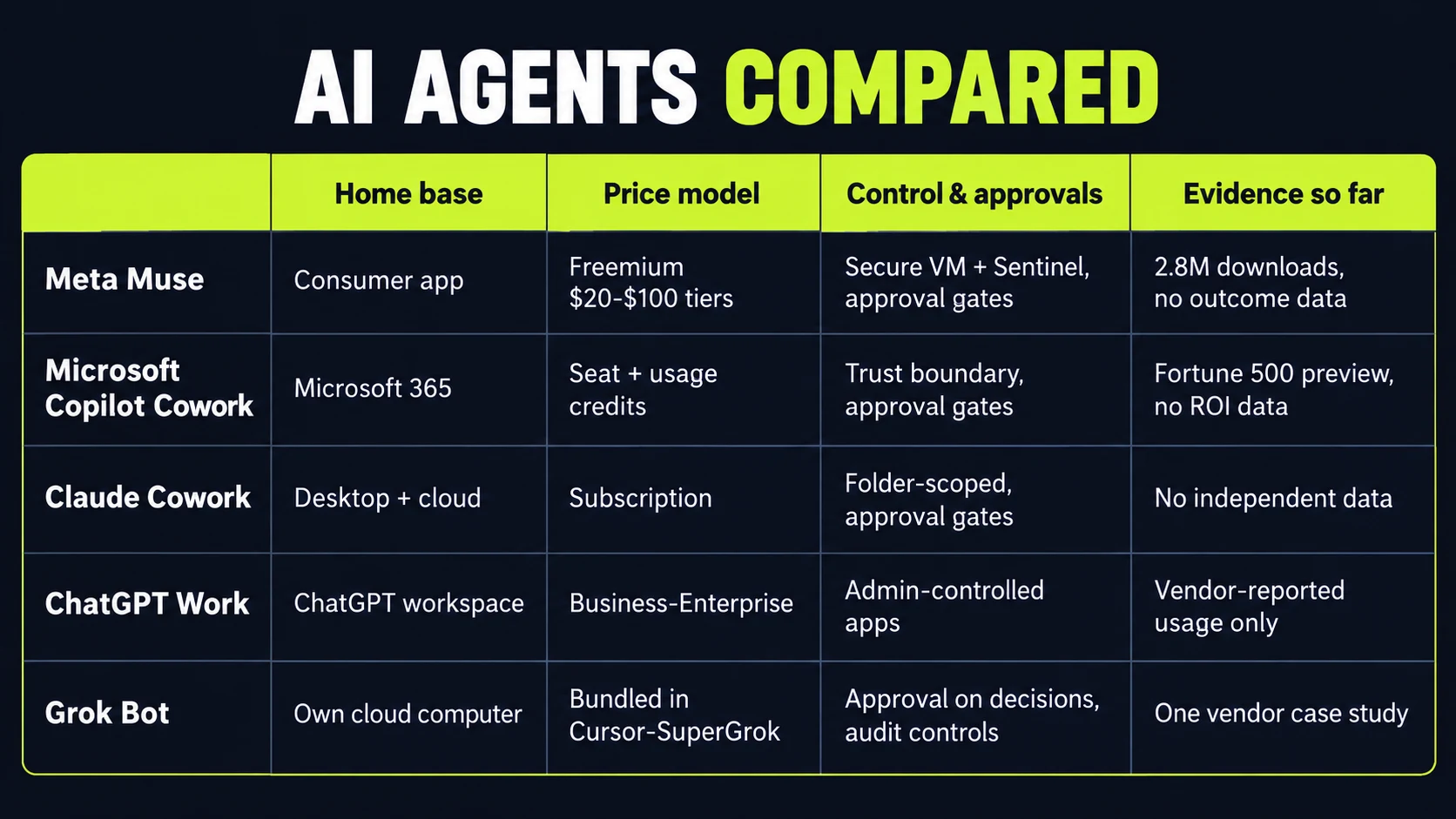
The pattern across all five: every one of them asks before spending money or sending messages. The real differentiators are home base (consumer app vs. your Microsoft 365 vs. ChatGPT workspace vs. its own cloud computer), pricing mechanics (free tier, seat-plus-meter, or bundled), and how much of the stack you control. Here is the part the launch videos skip.
What none of them give you: control
Every agent above is rented. You get the capabilities; the vendor keeps the roadmap, the pricing power, the data plane, and the off switch.
Consider what "rented" has already meant in practice. On September 20, Amazon started blocking Muse from browsing and purchasing on its site, stating Meta never obtained permission and that the agent creates privacy and security risks. Your shopping agent's reach turned out to be someone else's policy decision — made twelve days after launch. (What Tools Help Brands Optimize for Meta Muse?)

The control gaps are structural, not bugs — and AI agents add three dependencies that older SaaS did not. The model's behavior can change under you with an update, with no version pin. The agent takes actions on its own, so a misjudgment has consequences beyond a wrong answer. And the workflows the agent learns are not portable: you cannot export them if you leave.

Roadmap risk. Features arrive and disappear on the vendor's schedule. Pricing moves from promotional to standard without your vote — OpenAI's own "50% cheaper" model launch was measured against promotional pricing, a reminder that the meter is theirs to set. (OpenAI GPT-6 Sol and Luna Cut API Prices in Half)
Data plane. With the partial exception of Copilot Cowork inside the Microsoft 365 trust boundary, your work runs on someone else's computers under someone else's retention policies. You do not choose the model version, and behavior can shift under you with an update.
The off switch. Accounts get flagged, APIs get deprecated, products get redirected. An agent woven into your daily operations is a dependency — and dependencies you cannot move are risks worth pricing into the decision.
This is the argument for owning the agent layer rather than renting it: agents that run on your infrastructure, under your permissions, with your audit trail, and no vendor able to change the terms mid-workflow. We wrote about that architecture in detail — always-on AI agents you actually control.

Rent or own: a decision framework
Not every workflow needs an owned agent. A practical way to decide:
Rent when speed matters more than sovereignty. Standard workflows — meeting prep, research summaries, draft content, travel booking — where the cost of building exceeds the cost of the subscription, and no sensitive data is involved. Start with one repetitive workflow, measure the baseline hours, and compare after a month of agent assistance.
Own when the workflow is the business. Proprietary data, regulated processes, customer-facing automation, or any workflow where a vendor pricing change or policy block would hurt. If losing the agent would break operations, you should own the agent.
Ask every vendor four questions before committing: where does my data rest and for how long; what audit trail do I get; how do I export my workflows and history; and what happens to my agents if I stop paying.
And get the vocabulary right first — agents, chatbots, and workflow automation are different tools with different failure modes. Our breakdown: AI agent vs chatbot vs workflow automation.
The bottom line
September 2026 gave businesses five credible ways to hand work to an AI agent. Muse leads on consumer reach, Copilot Cowork on enterprise trust boundaries, Claude Cowork on file-based knowledge work, ChatGPT Work on finished deliverables, and Grok Bot on the boldest architecture. None of them has independent proof that it makes a business measurably better yet — adoption numbers are not outcome numbers, and a single vendor-supplied case study is not research.
Pilot one workflow. Measure it honestly. And decide up front which parts of your operation you are willing to rent — because the pricing, the roadmap, and the off switch stay with the vendor.
Sources
- Meta announces camera-free glasses, dedicated Muse AI gadget, more9to5mac.com
- What Tools Help Brands Optimize for Meta Muse?globenewswire.com
- Meta Muse AI Mac App Release and Key Featureshypebeast.com
- Meta Stock Surges 11% as Muse AI Assistant Gains Popularitywisedime.com
- Meta gives its Muse AI agent video avatars, email addresses, and Mac controlthe-decoder.com
- Meta's new Muse AI agent app overtakes ChatGPT as top iPhone app9to5mac.com
- Microsoft Copilot Cowork Complete Guidegithub.com
- New Microsoft Copilot: Home, Code & Autopilot Explainedwindowsmode.com
- Microsoft Copilot is becoming an AI coworker that works while you sleepnerds.xyz
- Claude Coworkgithub.com
- ChatGPT Work in 2026: How It Works and When to Use Itai-xblog.com
- ChatGPT is now a partner for your most ambitious work (OpenAI announcement snapshot)github.com
- Grok Bot sees user base extendagbest.com
- OpenAI GPT-6 Sol and Luna Cut API Prices in Halfsqmagazine.co.uk
- Grok Bot Already Got Into Your Company. Now xAI Is Trying to Get Paid for It.ainvest.com
- GPT-6 Astra: OpenAI's next generation model for workanicca.co.uk
Want to know what this means for your stack? A free AI audit maps your workflows and shows where automation pays off — in your numbers, not ours.