
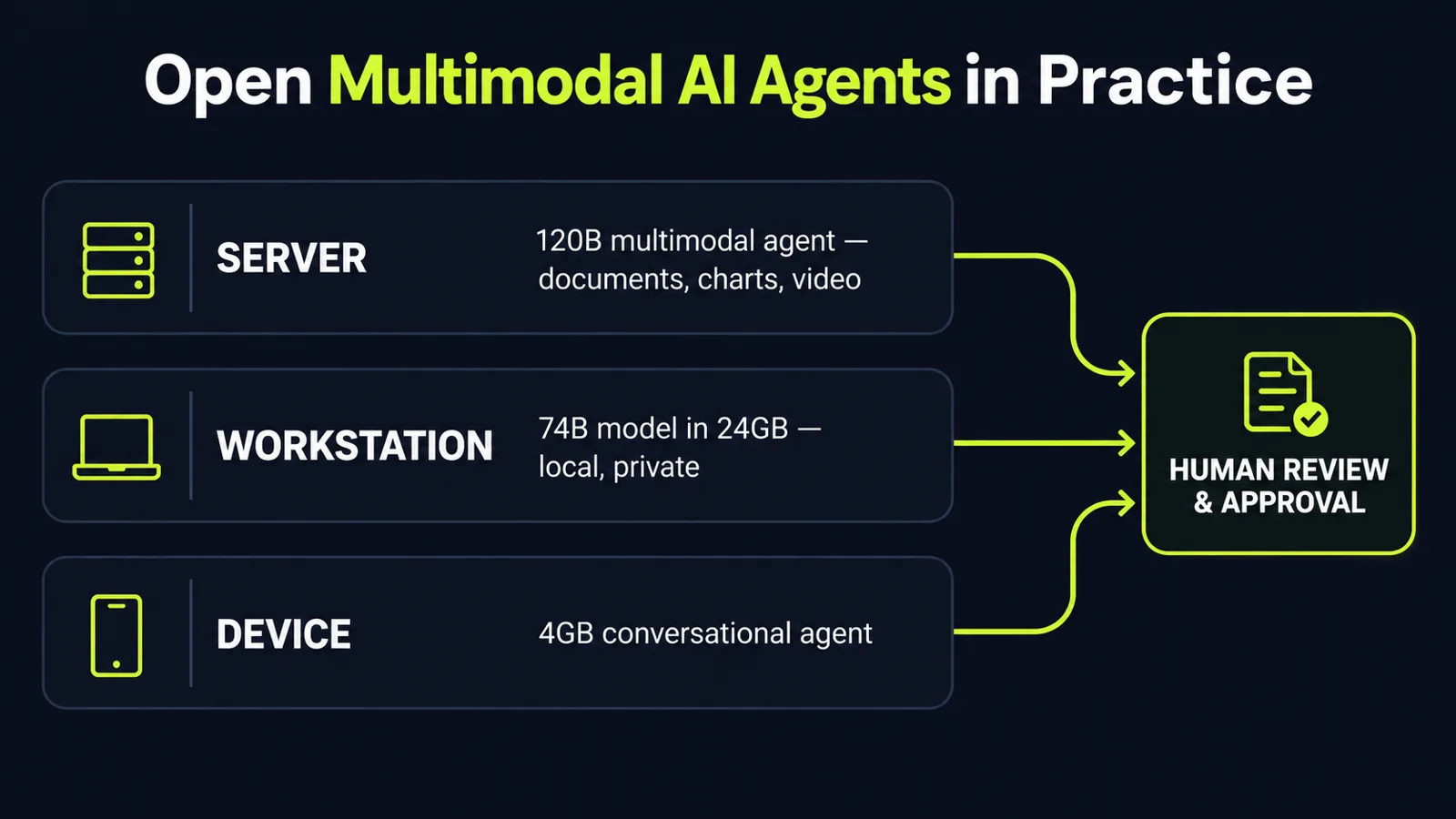
On October 15, 2026, NVIDIA released Nemotron 3.5 Super VL, an open 120-billion-parameter multimodal model built for specialised, always-on agents, alongside a 74-billion-parameter Bolt model compressed to a 24GB memory footprint for local inference. Super VL reads text, images, documents and video, follows multistep instructions and calls tools — with open weights, datasets and training recipes that let a team post-train it on its own data, tools and policies, and run it on infrastructure it controls.
Key takeaways
- Three tiers, one family. Super VL for server-side agents and two Bolt models for local and edge use cover deployments from enterprise servers to local hardware, per NVIDIA Releases Open Nemotron 3.5 Super VL and Bolt Edge Models.
- Sparse by design. Super VL activates 12 billion of its 120 billion parameters per token, so compute per token is closer to a much smaller model — while memory still has to hold the full model, per NVIDIA squeezes a 74B-parameter open model into 24 GB and releases a 120B agent model that reads PDFs.
- The headline speed is a vendor claim. Up to 5x higher throughput than other open models in its class, and comparable results to NVIDIA's largest reasoning model on selected agent benchmarks at roughly one-fifth the parameters, are NVIDIA-reported figures, per NVIDIA adds Nemotron 3.5 Super VL and two edge models.
- Open means downloadable, not free to run. The licence allows commercial use, but the hardware, serving and integration work is yours, per NVIDIA Nemotron 3.5 Super VL: 120B Open AI Model.
What actually shipped on October 15
Super VL is the flagship: reasoning, instruction following and tool use combined with text, image, document and video understanding in one system, so teams need no separate vision model passing context to a text model. Its vision training targets what agents meet in real work: text recognition, tables, charts and structured information in documents, per NVIDIA Releases Open Nemotron 3.5 Super VL and Bolt Edge Models. The release includes base, post-trained and 4-bit-quantised checkpoints, plus open datasets and training environments.
Bolt 74B-A9B 24GB is the practical half of the launch for most teams. Native 2-bit quantisation fits it in 24GB of memory to run locally alongside other applications. NVIDIA positions it for web research, writing and code debugging without sending the workload to a hosted service, per NVIDIA's latest 120B-parameter model completes tasks 5x faster. A third model, Bolt E4B 4GB, targets conversational and physical agents on smaller devices and is scheduled for October 23, 2026 — announced, not yet available, per NVIDIA Releases Open Nemotron 3.5 Super VL and Bolt Edge Models.
Read the performance claims like a buyer
Start with what the 5x figure is and is not. It is NVIDIA's own throughput comparison for open models in Super VL's size category, reported alongside benchmark scores the company selected, per NVIDIA's latest 120B-parameter model completes tasks 5x faster. That qualification matters claim by claim, not as a blanket dismissal: NVIDIA's material does cite an independent evaluation placing Super VL on the accuracy-versus-speed frontier for its hardware class, per NVIDIA Releases Open Nemotron 3.5 Super VL and Bolt Edge Models — but the headline throughput and leadership comparisons themselves rest on NVIDIA's own benchmarks and selected test conditions, as independent coverage of the launch notes, per NVIDIA adds Nemotron 3.5 Super VL and two edge models. Early hands-on coverage likewise noted that no independent benchmarks for Bolt had appeared by the evening of October 15, and that its model card shows weaker spots alongside the headline scores, per NVIDIA squeezes a 74B-parameter open model into 24 GB and releases a 120B agent model that reads PDFs.
Throughput matters only after accuracy clears your bar, and a compressed local model must be tested separately: quantisation changes results, so Bolt's scores are not Super VL's scores at a smaller size.
Teams are already post-training Super VL for finance review, credit-agreement analysis, receipt conversion and security work, per NVIDIA Releases Open Nemotron 3.5 Super VL and Bolt Edge Models. Those are announced customisation and integration projects, not independently established production results, and the reported gains are partner- and vendor-reported expectations — evidence that serious teams are testing it, not a forecast for your workload.
Why the open tier changes the buying question
A closed API rents capability: you pay per token, the provider controls the model version, and your documents travel to someone else's infrastructure. An open model inverts most of that — you keep the exact weights you validated, post-train on your own documents and policies, and run the system where your data rules require, per NVIDIA Nemotron 3.5 Super VL: 120B Open AI Model.
Check the licences separately, too: model, datasets and serving software can carry different terms, and open weights do not by themselves remove third-party obligations. The cost does not disappear; it moves. Super VL needs serious accelerator hardware, Bolt a capable workstation — plus serving, monitoring and integration. Compare that total against the per-token bill at your actual volume. Open wins when volume is high, the task is narrow and stable, or data control is non-negotiable. Hosted still wins when volume is low or nobody owns model operations.
What this means for your business
1. Test Bolt locally before you budget for Super VL. Bolt is available now, runs on one workstation and keeps test documents on your own machine. Run it on a repetitive document task that is easy to check — extracting amounts and dates, finding a clause, summarising a long file — including representative edge cases, and log every error and its severity against your current tool. Treat twenty documents as a smoke test, not proof of production reliability, and set your acceptance criteria before you start. If the local model clears your accuracy bar, you have a low-cost agent tier. If it does not, you have learned that before buying server hardware.
2. Post-train only after the base model earns it. First prove the base model completes your workflow end to end — document in, tool calls made, structured result out, human approval recorded. Post-training a model that fails your workflow just makes it fail in your vocabulary.
3. Keep the human gate where the output becomes a commitment. Reading, extracting and drafting are safe to automate early; sending, approving, paying and filing are not. Local inference is not automatically secure execution — tool permissions, document access and sandboxing stay your responsibility. A named person approves anything that leaves the business or changes a record, and inputs and outputs stay logged: with an open model you own that audit trail.
4. Price the full stack, then decide. Hardware or hosting, serving, integration, monitoring and retraining — against per-token spend and data-handling risk on a hosted alternative. Measure both sides as cost per successfully completed task, not cost per token or per second: a faster model that needs more human correction can be the more expensive one. Nemotron 3.5 makes self-hosting credible for document-heavy agents. Credible is not the same as cheaper for you.
The shift here is not that an open model got bigger. The open option now arrives as a complete ladder — server, workstation and device — built for agents that read real documents and use real tools. "Should we run this ourselves?" is worth re-asking with fresh numbers.
Want an independent review of which document and operations workflows are safe to automate — self-hosted or hosted — and where a human must stay in the loop? Get a free AI audit — we'll map your highest-leverage automation opportunities in one session.
Sources
- https://www.unite.ai/nvidia-releases-open-nemotron-3-5-super-vl-and-bolt-edge-models/unite.ai
- https://tech-insider.org/nvidia-nemotron-3-5-super-vl-2026/tech-insider.org
- https://interestingengineering.com/ai-robotics/nvidia-nemotron-35-super-vl-5x-fasterinterestingengineering.com
- https://maccus.fr/en/nvidia-nemotron-3-5-open-models/maccus.fr
- https://blockchain.news/news/nvidia-nemotron-3-5-super-vl-bolt-modelsblockchain.news
Want to know what this means for your stack? A free AI audit maps your workflows and shows where automation pays off — in your numbers, not ours.