
Meta released Muse Wonder and Muse Wonder Full on October 12, 2026 — its first attempt at a frontier model, built for long-running personal and professional agents. Independent testing puts the larger model near the top of the field. But the commercial story needs a closer read: the model you can buy by the token is not the model that earned the headline scores, it is priced like the leaders it still trails, and the subscription route to the stronger model carries a data-use default most teams will want to change on day one.
Key takeaways
- Two models, two doors. Muse Wonder is available now through the Meta Model API and Muse Code. Muse Wonder Full is not on the API at all — it is reserved for Muse Code subscribers, per Meta releases its first frontier model, Muse Wonder.
- Frontier pricing, not discount pricing. Wonder costs $4 per million input tokens and $20 per million output tokens, cached input $0.20 — in line with the top tier from rival providers, per Meta Launches Muse Wonder With Premium API Pricing and a Subscription-Only Full Model.
- Independent scores are close, not leading. On Artificial Analysis's Intelligence Index v4.3, Wonder scored 52 and Wonder Full 56, against 58 for Claude Opus 5.5 — up from 48 for Meta's earlier Muse Spark.
- The design bet is memory and persistence. Both models are built around Active Memory, which carries relevant context across conversations, and Active Focus, which keeps an agent working through obstacles on extended tasks.
- Check the data setting before the benchmark. Muse Code subscriptions default to a mode that trades more usage for permission to train on submitted content. It can be switched off — but only future content is protected.
What Meta actually shipped
The Wonder series is a deliberate step up from Muse Spark, which Meta positioned as a lightweight, low-latency model. Wonder and Wonder Full are larger, aimed at complex multi-step work such as coding and long professional assignments, and both carry a context window of about one million tokens, per Meta Launches Muse Wonder With Premium API Pricing and a Subscription-Only Full Model. Meta releases Muse Wonder AI models to challenge Anthropic and OpenAI notes the launch follows a fourteen-month overhaul of the company's AI efforts, and that both models will also power the Muse agent, subscribers first.
The two named capabilities matter more than the launch framing. Meta describes Active Memory as retrieving information a user shared in earlier conversations instead of forcing them to restate it. Active Focus is its stated persistence layer: keep working toward a hard goal, try another route when blocked, and check in before consequential actions. Those are the two failure modes that kill most agent deployments — lost context and early surrender — so the priorities are well chosen. Whether they hold up in production can only be answered on your own workloads.
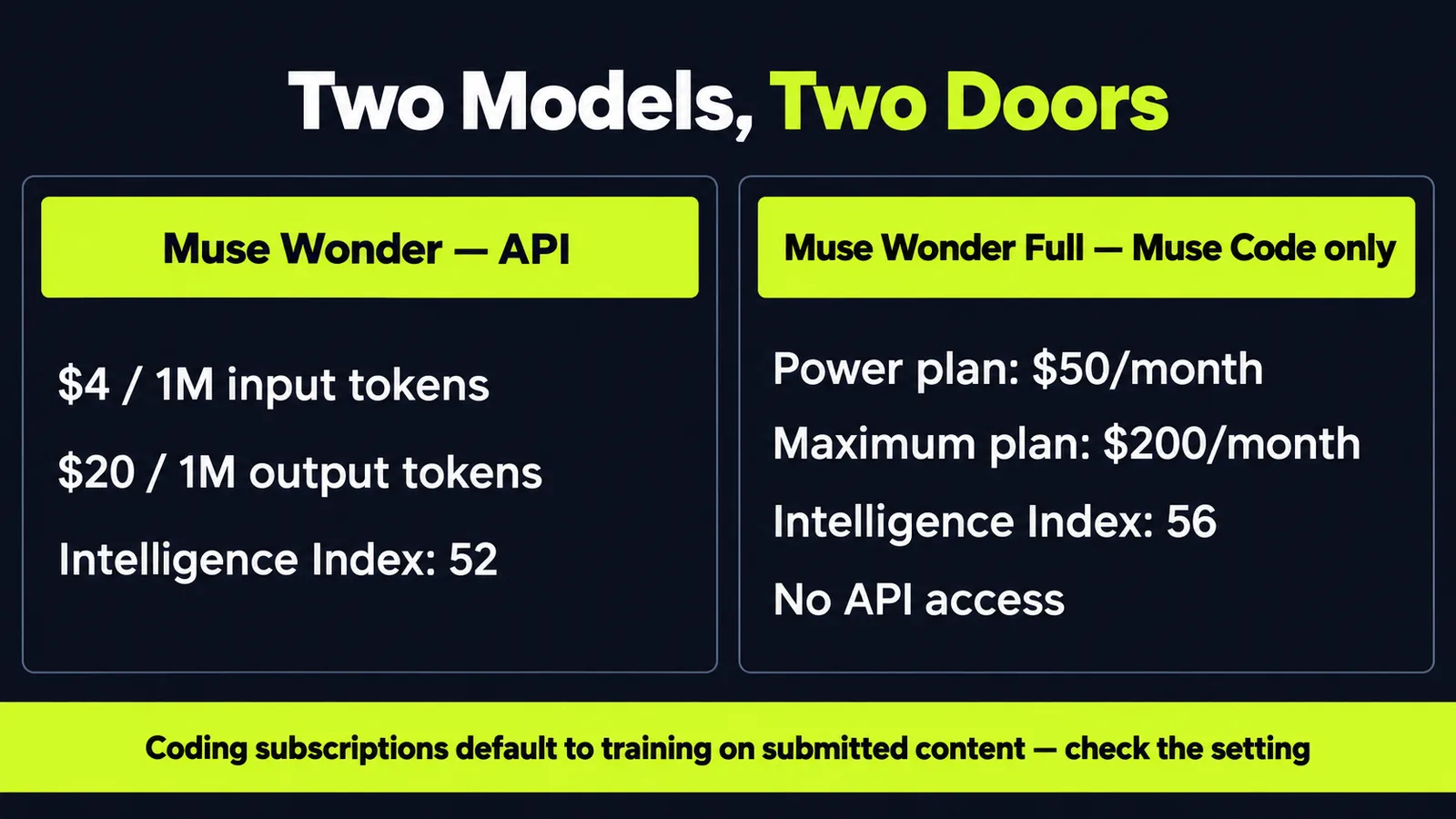
Two models, two doors: read the access rules first
Wonder's API price tells you where Meta thinks it now sits. At $4 input and $20 output per million tokens, it is priced at the level of the leading models from rival labs — and far above Meta's own Spark 1.3 at $1.25 input and $4.25 output: a 3.2-times premium on input and roughly 4.7-times on output, per Meta Launches Muse Wonder With Premium API Pricing and a Subscription-Only Full Model. Cached input at $0.20 softens the bill for repetitive, context-heavy agent work — exactly the workload these models target.
Wonder Full has no per-token price because there is no API endpoint. It sits inside Muse Code's Power Usage plan at $50 a month and Maximum Usage plan at $200 a month. Two consequences follow. First, you can evaluate Full inside Muse Code, but you cannot call it from your own stack, route production traffic to it, or substitute it for Wonder in an API-based application — it lives inside one vendor's coding tool, on that tool's terms and usage allowances. Second, its cost cannot be compared per task against API models, because the unit is a seat, not a completed job. Seat pricing is predictable; it is also easy to overbuy.
Read the benchmark gap the right way
The independent numbers are genuinely strong for a first frontier entry. Artificial Analysis, evaluating at maximum reasoning effort on Intelligence Index v4.3, scored Wonder Full at 56 and Wonder at 52, up from 48 for Spark 1.3, per Meta Launches Muse Wonder With Premium API Pricing and a Subscription-Only Full Model. Claude Opus 5.5 leads at 58. Meta is at the frontier; it is not alone at the top of it.
Two cautions apply. First, the API model is the 52, not the 56 — most launch coverage blurs the two, and any evaluation should target the model you can actually deploy. Second, some of the most flattering comparisons — notably SWE-Marathon, Meta's own test of long-running software projects, where Wonder Full leads by a wide margin — were run by Meta itself, mixing vendor-run and third-party results, as Meta Muse Wonder Full: No API, and Muse Code Trains on Your Code documents. Meta's reported lead on its MemoryBench memory test is likewise a vendor result on a vendor-chosen test: worth noting, worth verifying.
Cost per task cuts through this. The same independent evaluation put an average index task at $4.52 on Wonder versus $1.60 for Spark 1.3 — roughly 2.8 times as much, on a standardised workload, not a forecast of your invoice. Capability rose; so did unit cost. That trade may be right for hard, high-value tasks and wrong for volume work — a routing decision, not a platform decision.
The data term hiding in the coding plans
The most consequential line in the launch is not a benchmark. Muse Code subscriptions default to Contributor mode, which provides more usage in exchange for letting Meta train future models on submitted content and responses, per Meta Launches Muse Wonder With Premium API Pricing and a Subscription-Only Full Model. Users can turn it off, and both models remain available either way — but switching it off protects only future content, not what was already submitted, as Meta Muse Wonder Full: No API, and Muse Code Trains on Your Code makes clear.
For a solo developer on personal projects, that trade can be reasonable, and it is disclosed in plain language. For an engineer on a company codebase, it is a compliance problem waiting for one forgotten toggle: one sign-up on a $50 plan, one session touching proprietary code, and that code has been shared for training under terms that bar confidential material in that mode. The API works the other way for this model — Wonder on the Model API runs in Standard mode only, where submitted content is not used for training — which is another reason the API, not a personal subscription, is the right evaluation route for company work.
What this means for your business
1. Add Wonder to your evaluation set — through the API, on your tasks. A credible new frontier option improves your negotiating position even if you never switch. Run it against your current model on the same prompts, context, and acceptance tests, and compare cost per completed task, not cost per token. The published gap to the leader is small; your workload may rank them differently.
2. Do not let staff evaluate Wonder Full on personal coding plans. Until your organisation has reviewed the data terms, the default training setting makes individual Muse Code subscriptions the wrong place for company code. Set the procedure now: approved accounts only, Contributor mode verified off before any repository is connected, confidential code kept out of unapproved accounts — and an escalation path if company content was already submitted with the mode on.
3. Route by task value, not by headline. On uncached rates, Wonder costs 3.2 times its predecessor on input and about 4.7 times on output (cached input rises only from $0.15 to $0.20). Measure success rate, retries, tokens consumed, and human correction time per accepted result, then route: frontier-tier models for the long, ambiguous, high-value work they are built for, cheaper proven models on high-volume, well-defined tasks. A model router and per-workflow cost tracking will save more than any single model switch.
4. Treat availability structure as a lock-in signal. When a provider's best model exists only inside its own tool, adopting it means adopting the tool, its roadmap, and its data defaults. That can still be right for a coding team — but make it deliberate, with an exit path, not a dependency you discover after workflows are built on it.
Meta has done the hard part: a model family independent testing places near the top, built — on its own account — around memory that persists and focus that lasts. What remains unproven is production reliability on your workloads. So the buying work is specific: test the model you can actually integrate, price it per accepted result, and verify the data settings before any company code touches it.
Want an independent review of which models and agent tools fit your workloads — and what each completed task really costs you? Get a free AI audit — we'll map your highest-leverage automation opportunities in one session.
Sources
- https://techcrunch.com/2026/10/12/meta-releases-its-first-frontier-model-muse-wonder/techcrunch.com
- https://www.reuters.com/business/meta-releases-muse-wonder-ai-models-challenge-anthropic-openai-2026-10-12/reuters.com
- https://aiindustrytoday.com/news/ait-20261013-muse-wonder/aiindustrytoday.com
- https://letsdatascience.com/blog/metas-best-model-skips-api-coding-plan-trains-on-your-codeletsdatascience.com
Want to know what this means for your stack? A free AI audit maps your workflows and shows where automation pays off — in your numbers, not ours.