
Microsoft announced Maia 300 on October 12, 2026 — the third generation of its in-house AI accelerator, built specifically for inference: running models in production, not training them. The company says it will scale the Maia family to multi-gigawatt deployments starting in 2027 and make Maia the primary inference system for its own products and services. If you buy AI by the token, by the seat, or by the agent run, this is a story about your unit costs — not about a chip you will ever buy directly.
Key takeaways
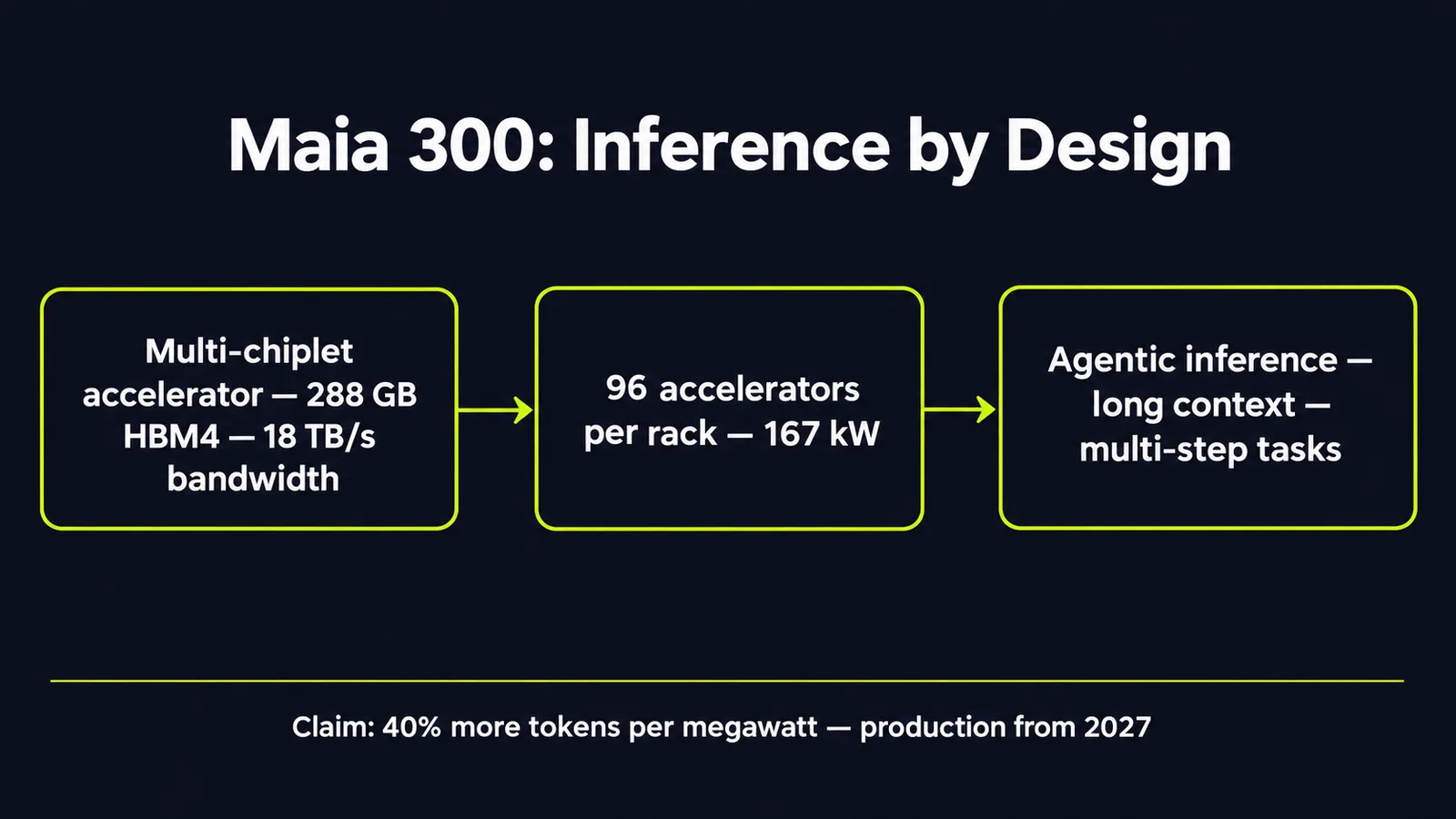
- Maia 300 is an inference chip, by design. Microsoft built it for long-context reasoning, latency-sensitive conversation, and sustained multi-step agentic tasks, per Microsoft Announces Maia 300 AI Chip, Multi-Gigawatt Azure Scale-Up.
- The headline claim is efficiency, not raw speed. Microsoft expects about 40% more tokens per megawatt than leading GPU-based systems, per Microsoft plans huge deployment of its own AI chips, with an eye on saving costs. It has not named the GPU system or workload behind that comparison.
- Scale is the strategy. Reuters reports a plan to deploy potentially more than one million Maia chips next year for internal services, with multi-gigawatt deployments starting in 2027.
- Production starts in 2027. Maia 300 does not change any bill this quarter. Maia 200, its predecessor, is already in production serving Copilot workloads today.
- Memory is the real upgrade. Each Maia 300 carries 288 GB of HBM4 memory at 18 TB/s of bandwidth — 2.5 times the bandwidth of Maia 200 — because moving data, not computing, is now the bottleneck in inference.
What Microsoft actually announced
The announcement has three parts. First, the chip: a multi-chiplet design that separates compute, memory control, and I/O onto different pieces of silicon, with the compute chiplets built on a 2-nanometre-class process and the supporting chiplets on a cheaper 3-nanometre process, as Reuters outlines. Second, the rack: 96 accelerators in about 167 kilowatts — the rack power envelope, distinct from the 950-watt power budget of each chip — which Microsoft says delivers up to seven times the rack-scale token throughput of a Maia 200 rack. Third, the commitment: Maia becomes the default place Microsoft's own products run inference, at multi-gigawatt scale, starting in 2027 — a move its chief executive described in a social post as the company's biggest bet yet on its own silicon, per Microsoft Maia 300: Specs, the 40% Claim, vs Maia 200.
Maia 200 matters here because it proves this is not a slide deck. That chip, announced in January 2026, is already running production workloads including Microsoft Copilot, and it runs a mix of OpenAI models, Microsoft's own models, and open-source families, per Microsoft Unveils Maia 300 AI Chip. GitHub Copilot and Microsoft Foundry are due to move onto Maia 200 by the end of the year. Microsoft says Maia 200 already delivers up to 1.7 times more tokens per watt than leading GPU infrastructure for built-in AI features in its collaboration and Copilot products.
The sequence is clear: prove the design on live products, then scale it, then make it the default.
Why memory, not compute, is the headline
Read the specifications carefully and Maia 300 is a memory story. Compute per watt improves only modestly over Maia 200 — roughly 8% on low-precision throughput, by the comparison in Microsoft Maia 300: Specs, the 40% Claim, vs Maia 200. Memory bandwidth per watt roughly doubles. Capacity per chip rises by a third, to 288 GB, and a full rack carries about 27.6 TB of high-bandwidth memory.
That trade-off matches the workload. An AI agent that works through a long task does not compute once and stop. It reads the model's weights and the growing context of the session again and again, for every token it generates. Long context windows, multi-step plans, tool calls, and retries all multiply that memory traffic. For that pattern of work, bandwidth per watt is where cost is won or lost — and it is exactly the metric Microsoft chose to optimise.
The lesson for teams building automation: profile agent workloads for memory and context, not just model size. A smaller model with a bloated context window can cost more than a larger model with disciplined context management. Inference cost is a system property — chip, memory, context design, and retry behaviour combined.
Read the 40% claim the right way
The 40% figure needs three caveats, all visible in the reporting. First, it is an expectation, not a measured result: Maia 300 enters production in 2027, so no independent test exists yet. Second, Microsoft has not named the GPU-based system it compared against, nor the model or workload used for the token count. Third, rack-level gains such as the seven-times throughput claim bundle hardware, networking, and software improvements together, so they do not isolate what the chip alone does.
None of that makes the announcement empty. It makes it a direction, not a benchmark. The verifiable parts are the specifications and the deployment commitment. Revisit tokens per megawatt once production systems publish measured results — more detail is promised at its developer conference next month, and production evidence arrives in 2027.
The wider pattern is also verifiable: Microsoft is one of several large providers building custom silicon to reduce dependence on purchased GPUs, as both Reuters and Dataconomy note. Inference is the recurring cost — it happens on every request, seat, and agent run — so it is where owning the hardware changes the economics most.
What this means for your business
One question sits under all four moves below: who captures the saving? More efficient inference lowers Microsoft's cost to serve a token. Microsoft can pass that on as lower prices, keep it as margin, or spend it on more capacity and more capable default features. The announcement does not say which, and no customer pricing schedule for Maia 300 has been published. Treat any benefit to your bill as unproven until it appears in your contract, your usage rates, or your renewal quote. Custom silicon also cuts both ways on dependence: it reduces Microsoft's reliance on purchased GPUs while deepening your reliance on Microsoft's stack — which makes portability, exit terms, and alternative-provider options worth pricing before you commit further.
1. Expect inference economics to keep improving — and negotiate like it. If the largest buyers are investing at this scale to cut their own cost per token, the long-run direction for buyers is more output per unit of spend. Do not lock into long, flat-rate AI contracts without a re-pricing mechanism, volume tiers, or a review point. Your leverage improves as efficiency improves, but only if your contract lets you use it.
2. Measure your own cost per completed task, starting now. Tokens per megawatt is Microsoft's metric. Yours should be cost per accepted outcome: a resolved ticket, a qualified lead, a merged change, a finished document. Track it per workflow, including retries, human review, and failed runs. Without that baseline, you cannot tell whether a cheaper model, a new agent platform, or a provider's efficiency gain actually saved you anything.
3. Treat context as a cost line. Maia 300's design says the industry now optimises for long-context, multi-step work — which is also the work that burns budget fastest on the buyer side. Track it concretely: input tokens, retrieved context, output tokens, and repeat calls per task. Set context budgets per agent, summarise and cache aggressively, and cap retry loops. Uncontrolled context growth is a common cause of runaway inference spend.
4. Do not plan around 2027 hardware. Nothing in this announcement changes what you should deploy this quarter. Maia 300 is not a product you can rent on stated terms yet, and Microsoft has not published pricing or direct access terms for it. Plan on the services and price points that exist today, and re-check the economics when production deployments and measured results arrive.
Microsoft building its own inference fleet at multi-gigawatt scale will not appear on your invoice as a line item. It will appear as pressure — on token prices, on agent pricing, and on what a well-run automation should cost per outcome. Teams that already measure cost per outcome will spot that pressure early and capture it. Teams that only track seats and subscriptions will not.
Want a clear-eyed review of what your AI and automation actually cost per outcome — and where the waste sits? Get a free AI audit — we'll map your highest-leverage automation opportunities in one session.
Sources
- https://www.reuters.com/business/microsoft-plans-huge-deployment-its-own-ai-chips-with-an-eye-saving-costs-2026-10-12/reuters.com
- https://dataconomy.com/2026/10/13/microsoft-maia-300-ai-chip-2027/dataconomy.com
- https://cellcog.ai/blog/microsoft-maia-300/cellcog.ai
- https://www.unite.ai/microsoft-announces-maia-300-ai-chip-multi-gigawatt-azure-scale-up/unite.ai
Want to know what this means for your stack? A free AI audit maps your workflows and shows where automation pays off — in your numbers, not ours.