

On October 8, 2026, Microsoft announced new CRM capabilities across Dynamics 365 and Microsoft 365: 30 Copilot skills, autonomous sales and service agents, and CRM access inside Teams. The changes bring selected CRM actions into the productivity workflows people already use, while Dynamics 365 remains the underlying system for customer data and business processes. For businesses, the real questions are what it costs, what the agents can actually do, and what breaks if your data is messy.
Key takeaways
- 30 new pre-built Copilot skills for Dynamics 365 Sales, Customer Service, and Customer Insights, per Futurum's October 9 analysis — availability differs by surface, with CRM in Teams, the Sales Development Agent, and Dynamics 365 Activate in public preview and Service Agent in private preview.
- Sales Development Agent (public preview) researches prospects, prepares outreach, and manages follow-ups inside configured workflows; Copilot credit consumption is scheduled to begin November 16, 2026.
- Service Agent (private preview) handles customer requests across Outlook, Teams, Word, Excel, and PowerPoint and creates CRM cases on its own.
- Work IQ, the shared context layer grounding Copilot and agents in Dynamics 365 and Power Platform data, began its business-application preview rollout September 30 with availability expanding through October, per Microsoft's announcement.
- Dynamics 365 Activate (public preview) uses AI-assisted analysis to map an existing CRM environment and recommend a migration approach — assessment, not a completed migration.
What Microsoft actually announced
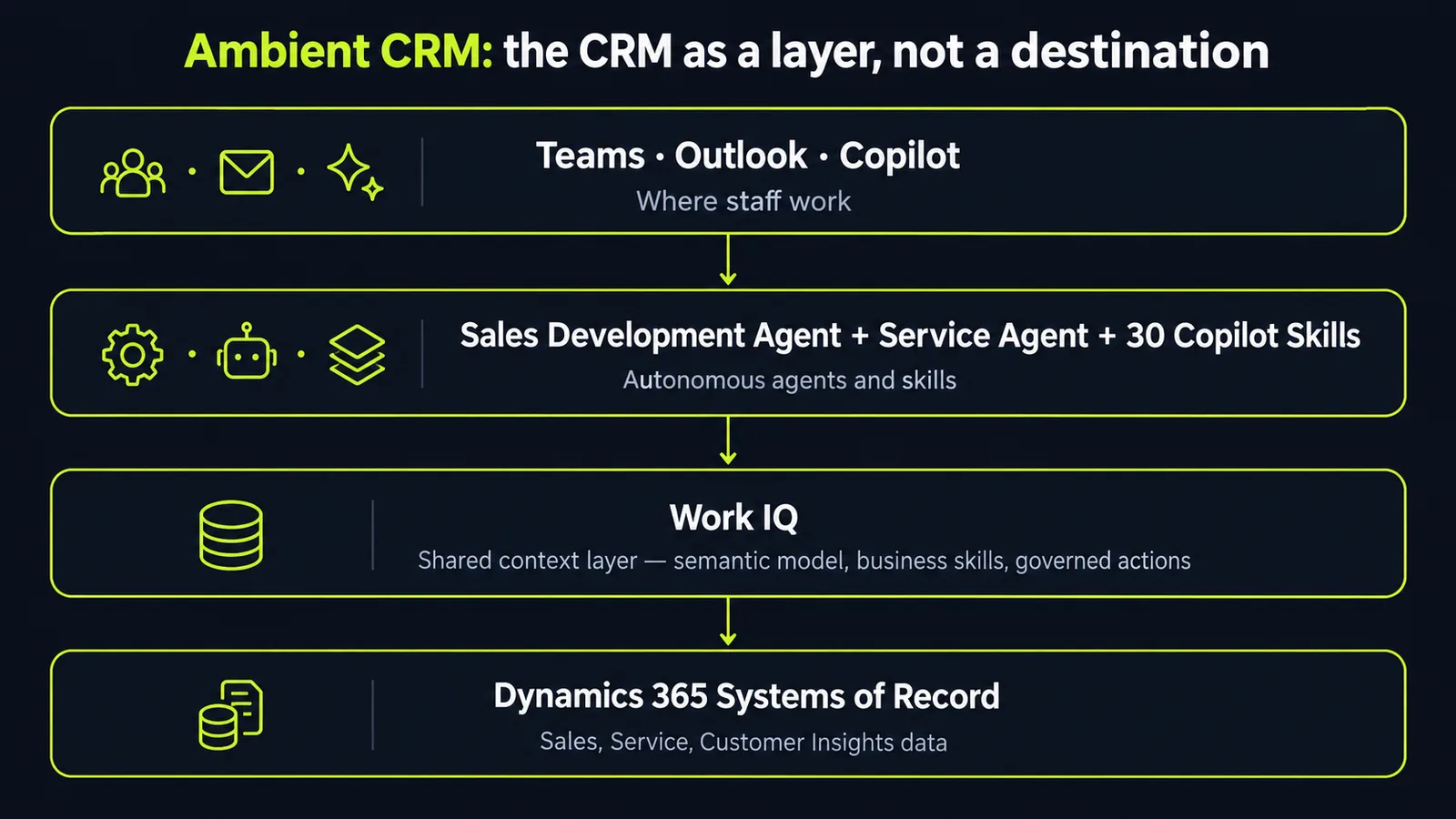
The October 8 package has three moving parts. First, the skills: 30 pre-built Copilot skills spanning sales, customer service, and customer insights, designed to execute CRM actions inside Teams, Outlook, and Copilot. Second, the agents: software designed to execute defined workflows — the Sales Development Agent researches prospects, prepares personalized outreach, and manages follow-up; the Service Agent takes customer requests across Microsoft 365 apps and creates the CRM case automatically. Third, the context layer: Work IQ, supplying shared business context through semantic models built on Dataverse that draw on existing application configurations, relationships, and organization-specific terminology, with governed actions that update source records within each user's permissions. Analysts are calling the result "ambient CRM": the CRM as a layer, not a destination.
That points at a genuine integration risk: fragmented business context, where separate agents run on different instructions, data definitions, and governance configurations.
Agent capabilities and usage-based costs
Microsoft's integration of CRM capabilities with Teams, Outlook, and Copilot may reduce application switching for organizations already on its productivity stack. The tradeoff is dependence on connected workflows and configurations — building around Dynamics-specific data, skills, and integrations creates switching costs that should be priced into the decision.
The agent rollout introduces a measurable consumption-based commercial dimension to Microsoft's CRM strategy. Futurum identifies Copilot credit consumption after November 16 as an early adoption signal — it measures activity and spending, not workflow success. For customers, the more relevant test is whether the cost of agent-assisted prospecting is justified by qualified opportunities and reduced manual work.
The early customer evidence needs the same care. Microsoft reports that Adobe secured meetings with more than 10 previously unreached customers during a three-week limited rollout, and Comcast says Activate accelerated its migration assessment. These are vendor-published customer accounts, not independent benchmarks — they do not establish general productivity gains or ROI. Use your existing prospecting performance as the baseline, not someone else's.
Service Agent is entering a limited private preview, so production-readiness evidence is thinner than for capabilities already in public preview or general availability. What is announced is an agent that can automate portions of customer-service intake, research, and case creation across supported Microsoft 365 applications, reducing manual coordination for defined workflows. The deployment questions that matter: agent identity, which write operations are permitted, what triggers human approval, where audit logs land, and who is accountable when the agent gets a response wrong.
Dynamics 365 Activate: assessment, not migration
The third leg targets the biggest reason companies stay on legacy CRMs: migration is hard. Activate applies AI-assisted analysis to an existing CRM environment and recommends a migration approach. That is real value — but it is assessment, not completed migration. Implementation costs, data conversion, integration changes, custom workflow migration, testing, and cutover still require evaluation, and the faster assessment says nothing about the conversion effort.
For context, Futurum's 1H 2026 survey found 48.6% of decision makers planning to deploy agentic AI in customer experience within 18 months. Microsoft is building where buyers say they want to go — but Activate's commercial significance will depend on how many assessments convert into completed deployments, something to watch through early 2027.
What Microsoft hasn't answered yet
Several deployment questions remain open: general availability timelines, tenant-level feature access, applicable licensing, usage-based costs, and the supported scope of ERP data integrations (Microsoft's documentation puts Finance and Operations coverage in Work IQ in late October — not something to assume is live). Pricing should be verified separately for each capability.
And the data-quality catch, flagged by practitioners covering the release: Work IQ builds its semantic model from your existing Dynamics configuration. Stale opportunity stages, disputed account ownership, or inconsistent business definitions can produce misleading agent recommendations unless the underlying data and configuration are reviewed.
What this means for your business
Whether or not you run Dynamics 365, the October 8 announcement makes CRM evaluation more demanding. Three practical moves:
1. Audit data discipline before enabling agents. Review opportunity stages, account ownership, customer records, and business rules before enabling automated decisions or outbound actions. Use a limited test environment to surface inconsistent definitions and incorrect recommendations before expanding access.
2. Pilot against your own baseline. Compare agent-assisted prospecting against your current process on qualified opportunities, meeting acceptance, review effort, and cost per outcome — credits, licensing, integration work, human review, and administration. Don't treat credit consumption as ROI.
3. Separate the migration assessment from the migration. If your CRM is up for review in the next 12 months, get the assessment before your renewal negotiation, not after — then walk it through a real checklist: data mapping, custom entities, plugins, integrations, permissions, historical records, testing, and cutover.
A compact evaluation framework works for both pilots and procurement: qualified opportunities per hundred contacted prospects, positive reply rate and complaint rate, time to resolution and reopen rate for service, frequency of unauthorized or incorrect agent actions, and total cost per accepted outcome.
Microsoft's announcement brings CRM data, reusable skills, and automated actions closer to employees' existing workflows. Whether that delivers measurable value will depend on deployment maturity, data quality, integration effort, and operational controls.
Want a clear-eyed read on whether your sales and service workflows are ready for agentic AI — and what it would actually cost? Get a free AI audit — we'll map your highest-leverage automation opportunities in one session.
Sources
- https://futurumgroup.com/insights/microsoft-turns-dynamics-365-into-an-ambient-crm-layer/futurumgroup.com
- http://aiagentstore.ai/ai-agent-news/todayaiagentstore.ai
- https://cxm.world/customer-experience/microsoft-work-iq-copilot-dynamics-365/cxm.world
- https://erp.today/microsoft-opens-work-iq-preview-for-dynamics-365-and-power-platform-data/erp.today
- https://aiagentsdirectory.com/news/ai-agents-news-brief-october-9-2026aiagentsdirectory.com
- https://www.microsoft.com/en-us/dynamics-365/blog/it-professional/2026/09/25/work-iq-business-and-workplace-intelligence-in-the-flow-of-work/microsoft.com
Want to know what this means for your stack? A free AI audit maps your workflows and shows where automation pays off — in your numbers, not ours.