
Cloudflare announced on October 9 that it is acquiring Deno, the team behind the JavaScript and TypeScript runtime of the same name. The stated goal is not another hosted runtime. It is to make self-hosted Cloudflare Workers a supported, first-class way to run applications — including on infrastructure you operate yourself. For teams on Deno Deploy, the same announcement starts two clocks: six months for the hosted service, and one year of maintenance for the runtime. Both clocks matter more than the acquisition headline.
Key takeaways
- The deal targets portability. Cloudflare will fold celld — Deno's open-source implementation of the Workers and Durable Objects model, released in August — into workerd, its open-source Workers runtime, per Cloudflare acquires Deno to improve its Workers programming model | TechCrunch.
- Financial terms were not disclosed. Deno had raised $26 million in total, including a Series A led by Sequoia, according to the same TechCrunch report.
- Deno Deploy shuts down in six months. Migration support is named for paying customers moving to Cloudflare Workers, per Cloudflare acquires Deno; Deno Deploy to shut down in six months.
- The Deno runtime gets one more year of monthly bug-fix and security releases. After that, the team ends its own development; the code stays open source for anyone else to continue.
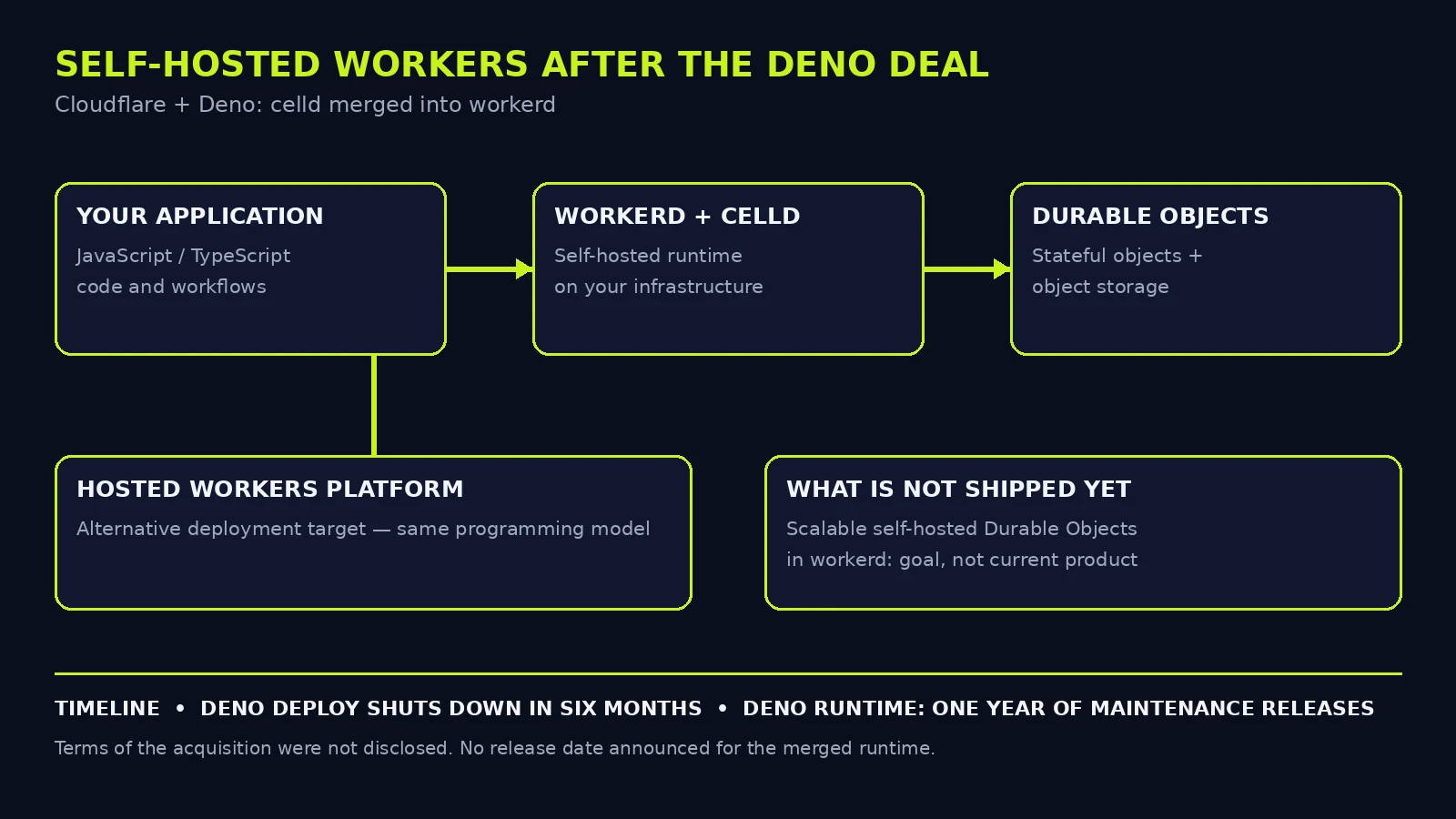
- The merged self-hosting product has not shipped. No release date has been announced, and today's workerd still limits Durable Objects to a single instance — suitable for local testing, not distributed production scale.
What Cloudflare is actually buying
Deno was co-founded by Bert Belder and Ryan Dahl, the creator of Node.js. The company built three things that matter here: a standalone runtime, a hosting service called Deno Deploy, and, most recently, celld. Celld is the piece Cloudflare wants. It implements the Workers programming model — code plus persistent, stateful Durable Objects — in a form designed to run on your own infrastructure, using object storage for coordination and persistence rather than a stack of separate services.
Workerd is Cloudflare's open-source Workers runtime, but its Durable Objects implementation was never built for distributed self-hosting. That gap is the honest core of this deal, as Cloudflare Deno Acquisition Targets Self-Hosted Workers lays out: each Durable Object pairs code with its own persistent state and storage, which suits real-time collaboration, chat, session state, and agent backends — exactly the workloads that are hardest to move off a hosted platform today.
Cloudflare's stated position is that an open runtime with a working exit path is good business. That position is now testable: if the merged workerd ships with scalable Durable Objects and decent tooling, the Workers model becomes one you can adopt without marrying one network. If the merged release slips, that claim stays unproven.
The two clocks for Deno teams
The product timelines are specific about windows and vague about dates, as Deno is joining Cloudflare notes in tracking the announcements. Deno Deploy keeps operating for six months, then shuts down. The runtime gets a year of monthly maintenance releases, then the original team stops. JSR, the package registry, continues, with its infrastructure moving to Cloudflare. Support for rusty_v8 continues, with work toward integrating it into workerd.
Treat the windows as deadlines with unknown end dates, not as six comfortable months. Migration support is explicitly mentioned only for paying Deploy customers moving to Workers. Free-tier users, and teams whose Deploy apps depend on stored data, cron-style jobs, or integrations, should not assume a guided path exists for them. Inventory first: what runs on Deploy, what state it holds, which bindings and external services it touches, and what a move to Workers — or anywhere else — actually requires in code and configuration changes.
For runtime users, nothing breaks on day one of year two — the code stays open source. The risk is slower: security response, compatibility drift, and tooling attention depend on who, if anyone, picks up maintenance. Plan an exit or a successor; do not panic-migrate a stable service this quarter.
Why this matters beyond JavaScript
Strip away the runtime politics and this is an automation infrastructure story. The workloads moving into production now — AI agents, workflow engines, real-time internal tools — need stateful compute that sits close to users and data and survives scrutiny about where it executes. Durable Objects are one clean answer to the state problem. Making that answer self-hostable changes procurement: exit cost, data control, and deployment choice become design inputs instead of contract regrets.
Our read on the wider pattern: standalone developer tools keep getting absorbed into platforms, because the durable revenue sits in hosting and adjacent services, not in a free runtime. So evaluate any runtime, agent framework, or automation platform on its export path before its features — what runs where, what state leaves with you, and what the vendor has shipped, not promised, for self-hosting.
What has not been answered yet
Four gaps should stay on your risk list. First, no calendar shutdown date for Deploy and no date for the merged workerd release — only windows and a promise of more announcements in the coming months. Second, what migration support includes, and whether free-tier Deploy users get any of it. Third, whether celld continues as a separate project once its code moves into workerd. Fourth, the adjacent-services problem: Cloudflare itself acknowledges the tooling and services ecosystem around workerd needs work, and Workers apps that lean on hosted bindings may not port cleanly today.
What this means for your business
1. If you run anything on Deno Deploy, start the inventory this week. List services, data stores, integrations, and owners. Set your internal migration target well inside the six-month window, and engage the offered migration support early if you are a paying customer.
2. If you use the Deno runtime in production, make the year-two decision now. Stay on community maintenance, move to Node.js, or move to Workers — each is defensible, but choosing by default when support ends is not.
3. If you are evaluating Workers for agent or automation backends, do not design around unshipped self-hosting. Scalable self-hosted Durable Objects are the goal of this deal, not a current product. Design for portability — isolate platform bindings, keep state exportable — and let the merged release prove itself before it carries production weight. Remember that code is the easy part of any migration: stored state in Durable Objects, queues, and scheduled jobs is what needs an export path, and it is rarely in the demo.
Self-hosting is not free, either. Running workerd and celld yourself means operating object storage, upgrades, monitoring, and incident response — and owning patching and compliance for the runtime layer a hosted platform used to carry. Price that operating cost against the hosted bill before treating self-hosting as a saving.
4. Add an exit test to platform procurement. Ask every infrastructure vendor the question Cloudflare is now volunteering to answer: show us the supported way to run this somewhere else. Score the answer on shipped code, not announcements.
Cloudflare buying Deno does not change what you deploy tomorrow. It changes what you should demand from the platforms you deploy on next year — a programming model with a working exit, backed by code you can run yourself.
Want a clear-eyed review of your automation stack's platform risk — where you are locked in, and what a portable architecture would cost? Get a free AI audit — we'll map your highest-leverage automation opportunities in one session.
Sources
- https://techcrunch.com/2026/10/10/cloudflare-acquires-deno-to-improve-its-workers-programming-model/techcrunch.com
- https://appstackinsider.com/insights/cloudflare-s-deno-acquisition-could-reshape-the-workers/appstackinsider.com
- https://simonwillison.net/2026/Oct/9/deno-is-joining-cloudflare/simonwillison.net
- https://saganote.com/cloudflare-acquires-deno-self-hosted-workerssaganote.com
Want to know what this means for your stack? A free AI audit maps your workflows and shows where automation pays off — in your numbers, not ours.