
On October 8, 2026, Google Cloud announced the Gemini agent at its Gemini at Work 2026 event — described by CEO Thomas Kurian as "a single, universal agent for work" that takes objectives, plans the work, connects to company systems, and returns finished output. It is Google's sharpest move yet in the race to replace chatbots with software that does the job itself.
Key takeaways
- One agent, one prompt box: the Gemini agent handles knowledge work, Q&A, content creation, and coding from a single interface — inline in Gmail, Drive, Docs, Slides, Sheets, Chat, and Calendar, plus Microsoft 365, Slack, Salesforce, ServiceNow, Jira, BigQuery, Databricks, Postgres, and Snowflake.
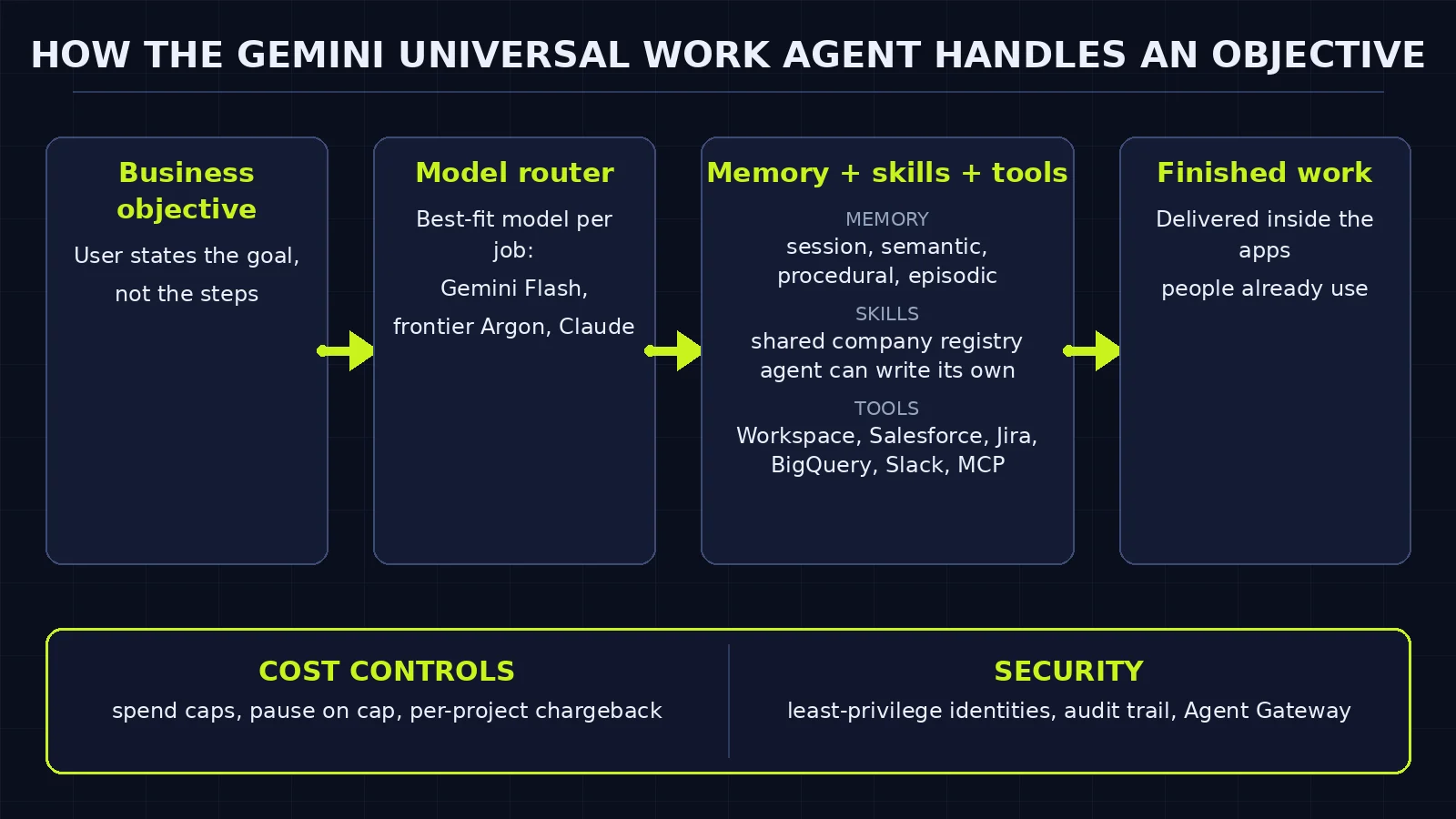
- Model-agnostic routing: it picks the best model per job — Gemini Flash for simple tasks, frontier-class Argon for hard ones — and already orchestrates across the Gemini family and Anthropic's Claude, with more private and open models planned.
- Agents get coworkers, not just users: temporary sub-agents and persistent "coworker agents" get their own identities, email addresses, calendars, and Drive storage — they join the company directory like staff.
- Enterprise controls come first: spending caps in Cloud Billing, audit trails attributed to the agent, least-privilege identities, and a sandboxed execution environment are part of the launch, not an afterthought.
- Status: private preview now; general availability expected around the end of October or early November, per analyst reporting — no published per-task pricing yet.
What Google actually announced
The framing matters. Google is explicitly telling users to give the agent "objectives, not instructions". You don't write the steps; you state the goal, and the agent plans, picks skills and tools, connects to business systems, and delivers completed work back inside the documents, inboxes, and developer environments people already use. That is a delegation layer, not a chatbot.
Google built it on six architectural principles: one unified agent for chat, autonomous objectives, and code; access from any device or channel (web, mobile, desktop, command line, Workspace, Microsoft 365, Slack, headless inside third-party apps); persistent cloud execution that keeps running for hours or days after you close the laptop; multi-agent orchestration; deep business context; and flexible model choice. The memory system keeps four kinds of memory — session, semantic, procedural, and episodic — and the agent is said to onboard itself the way a new hire would, learning the user, the tools, and the team before starting work.
This did not appear from nowhere. Since April, Google has staged the pieces in public: an enterprise agent platform with long-running execution and identity management, seven-day continuous execution, monthly spending caps, and cross-app Workspace operation. October 8 assembled them into a single product. That sequencing should reassure buyers more than a surprise launch would.
The five pieces that actually matter
1. Model routing across vendors. The agent "runs each job on the model that fits best," orchestrating across Gemini and Claude today. If that works as described, it ends the single-model-lock-in problem: cheap models handle triage and drafts, frontier models handle the hard calls, and cost follows the task instead of the subscription.
2. Memory and skills as company assets. Skills are reusable instruction modules — how your team writes a status report, how it qualifies a lead, how it reviews a contract — stored in a shared company registry. Individuals get personal skills; the agent can also write its own. This is where automation compounds: the workflow stops living in one employee's head or one brittle Zap and becomes shared infrastructure.
3. Sub-agents and coworker agents. For multi-step work, Gemini spins up temporary sub-agents with their own identities — and introduces coworker agents that get a real Workspace presence: an email address, calendar, Drive, and a directory entry. They see only what is shared with them. Employees delegate by mentioning them in documents or assigning work in a tasks inbox. It is the closest thing yet to hiring a digital colleague.
4. It meets people where they work. Everything routes through one interface and one API: inline in Workspace apps, reachable from Slack and Microsoft 365, running headless in third-party applications. There is no separate agent console to adopt — the interface people already use becomes the interface for delegation.
5. Controls a security team can read. Every agent gets a cryptographically attested, least-privilege identity; every action is written to an audit trail attributed to the agent, not a person; identities propagate to external systems through OAuth. All agents run in a sandbox, and all traffic passes through an Agent Gateway that enforces organization-wide policy. Admins set hard spend caps per project — hit the cap and the agent pauses until someone resumes it — and costs are tracked per project so departments can be charged back.
The coworker is the real shift
Agent products have competed on capability for two years. Google is competing on org-chart compatibility. Giving an agent a mailbox, a calendar, and a directory entry is a strange decision until you think about how companies actually adopt software: through the systems and rituals they already have. Delegation by email, assignments visible in a tasks inbox, permissions inherited from existing sharing settings — that is adoption with the grain of the organization, not against it.
The audit-trail design matters as much. Attribution to the agent rather than a person, policy enforced at a gateway, skills shared through a registry — this is the shape of software you can put inside a regulated process and defend to a compliance team. The announcement also notes specialized versions for Financial Services and Legal are in preview, with Government, Healthcare, and Retail to follow. Regulated industries are where AI budgets are largest and approval gates are highest; Google is aiming squarely at them.
What Google hasn't answered yet
The gaps are worth naming before any pilot. There is no published per-task or per-token pricing for agent usage — consumption-based pricing is reported, with no extra SKU, but the actual rates are unknown. Routing transparency is unconfirmed: it is not clear admins can see which model handled each task or how Claude-routed jobs are treated for data handling. General availability timing is reported as end of October or early November by analysts, but Google has only said "soon," and some admin controls reportedly arrive in the weeks after launch. And the usual enterprise questions — which Workspace plans qualify, data residency, offboarding rules for coworker agents — still need answers.
None of that kills the story. But it does mean the current move for a buyer is evaluation, not commitment: confirm plan eligibility, test a cap pausing a long job, decide whether your data-processing terms allow automatic routing to Anthropic's models, and check that agent audit trails reach your existing logging.
What this means for your business
The pattern across this week's announcements is unmistakable. OpenAI shipped persistent agents in September, Meta launched its personal assistant, OpenAI just turned ChatGPT into an interface generator, and now Google has launched a universal work agent with its own coworkers. The product battle has moved from who answers best to who finishes the work — and the vendors all agree the winning surface is the tools you already use, not a new app.
For a business leader, the practical takeaways are three:
- Start inventorying delegation-ready work now. The agent's value is a function of how clearly you can state objectives. Teams that can describe what "done" looks like — the inputs, the systems, the approval gates — will get value on day one; teams that can't will get a chatbot. Writing down three repeatable workflows with their decision points is the cheapest preparation there is.
- Treat skills as an asset, not a config. The shared skills registry is the most underappreciated part of the announcement. Your team's repeatable know-how — how you triage, how you report, how you review — becomes portable, versioned, shareable infrastructure. That is a moat a competitor's chatbot cannot cross.
- Pilot with a cost ceiling and a compliance checklist. Use the spend caps from day one, require audit-trail visibility in your own logging, and decide your model-routing policy before you turn automatic routing on. The controls exist; using them is your job.
The chatbot era trained everyone to ask better questions. The agent era will reward companies that write better objectives — and that build the skills, permissions, and cost guardrails that let software act on them safely. That work does not need Google's general availability to start. Run a free AI audit and map exactly which of your workflows are ready to delegate — before your competitors map theirs.
Sources
- https://www.unite.ai/google-cloud-unveils-gemini-its-universal-agent-for-work/unite.ai
- https://www.marktechpost.com/2026/10/08/google-cloud-launches-gemini-agent-one-universal-agent-for-enterprise-work/marktechpost.com
- https://appstackinsider.com/insights/google-cloud-launches-gemini-agent-for-enterprise-work/appstackinsider.com
- https://oossa.com/en/google-cloud-launches-gemini-agent-for-enterprise-tasksoossa.com
- https://www.martechai.com/ai-news/google-cloud-introduces-gemini-agent-to-automate-workplace-tasks-3470.htmlmartechai.com
- https://techwireasia.com/2026/10/google-gemini-ai-agent-enterprise-workflows/techwireasia.com
- https://www.everydev.ai/p/news-weekly-ai-dev-news-digest-october-3-9-2026everydev.ai
- https://dwealth.news/2026/10/ai-intelligence-weekly-top-10-10-8-26/dwealth.news
Want to know what this means for your stack? A free AI audit maps your workflows and shows where automation pays off — in your numbers, not ours.