

On October 7, 2026, Automation Anywhere announced it will acquire Boost.ai, the enterprise conversational AI platform, from Nordic Capital. It's the automation giant's second AI acquisition in a year — and it signals a real shift: enterprise AI is moving past chatbots that answer questions toward systems that hear a request and carry the whole process through to completion.
Key takeaways
- Automation Anywhere agreed to acquire Boost.ai on October 7, 2026, with the deal expected to close in Q4 2026 subject to regulatory approvals. Financial terms were not disclosed, per the press release.
- This is its second AI acquisition in a year, following the late-2025 purchase of Aisera, which added enterprise knowledge and automated employee service.
- Boost.ai brings voice and chat AI built for regulated industries: 36+ languages, hybrid NLU plus generative AI, 90%+ resolution rates in production, and more than 150 million automated conversations across 650+ deployments.
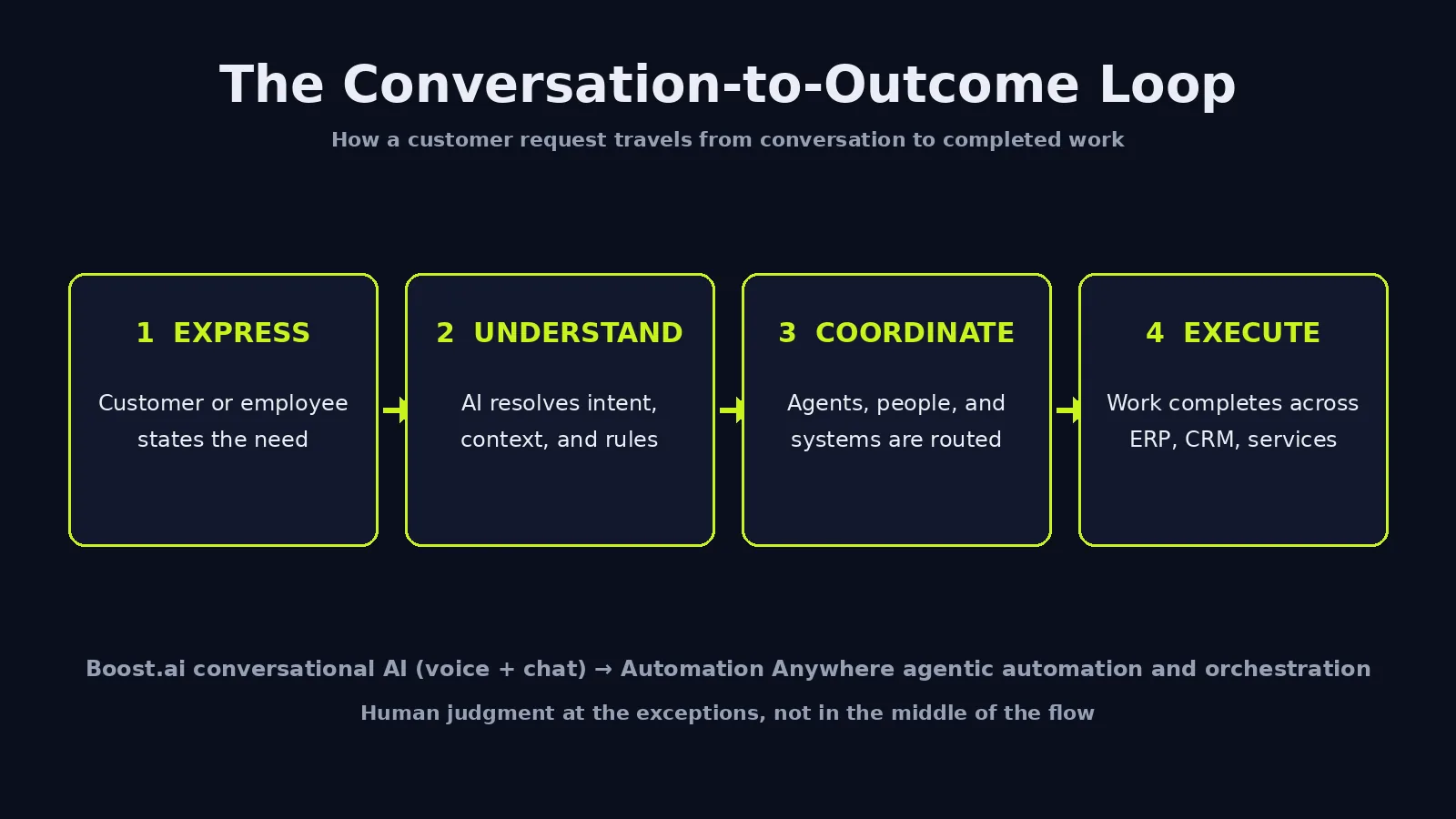
- The combined pitch is the "Conversation-to-Outcome Loop": a customer or employee states what they need, AI understands intent and context, reasons within company rules, coordinates agents, people, and systems — and executes across ERP, CRM, and other enterprise applications.
- Automation Anywhere's momentum: AI bookings are nearly 70% of new and upsell bookings over the past six quarters; agentic AI executions grew 5x in a year; the company now delivers nearly half a billion agent and automation executions annually.
Why this deal happened now
The enterprise AI market has spent two years installing copilots and pilots. The announcements that keep landing — OpenAI's always-on agents, Google Cloud's Gemini agent for work, ServiceNow's AI Workflow Factory — all point at the same gap: companies can now generate answers everywhere, but execution still lives in disconnected systems. Automation Anywhere is betting that the next buying cycle goes to whoever closes the gap between the conversation and the outcome.
Boost.ai fills the missing front end. Automation Anywhere already had back-office orchestration and, after the Aisera deal, employee-facing knowledge and service. What it lacked was the customer-facing conversational layer — voice and chat AI that can take the initial request in natural language and hand it, with full context, to the automation engine that finishes the job. As Unite.AI's coverage notes, the deal extends the company's "Autonomous Enterprise" model — business functions running up to 80% autonomously or with AI assistance — directly into customer experience.
The timing also matters for regulated industries. Boost.ai's profile is strongest in financial services, telecommunications, and insurance — sectors where governance and compliance decide which vendors get shortlisted. Its security posture (GDPR and HIPAA aligned, SOC 2 report) and four consecutive years on Gartner's Magic Quadrant for Conversational AI Platforms, cited by Destination CRM, make it a plausible bridge into the regulated enterprise, where AI budgets are large and approval gates are brutal.
The "Conversation-to-Outcome Loop," explained
Automation Anywhere's framing deserves a plain-language translation, because the phrase is doing real work here.
The old model: a chatbot resolves the conversation; a separate RPA bot does the back-office work; humans glue the two together with swivel-chair handoffs. Three systems, three owners, and every exception becomes someone's ticket.
The proposed model has four steps:
1. Express — a customer or employee states what they need, in voice or chat.
2. Understand — AI resolves intent and context: who is asking, what the history is, which rules apply.
3. Coordinate — the system reasons within company policy, decides which agents, people, and systems are needed, and brings humans in only where judgment or exceptions require it.
4. Execute — work runs across connected enterprise applications — ERP, CRM, service systems — to deliver the finished outcome.
The key difference from a chatbot is the last two steps. A chatbot optimizes for resolution; the loop optimizes for completion. If the customer's issue needs a billing adjustment in the ERP and a confirmation email, the same system that understood the request should trigger both — or know when to stop and escalate to a person.
What this means for your business
1. Audit your conversational dead ends. Most businesses already have a chatbot or IVR somewhere. Map what happens after the conversation ends — every point where a human re-keys, re-reads, or re-routes is a candidate for a conversation-to-outcome loop. You don't need an acquisition to start: the discipline is noticing where conversations die without producing outcomes.
2. Voice is having an enterprise moment. Boost.ai's voice capabilities reportedly reached a point where enterprise conversations feel natural — and the use cases listed (sales, customer service, outbound calling, field service) are exactly the ones where a phone call is still the primary interface. If your customers still call you, the next automation wave reaches them through voice first, not a web form.
3. Governance is the buying criterion, not the afterthought. Regulated industries keep surfacing as the growth story — Boost.ai's GDPR/HIPAA posture and SOC 2 report are deal infrastructure, not marketing. If you're evaluating any AI vendor for customer-facing work, ask for the compliance documentation before the demo. The vendors that survive procurement are the ones whose security story was built first.
4. Don't buy the platform; buy the outcome. The most useful line in this whole announcement is Automation Anywhere's own thesis: stop measuring agents and start redesigning how work gets done around outcomes. Whether you use their platform or not, that's the right unit of analysis for your AI budget. An agent that answers questions is a cost center. A loop that completes processes is a P&L line.
The open questions
Two caveats before you plan around this. First, the deal hasn't closed — Q4 2026, pending approvals — and integrating a voice/conversational platform into an automation engine is genuinely hard work; the "single offering" pitch will take quarters, not weeks, to prove out, as AI Understanding also notes. Second, financial terms weren't disclosed, so the market can't yet judge what premium was paid for conversational AI. Watch whether competitors respond with their own acquisitions — that's how you know a category is forming rather than a single vendor's story.
The broader signal is clear enough, though. The chatbot era is ending. The question for every business is no longer "can AI talk to our customers?" — it's "when AI talks to our customers, does anything actually get done?" The vendors that answer the second question will own the next budget cycle.
Curious where conversation-to-outcome loops would pay off in your business? Our free AI audit maps exactly that — where conversations stall, what outcomes they should produce, and what automation would cost to deliver them.
Sources
- https://businessnewsthisweek.com/business/conversational-ai-is-finally-connected-to-the-work-automation-anywhere-to-acquire-boostai/businessnewsthisweek.com
- https://www.unite.ai/automation-anywhere-agrees-to-acquire-conversational-ai-firm-boost-ai/unite.ai
- https://www.destinationcrm.com/Articles/ReadArticle.aspx?ArticleID=176924destinationcrm.com
- https://aiunderstanding.org/news/automation-anywhere-agrees-to-acquire-conversational-ai-firm-boost-aiaiunderstanding.org
- https://www.reuters.com/business/google-cloud-introduces-gemini-agent-work-ai-race-heats-up-2026-10-08/reuters.com
- https://www.hpcwire.com/bigdatawire/this-just-in/servicenow-launches-ai-workflow-factory-for-enterprise-automation/hpcwire.com
Want to know what this means for your stack? A free AI audit maps your workflows and shows where automation pays off — in your numbers, not ours.