

On October 7, 2026, OpenAI pushed GPT-6 with an interactive "Intelligent UI" out to hundreds of millions of ChatGPT users — and Anthropic answered the same day by cutting its small model's price by 75%. Two labs, one 24-hour window, one message: the cost of running AI at scale is collapsing.
Key takeaways
- OpenAI rolled out GPT-6 with Intelligent UI starting October 7 to Plus, Pro, Business, and Enterprise users, expanding to Free and Go tiers from October 8. ChatGPT answers can now include interactive charts, forms, buttons, and on-the-fly tools like calculators and bill splitters.
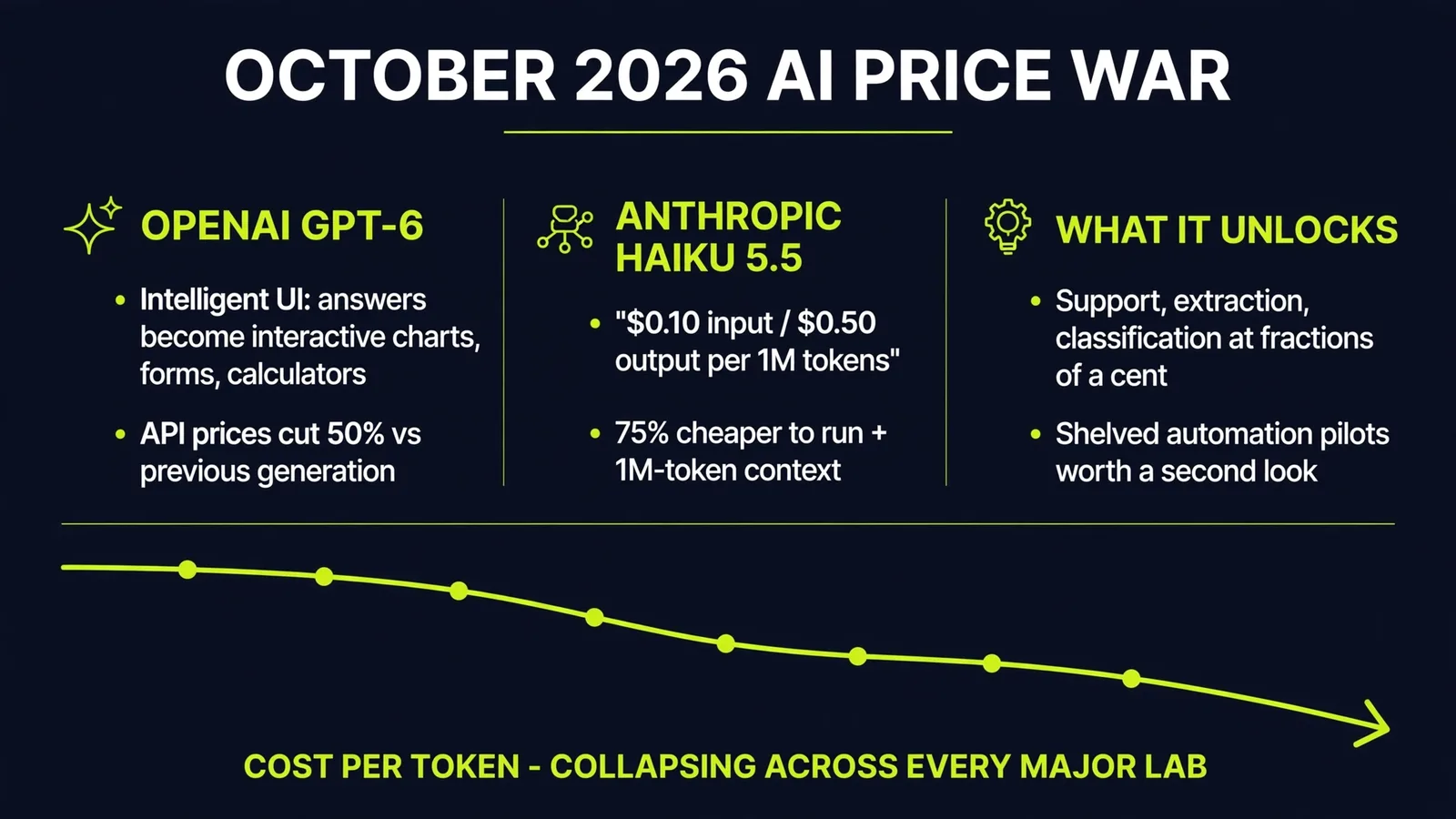
- Anthropic shipped Claude Haiku 5.5 the same day at $0.10 per million input tokens and $0.50 per million output tokens — roughly 75% cheaper to run than its predecessor — with a 1-million-token context window and up to 2.5x faster agentic inference per turn.
- The cuts are structural, not promotional. OpenAI's GPT-6 Sol and Luna APIs sit 50% below the previous generation's pricing; Anthropic's cut passed through efficiency gains in serving. Forrester analysts describe a "prolonged price-performance race" — meaning these prices are unlikely to be walked back.
OpenAI: answers that build their own interfaces
The October 7 rollout changes what a ChatGPT answer can contain. Instead of a wall of text, GPT-6 can now compose responses from text, visuals, charts, buttons, and forms — choosing the format based on the question. A road-trip plan can render on a map. A recipe can carry its cooking timeline alongside it. A comparison question can produce a side-by-side view. The model can even generate small interactive tools on request: a savings calculator, a bill splitter, a quiz.
The mechanism matters for anyone building on these systems. Intelligent UI is built on a library of native, streamable components with a compiler that processes the interface while the model generates it — so interactive elements appear progressively rather than after the full response finishes.
The rollout itself is tiered: paid tiers get GPT-6 Sol, Free and Go tiers get the faster GPT-6 Luna, both tuned for everyday conversation — and the update applies to the Chat experience only (Work and Codex are unchanged). OpenAI claims GPT-6 makes better decisions about when to search the web; those numbers are company-reported, so treat them as directional, not audited.
Why this matters beyond consumers: 1.2 billion people use ChatGPT weekly, per OpenAI's own figure. Whatever interface pattern wins inside ChatGPT becomes the pattern your employees and customers will expect everywhere else.
Anthropic: the volume workhorse gets 75% cheaper
Haiku 5.5 is not a flagship and doesn't pretend to be. Anthropic describes it as its "cheapest, fastest, and most capable small model," aimed at the high-volume workloads that make up the bulk of production AI traffic: classification, summarization, data extraction, customer support, voice agents, and in-app assistants.
The numbers, from Anthropic's release notes: for prompts under 100,000 tokens, input costs $0.10 per million tokens and output $0.50 per million; beyond 100,000 tokens the price steps up to $0.50/$2.50 per million. The context window jumps fivefold to 1 million tokens — a support-ticket classifier that used to choke on long thread histories, or a document-extraction job that had to chunk a 300-page PDF into fragments, can now run on the budget model end to end. Task-completion latency is down more than 30% versus the model it replaces, and agentic inference throughput is up to 2.5x faster per agent turn — a per-turn speedup that compounds fast inside multi-step agent loops.
On safety: in malicious computer-use testing, Haiku 5.5 refused 82.59% of harmful tasks, up from 58.93% on its predecessor — and better than Anthropic's own larger models on the same test. It is also the first Haiku with built-in safeguards against a narrow set of high-risk cybersecurity requests.
One honest caveat from the coverage: the 2.5x speedup and latency figures are company-reported, tied to Anthropic's internal workloads, not independently audited benchmarks. Teams migrating production traffic should run their own load tests before committing.
The unit-economics math businesses actually care about
Zoom out from the model names and look at the arithmetic. For the high-volume tier — the classification, extraction, and support workloads that dominate production token spend — the cost floor just moved dramatically.
Take a support-ticket summary: roughly 2,000 tokens in, 500 tokens out. On Haiku 5.5 pricing, that's about $0.00045 per ticket — under a twentieth of a cent. A pipeline processing a million such tickets a month costs roughly $450 in model fees. That is the order of magnitude to internalize.
The timing is not an accident. Small-model pricing is the deciding factor in high-volume enterprise contracts, and providers know it. OpenAI cut GPT-6 Sol and Luna API prices 50% against the previous generation at launch; Anthropic's three-model 5.5 lineup — Opus for frontier reasoning, Sonnet for general production use, Haiku for volume — only works commercially if the cheap tier is genuinely cheap. The open-weight ecosystem is the backdrop: when a team can self-host a capable open model for the price of compute alone, a hosted API has to justify its premium on price, not just convenience.
The practical consequence: any automation business case that failed on unit economics 6–12 months ago deserves a re-run with today's prices. The spreadsheet changed; the decision built on the old spreadsheet should change with it.
What this means for your business
1. Re-run the ROI math on every shelved automation pilot. If a project died because "the API cost eats the savings," that objection may be gone. Start with the ones that failed on cost alone — the design work is already done, so they are the cheapest to resurrect.
2. Aim automation at the boring, high-volume work first. The pattern is consistent across every lab: frontier models get more capable at the top while budget models get cheaper and gain context length — because that's where production volume actually lives. Classification, summarization, data extraction, support triage, and voice agents are the workloads where a fraction-of-a-cent-per-call difference becomes a real line item.
3. Treat interactive AI answers as an interface strategy, not a gimmick. Intelligent UI points at a bigger shift: instead of employees learning to use software, software built on the fly for the task at hand. The caution is real — the model's design judgment is explicitly unfinished — so keep a human in the approval loop for anything customer-facing.
4. Budget for the pilot, not the model. A 75% cheaper model still costs real money when it retries failed calls or needs a human to clean up its output. The wins come from total workflow cost — model price plus retries plus oversight — which is exactly what a proper pilot measures.
The price war is good news, but it does not plan your automation for you. It just lowered the bar on the business case — the execution still decides whether you clear it.
Want to know where the new prices change your numbers? Our free AI audit maps your workflows to the automation opportunities the October pricing actually unlocks — which processes to automate first, what the unit economics look like, and where human oversight still pays for itself. It takes a few minutes, and it costs nothing.
Sources
- https://www.unite.ai/openai-brings-gpt-6-with-intelligent-ui-to-all-chatgpt-tiers/unite.ai
- https://www.macrumors.com/2026/10/07/chatgpt-intelligent-ui/macrumors.com
- https://techstartups.com/2026/10/07/openai-launches-gpt-6-with-intelligent-ui-turning-chatgpt-into-an-interactive-visual-experience/techstartups.com
- https://tech-insider.org/anthropic-claude-haiku-5-5-price-cut-2026/tech-insider.org
- https://www.infoworld.com/article/4225637/openai-anthropic-cut-ai-model-costs-as-price-performance-race-intensifies.htmlinfoworld.com
- https://runtimewire.com/article/openai-gpt-6-intelligent-ui-chatgptruntimewire.com
Want to know what this means for your stack? A free AI audit maps your workflows and shows where automation pays off — in your numbers, not ours.