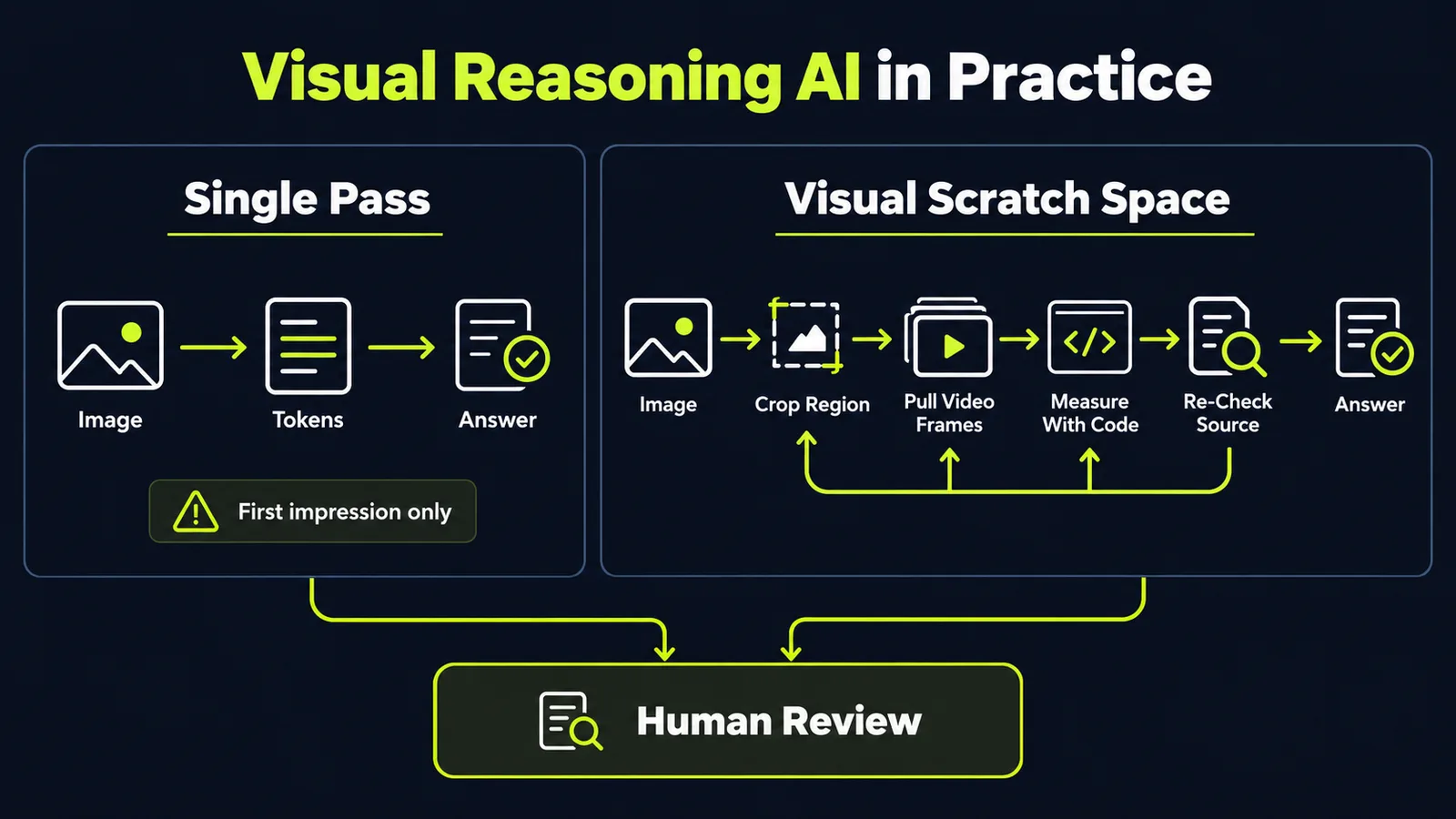
On October 16, 2026, Elorian released Glimpse, its first model, as a research preview with API access. The conventional multimodal approach looks at an image once, converts it into tokens and then reasons about it in text. Glimpse can revisit the source while it reasons: it can crop into a region, pull specific frames from a video, or run code to measure and compare what it is looking at. Elorian calls that loop a "visual scratch space," per Elorian's first AI model wants to reason with images, not just about them. The commercial question is whether repeated visual inspection improves accuracy on real work enough to justify adding or swapping a model — and that question has a testable answer.
Key takeaways
- A second look, built in. Glimpse can revisit the underlying image or video mid-reasoning instead of relying only on its initial visual representation, per Elorian's first AI model wants to reason with images, not just about them.
- The wins are narrow, and company-reported. In Elorian's published evaluations, Glimpse leads GPT-6 Astra on four tests, ties one and trails on six — and none of it has been independently validated in the launch coverage, per Nvidia-Backed Elorian Prices Glimpse 94% Below GPT-6 Astra.
- Listed pricing undercuts the frontier rival. $0.60 per million input tokens and $3 per million output tokens — cheaper than mid-level models, more expensive than lightweight ones, per Elorian's first AI model wants to reason with images, not just about them.
- Research preview means research preview. TechCrunch reports API access with the chat interface waitlist-only, and no independent test was reported in the launch coverage, per Elorian launches Glimpse to give AI a second look at visual evidence.
What actually shipped on October 16
Elorian positions Glimpse as a visual-reasoning model for tasks including chart interpretation, object counting and video-event understanding — particularly where the answer depends on a detail that is easy to miss at first glance. Mid-reasoning, it can zoom into one corner of a chart, watch a short interval at a denser frame rate, or track one feature across time, per Nvidia-Backed Elorian Prices Glimpse 94% Below GPT-6 Astra.
The idea is not entirely new — OpenAI added crop-and-zoom during reasoning to its o-series models in 2025. Elorian's pitch is that it built the whole model around the loop. Elorian says a small team post-trained an open-weights base model on a few hundred GPUs, and describes the result as substantially smaller than the frontier systems in its comparisons, per Elorian's first AI model wants to reason with images, not just about them. Note what that does not mean: an open-weights base is a development detail, not a deployment offer. Glimpse itself is sold through an API, per Nvidia-Backed Elorian Prices Glimpse 94% Below GPT-6 Astra.
Elorian raised a $55 million seed round at a $300 million valuation before launching a product, with participation from Nvidia and Google chief scientist Jeff Dean; its chief executive, Andrew Dai, is a former Google DeepMind researcher, per Elorian's first AI model wants to reason with images, not just about them. The first targets are teams sitting on large volumes of video and images — robotics firms, scientific labs, media and creative companies, per Elorian launches visual reasoning model for enterprise AI market. Direct robot control is a longer-term aim, not part of this release, per Elorian's Glimpse bets image-first reasoning can undercut bigger AI models.
Read the benchmark table like a buyer
Elorian's own figures put Glimpse ahead where close inspection matters most: scientific chart reasoning 92.90 against 92.10 for GPT-6 Astra, short-form video captioning 82.66 against 80.32, open-vocabulary counting 83.36 against 82.02, and manipulation-event understanding 42.70 against 39.42, with both tied on embodied spatial reasoning, per Nvidia-Backed Elorian Prices Glimpse 94% Below GPT-6 Astra. The reported leads are modest in absolute points, in a comparison published by Elorian, and their practical significance is unproven. Two more caveats belong in the same breath: Elorian notes its results use the highest thinking effort and each model's native agent harness, so the scores reflect complete evaluation setups, not weights alone, per Nvidia-Backed Elorian Prices Glimpse 94% Below GPT-6 Astra; and the counting results are mixed — Glimpse trails Astra on product-image counting, per Elorian's Glimpse bets image-first reasoning can undercut bigger AI models.
The same table cuts the other way on breadth. Astra stays ahead on six other evaluations, including scene understanding — 53.6 against 46.36 on a benchmark Elorian built — and a longer-video test, 64.06 against 56.68, per Elorian's Glimpse bets image-first reasoning can undercut bigger AI models. Independent coverage makes the same point: the wins are narrow and company-reported, per Elorian launches Glimpse to give AI a second look at visual evidence.
So read the results as a list of tasks worth testing, not proven deployment strengths. Glimpse leads on scientific chart reasoning, short-form captioning and one counting benchmark, and trails on product-image counting and scene understanding. What no launch table can tell you is how it handles your charts, your labels and your edge cases.
Why a second look matters in real workflows
Visual errors in business automation follow a pattern. A model reads the wrong bar, misses a small total in a table, counts most of the items in a frame, or describes a clip from its opening seconds. The output reads confidently, so the error can land in a report or a customer answer before anyone checks it. Glimpse's inspection tools are designed to address those failure modes — cropping a region before reading the number, pulling more frames before describing the event, measuring with code instead of estimating. Whether they reduce errors on production data remains to be demonstrated; that is what a pilot is for.
On price, separate the listed rates from the cost of a finished task. Elorian lists its token prices 94% below Astra's standard rates, and in one company-reported robot-planning comparison, Glimpse cost $0.035 per episode against $0.249 for Astra, per Nvidia-Backed Elorian Prices Glimpse 94% Below GPT-6 Astra. Neither figure establishes the cost of completing a typical workflow: repeated inspection adds processing steps, and the launch coverage establishes nothing about production latency or throughput. The right comparison is cost per correctly completed task, measured on identical inputs with the same success criteria. Only your own test set separates a cheaper model that needs less correction from one that fails in new ways.
What this means for your business
1. Pilot it on one visual task you can score — and set the thresholds first. Pick a job with a right answer you can check automatically: extracting values from charts, counting items in product images, captioning short clips, or verifying a screenshot against a specification. Compare Glimpse with your current model on a representative set that includes the messy cases, and record accuracy, error severity, latency, total task cost and manual-review effort — not just the headline score. Define what counts as success before you run it; a few hundred items with no acceptance bar is a demo, not an evaluation.
2. Keep the human gate where a visual error becomes a commitment. Start with reversible tasks whose outputs can be checked before they trigger anything downstream. Require human approval where a visual error could cause a material financial, operational or customer-facing consequence — publishing a figure, approving a shipment, telling a customer what a video shows. Repeated inspection may catch errors, but it does not establish reliable interpretation: on Elorian's own scene-understanding test, Glimpse's reported score trails Astra's, per Elorian's Glimpse bets image-first reasoning can undercut bigger AI models.
3. Verify the preview terms before you build on them. Glimpse is an early research preview from a company that shipped its first product this week. The launch coverage does not establish data-retention policies, data-training defaults or private deployment options — all material if you process confidential documents, customer screenshots or proprietary video — so confirm them with the vendor, along with access limits and support. Keep prompts and test sets portable, and keep an alternative model available until the terms and the workload performance are both acceptable.
4. Test re-inspection as a workflow, whatever model you run. Add the second-look discipline to your existing stack: a cropped re-check for small text and numbers, denser frame sampling before a video summary is accepted, and a measurement step for counts and comparisons. Re-inspection is worth testing independently of Glimpse — the available evidence does not show how much of the reported performance comes from the model, its training, or the inspection tools themselves.
Glimpse offers a testable proposition: lower listed prices and competitive results on selected visual benchmarks, from a model designed to inspect evidence repeatedly. Adoption depends on whether that combination delivers fewer costly errors, acceptable latency and lower total task cost on your own workloads. That is a pilot you can run this quarter, with numbers you own.
Want an independent review of which document, media and operations workflows are safe to automate — and where a human must stay in the loop? Get a free AI audit — we'll map your highest-leverage automation opportunities in one session.
Sources
- https://techcrunch.com/2026/10/16/elorians-first-ai-model-wants-to-reason-with-images-not-just-about-them/techcrunch.com
- https://runtimewire.com/article/elorian-glimpse-visual-reasoning-model-launchruntimewire.com
- https://fourweekmba.com/ai-nvidia-backed-elorian-prices-glimpse-94-below-gpt-6-astra/fourweekmba.com
- https://www.cryptopolitan.com/elorians-glimpse-bets-image-first-reasoning-can-undercut-bigger-ai-models/cryptopolitan.com
- https://tradersunion.com/news/companies/show/3851024-elorian-visual-ai-model-enterprise/tradersunion.com
Want to know what this means for your stack? A free AI audit maps your workflows and shows where automation pays off — in your numbers, not ours.