On October 17, 2026, DeepSeek replaced its Flash model in place. DeepSeek-V4.1-Flash-1017 is a post-training update to the September release, served under the same API name at no listed price change, with open weights published the same day. DeepSeek calls it a minor update, yet its own table shows gains on all 11 benchmarks it reports, and its cost chart puts a finished coding task at just under $0.20 — less than half the predecessor's cost. The useful question is whether AI coding agent cost really falls on your workloads, without quality falling with it. That is testable now, because existing API users already have the new model.
Key takeaways
- Same name, new checkpoint. `deepseek-flash` now serves 1017, the calling method is unchanged, and legacy names still route to it at the Flash price, per DeepSeek V4.1 Flash: Price, Specs, and the Rumor Scorecard.
- The saving comes from shorter work, not a price cut. No price change is listed; DeepSeek says the model finishes tasks faster with shorter outputs, per DeepSeek V4.1 Flash: Price, Specs, and the Rumor Scorecard.
- The benchmarks are vendor-reported. No independent run had been published in the launch coverage, per DeepSeek V4.1 Flash 1017: 6 Powerful Facts For Agent Builders - Softtechhub.
- Search and Fetch APIs also launched. They opened at $0.75 per 1,000 calls per endpoint, with a free window for named agent tools ending October 31, 2026, per Deepseek V4.1 Flash 1017 beats larger rivals in agentic tasks while once again massively cutting per-task costs.
What actually shipped on October 17
This is not a new architecture. It is an updated post-training checkpoint of V4.1-Flash, released on October 17, 2026 and served under the same model name, per DeepSeek V4.1 Flash 1017: 6 Powerful Facts For Agent Builders - Softtechhub. It is live on DeepSeek's website, app and API, and the weights were posted to Hugging Face and ModelScope under the MIT licence, which allows commercial use, modification and redistribution, per DeepSeek V4.1-Flash-1017 Explained: Cost, Benchmarks, API.
DeepSeek credits the gains to reinforcement learning with self-feedback: instead of relying only on human raters or a separate reward model, the model's own confidence and self-generated critique supply part of the training signal, a method DeepSeek says it used to improve end-to-end project building, per Deepseek V4.1 Flash 1017 beats larger rivals in agentic tasks while once again massively cutting per-task costs. The checkpoint is tuned for specific agent harnesses — DeepSeek Harness (version 0.2.1-rc.1 or later recommended), Tencent CodeBuddy and WorkBuddy — per the same report. That matters: a harness decides how tool calls are formatted and when an agent stops, so part of the gain may not transfer to a different harness.
One caution belongs with the open weights. The model card lists 763 billion parameters, with weights stored in a mix of FP8 and BF16, so the weights alone run to hundreds of gigabytes; running it yourself is a multi-GPU server job — hardware, throughput and operations included — not a workstation experiment, per DeepSeek V4.1-Flash-1017 Explained: Cost, Benchmarks, API. For most teams the practical route is the hosted API, and the open licence is leverage and an exit option rather than a deployment plan.
Read the benchmark table like a buyer
DeepSeek's own table shows the largest gains exactly where agents work. Terminal-Bench 4.0 rises from 31.2 to 42.3, ProgramBench from 20.3 to 29.1, Automation-Bench from 54.8 to 60.5, and DeepSWE v1.1 — a software-engineering test — from 74.2 to 77.0, with every reported row up between 2.0 and 11.1 points, per DeepSeek V4.1 Flash: Price, Specs, and the Rumor Scorecard. All 11 reported benchmarks rose, and none of the scores has been independently reproduced, per DeepSeek's Flash update claims gains on 11 benchmarks at the same price.
The same table also shows where the update does not lead. Claude Opus 5 stays ahead on Terminal-Bench 4.0 at 51.8 against 42.3, on ProgramBench at 37.0 against 29.1, on NL2Repo-Bench at 75.3 against 68.2, and on a reasoning test without tools at 56.3 against 42.6, per DeepSeek V4.1-Flash-1017 Explained: Cost, Benchmarks, API. So the pattern is specific, not sweeping: on DeepSeek's numbers, the checkpoint leads on the reported software-engineering and workflow rows and trails on terminal-heavy execution, repository reconstruction and raw reasoning. Which rows matter depends on which work your agents actually do.
Why shorter outputs change the bill
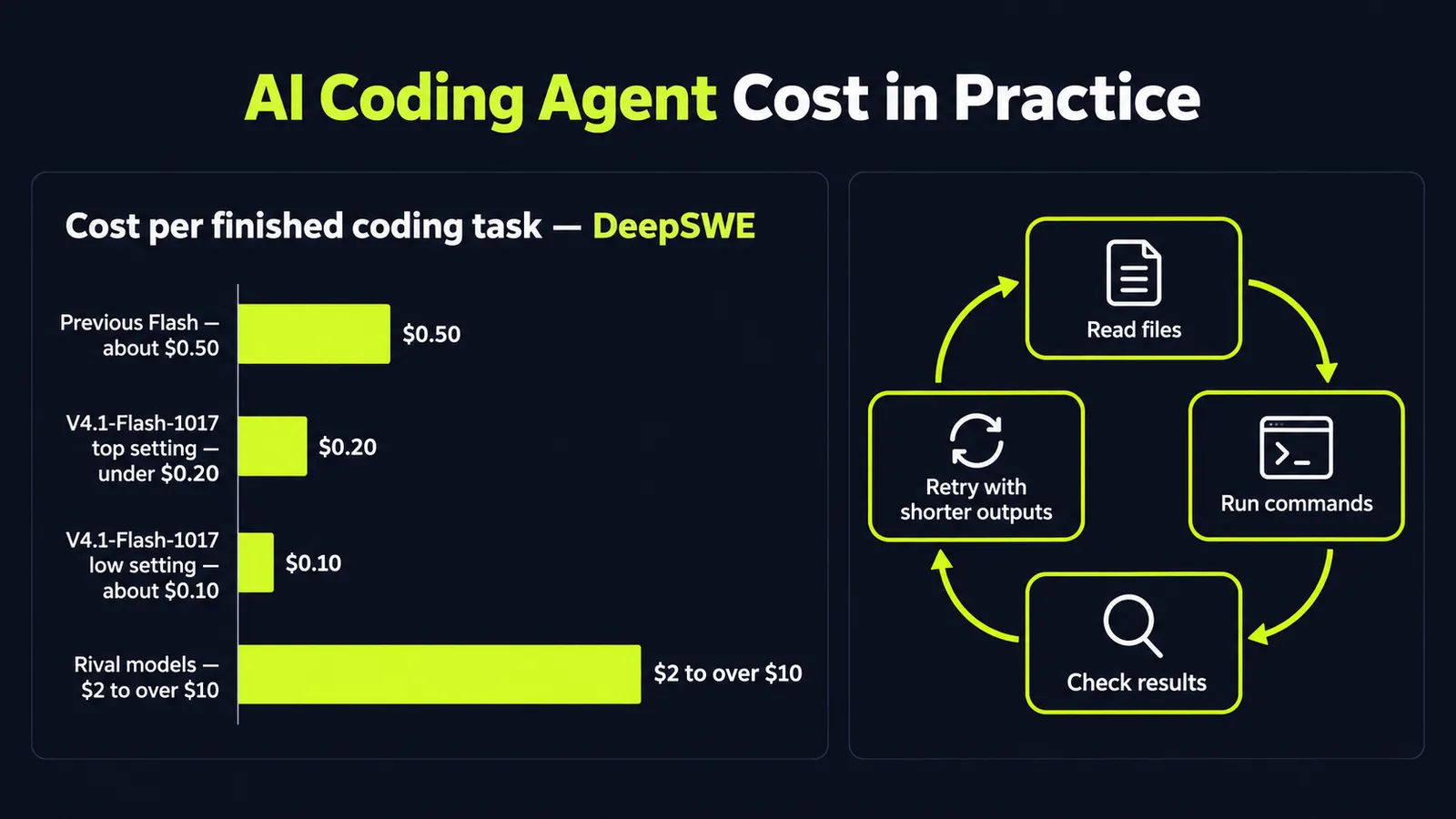
Agent cost is rarely one answer. A coding agent reads files, runs commands, reads the results and tries again, often for many rounds — and output tokens are the expensive part of the bill. DeepSeek lists peak rates of $0.30 per million uncached input tokens, $0.006 per million cached input tokens and $1.20 per million output tokens, with off-peak rates at exactly half, per DeepSeek V4.1-Flash-1017 Explained: Cost, Benchmarks, API. That is why a model can cut cost per task without cutting its price list: fewer, shorter attempts mean fewer expensive output tokens per finished job.
DeepSeek's DeepSWE cost chart makes the claim concrete. At its top setting, the 1017 checkpoint scores 77.0 percent at an average cost of just under $0.20 per task; at a lower setting it still clears 72 percent for about $0.10, while the predecessor scored 74.2 percent at around $0.50 per run and rival models in the same chart land between $2 and more than $10 per task, per Deepseek V4.1 Flash 1017 beats larger rivals in agentic tasks while once again massively cutting per-task costs. Treat those figures as chart readings from one harness, not a rate card: your cost will move with project size, cache hit rates and retry counts.
The second half of the release changes agent architecture, not just model price. Search returns structured results from DeepSeek's own search engine and Fetch turns a single page into Markdown; each costs $0.75 per 1,000 successful calls, and failed or empty calls are not billed, per DeepSeek V4.1-Flash-1017 Explained: Cost, Benchmarks, API. Calls through server-side tools in DeepSeek Harness, Claude Code and Codex are free until 16:00 UTC on October 31, 2026, per DeepSeek V4.1 Flash: Price, Specs, and the Rumor Scorecard. That free window is a deadline, not a discount: an agent that searches on every step can build real volume before billing starts, so instrument call counts now.
What this means for your business
1. Re-run your evaluation — the model under your existing name already changed. If you call `deepseek-flash`, you are already on the new checkpoint, and a September evaluation no longer describes what you are paying for. Re-test prompts and parsers on your own tasks, record the checkpoint, harness and configuration behind each run, and compare accuracy, retries, output length, human review and cost per correctly finished task — not cost per token.
2. Route by workload, not by headline. On the vendor's table, this checkpoint suits repository-level fixes and workflow automation, and is weaker where terminal execution or deep reasoning decides the result. Keep a stronger model for review and the hard rows, and measure whether routing still saves money after review and rework.
3. Do the governance check before the volume check. Open weights do not settle data handling on the hosted API, retention and training defaults, or whether your code and customer data may travel to that API at all. Confirm those terms in writing first, treat retrieved web content as untrusted input, and keep a second model wired in so a policy change is a configuration change, not an outage.
4. Model the Search and Fetch bill before the free window ends. Log calls per completed task during the free period, set a budget alert, and test whether retrieval actually raises your success rate. Retrieval that does not improve outcomes is a cost, however cheap each call is.
The release makes one proposition worth testing: a model that says less, finishes sooner and, on its maker's tests, scores higher — at an unchanged token price. Whether AI coding agent cost falls in your operation depends on your tasks, your harness and your retry rates, and all three are measurable within a week.
Want an independent review of where coding agents and workflow automation will actually cut cost in your operation — and where a stronger model or a human must stay in charge? Get a free AI audit — we'll map your highest-leverage automation opportunities in one session.
Sources
- https://the-decoder.com/deepseek-v4-1-flash-1017-beats-larger-rivals-in-agentic-tasks-while-once-again-massively-cutting-per-task-costs/the-decoder.com
- https://cellcog.ai/blog/deepseek-v4-1-flash-release-date/cellcog.ai
- https://savedelete.com/article/deepseek-flash-1017-agent-costs/savedelete.com
- https://softtechhub.us/2026/10/17/deepseek-v41-flash-1017/softtechhub.us
- https://www.techi.com/deepseek-v4-1-flash-1017-update-benchmarks-price/techi.com
Want to know what this means for your stack? A free AI audit maps your workflows and shows where automation pays off — in your numbers, not ours.