

On Sunday, October 18, 2026, World — the iris-scanning identity project co-founded by Sam Altman — announced World ID for banking and finance, its first industry-specific offering. For automation teams, the relevant component is World ID for Agents, also described as AgentKit: a verified person can delegate identity credentials, called Proofs, to an AI agent, and the agent can present those Proofs to a website or service without revealing the person's underlying information. AgentKit remains in beta. The launch packages its delegated-credential model for financial services alongside a newly generally available video-call verification tool — without naming a bank customer or publishing pricing.
Key takeaways
- The bundle has three parts. An identity wallet app, a video-call check that has just become generally available, and agent credentials that remain in beta, per World Pitches Banks a Bundle of Human-Verification Tools to Counter Deepfakes.
- A delegated Proof establishes a verified-human connection — not transaction permission. The agent presents the Proof without exposing personal information; whether it can bind a specific payment or approval is not established in the launch coverage, per PYMNTS | Sam Altman's World Debuts ID Verification for AI Agents.
- Adoption evidence is thin so far. World named design partners to explore uses, but did not identify a bank using the suite, and gave no pricing, per World Pitches Banks a Bundle of Human-Verification Tools to Counter Deepfakes.
- Consumer willingness varies by task. Research cited at the launch found 56% of consumers would let an agent search and compare products, but only 35% would give it access to saved payment credentials, per PYMNTS | Sam Altman's World Debuts ID Verification for AI Agents.
What actually shipped on October 18
World is packaging three existing products into one offering for banks and financial firms, and describes it as the first time it has aimed World ID at a single industry, per World Pitches Banks a Bundle of Human-Verification Tools to Counter Deepfakes. Co-founder Alex Blania unveiled the suite at the Money20/20 conference, per World ID Launches Banking Suite to Fight AI Fraud.
The first part is the World ID app, an identity wallet where people store and present Proofs — credentials covering, in World's terms, proof of human, presence and attributes. The second is World ID for Zoom, now generally available in the Zoom App Marketplace after a limited beta that began in April: following a one-time verification at World's Orb device, a participant can authenticate before or during a call with a live selfie, and the check compares the Orb image with the selfie and the meeting video, per World Pitches Banks a Bundle of Human-Verification Tools to Counter Deepfakes. A verified participant displays a badge, and the company says the meeting platform receives no personal information, per World ID Launches Banking Suite to Fight AI Fraud.
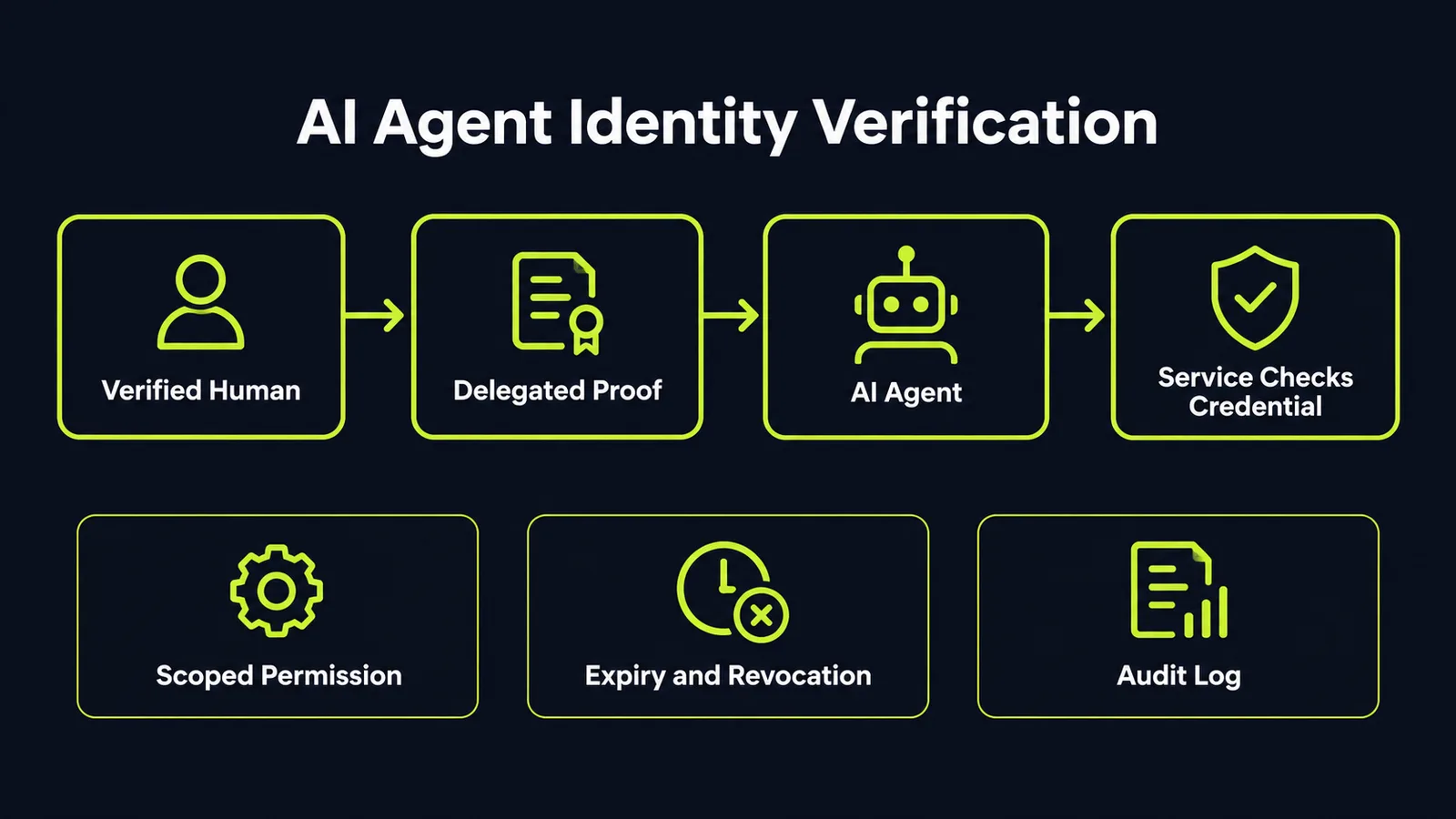
The third part is the one that matters for automation. World ID for Agents is the tool launched as AgentKit with a partner in March and widened in June, and it is still in beta, per World Pitches Banks a Bundle of Human-Verification Tools to Counter Deepfakes. One report compares the delegation arrangement to a power of attorney; the supported technical claim is narrower — an agent can present delegated Proofs without exposing the person's underlying information, per World ID Suite for Banks Launches Verification Tools. World says more than 18 million people hold its Proof of Human credential — a company-reported holder count, which is not the same as active coverage at the services an agent needs to enter, per World ID Suite for Banks Launches Verification Tools.
Agent identity adds another authorization check
Payment systems are good at asking whether a transaction should be authorized. Agentic commerce inserts a prior question, as PYMNTS put it in coverage the launch reporting draws on: not "should this transaction be authorized," but "was this machine authorized to make this decision?", per PYMNTS | Sam Altman's World Debuts ID Verification for AI Agents. World's pitch follows directly from that question: "For a merchant or financial institution, that offers a way to distinguish an AI agent connected to a verified human from anonymous automated traffic that some sites are now blocking," the company said in its release, per the same report.
Hold the distinction precisely, because the launch coverage supports only half of it. A Proof can establish that an agent is connected to a verified human. The coverage does not establish that a Proof can bind a specific transaction — an amount, a recipient, an approval — or how a delegated Proof is expired, revoked or rotated if an agent is compromised, or what evidence a business can retain when an agent's action is disputed. Identity and authorization are separate problems, and this launch addresses the first.
The pressure behind it is still real. Some services have restricted automated-agent access, and litigation over an agent's right to act on a user's behalf is already on record, per World ID Suite for Banks Launches Verification Tools. A competing infrastructure vendor launched its own agent identity product and an agent wallet in August, per the same report — so World is not defining this category alone. Expect the pattern identity systems always follow: several credential schemes launch, enterprises refuse to bet on one, and the winners are decided by which services actually check the credential at the door.
The Zoom integration addresses video-call impersonation, and it has a hard case behind it. World pointed to a 2024 incident in which an employee at engineering firm Arup transferred $25.6 million after joining a video call in which every other participant was a deepfake, per World ID Launches Banking Suite to Fight AI Fraud. Whatever you think of iris scanning, "the person on this call was verified as a live human at call time" is a control most finance teams currently do not have.
The limits are part of the story
Three gaps should keep any buyer cautious. First, status: the agent toolkit is in beta, the Zoom check has only just left beta, and the announcement named design partners — Bain Capital, Pantera Capital, VanEck Funds, OpenExchange and Outtake — to explore uses; World did not identify a bank using the suite in production, and it gave no pricing, per World ID Launches Banking Suite to Fight AI Fraud. Second, reach: a credential only works where people hold it and where services check it, and a holder count establishes neither. Third, the underlying biometric model carries regulatory baggage: authorities in several markets have restricted or suspended World's operations or its biometric data collection in recent years, per World ID Suite for Banks Launches Verification Tools. Any enterprise adopting an identity layer has to price in the chance that the layer itself becomes a compliance project.
None of that makes the launch noise. It makes it an early, checkable claim: agent identity will be a product category, the credential will be delegated rather than shared, and verification will be asked for at transaction time. The open questions are whose credential, checked by whom, and with what liability when a verified agent still does the wrong thing.
What this means for your business
1. Inventory agent traffic in both directions. List the agents your team runs that touch money, customer data or third-party services, and separately list where outside agents arrive at your own properties — checkout, support, account recovery. Most businesses can name neither list today. Identity controls attach to specific flows; you cannot scope them to an inventory you do not have.
2. Interrogate delegation before you adopt it. Before adopting delegated Proofs from any vendor, verify whether permissions can be restricted by action, limited in time and revoked, whether the credential binds a specific transaction or only a human association, and whether the resulting authorization evidence is auditable. Those answers — not the holder count — decide whether an identity layer reduces your risk or just relabels it.
3. Add an independent approval step to consequential calls. The deepfake payment case was not a systems failure; it was a trust failure on a video call. For large transfers, bank-detail changes and account recovery, require an approval step independent of the call itself — and do not let a verified meeting participant automatically count as approval for a financial transaction. A call-back procedure you control works today; verified-participant badges can strengthen it later.
4. Do not rebuild your stack on a beta credential. Pilot AI agent identity verification where it is cheap to test — one storefront check, one support flow — and keep human approval on money movement until a credential scheme shows production adoption, published pricing and a liability model. The category is real; the standard is not settled.
For businesses deploying transactional agents, the practical requirement is evidence of both things: a verified human behind the agent, and the actions that agent was permitted to perform. World has shipped a proposed identity layer for the first. The second remains an engineering problem — and it is the one your own automation design has to solve either way.
Want an independent review of where AI agents can safely act in your operation — and where identity, approval and audit controls need to come first? Get a free AI audit — we'll map your highest-leverage automation opportunities in one session.
Sources
- https://www.pymnts.com/news/artificial-intelligence/2026/sam-altmans-world-debuts-id-verification-for-ai-agents/pymnts.com
- https://unchainedcrypto.com/world-pitches-banks-a-bundle-of-human-verification-tools-to-counter-deepfakes/unchainedcrypto.com
- https://en.cryptonomist.ch/2026/10/19/world-id-suite-banks/en.cryptonomist.ch
- https://coincentral.com/world-id-launches-banking-suite-to-fight-ai-fraud/coincentral.com
Want to know what this means for your stack? A free AI audit maps your workflows and shows where automation pays off — in your numbers, not ours.