

On Monday, October 19, 2026, Cloudflare released a preview of Clairic on Workers AI — an AI data extraction model that does not generate free-form responses. You send it text and up to four images, plus a map of typed fields you want filled, and it returns typed values for those fields: a number, a date, a duration, a list, an estimate, a forecast. It generates no output tokens, so there are no output tokens to bill. For teams paying a frontier language model to pull totals and dates out of invoices, emails, and tickets, that is a purpose-built alternative for the extraction step — and a reason to ask which steps of a pipeline actually need generation at all.
Key takeaways
- Clairic is built for one job. It extracts, computes, estimates, and forecasts typed values from unstructured input, priced at $0.10 per million input tokens with no output charge, per Cloudflare Releases Clairic, Its First System One Extraction Model.
- Scalar answers carry their own doubt. Each scalar field returns a confidence score and a probability that the value is missing, estimates and forecasts return uncertainty intervals, and a field the model determines is absent can return null instead of a plausible guess, per Introducing Clairic, a new System One class of extraction models.
- The speed and cost numbers are the vendor's own. In Cloudflare's claims pipeline test, a cascade using Clairic cost 49% less and ran about 3.2 times faster than the same pipeline run entirely on a language model, per Cloudflare's Clairic model cuts AI pipeline cost 49% in its own test.
- An independent test found a real accuracy gap. On hard extraction items, Clairic answered 82% of text fields correctly against 95% for Haiku 5.5, with arithmetic, unit conversion, and counting as the main failure modes, per Clairic against Haiku 5.5 on extraction.
What an AI data extraction model actually does
The mechanics are simple, and they are the point. A request pairs a `state` — the text to read, plus up to four optional images — with named fields, each given a type and optional plain-language instructions. Supported types cover text spans, numbers, dates, times, durations, lists, estimates, and forecasts, and the model answers the fields in one parallel forward pass — 0.46 seconds for the extraction step in Cloudflare's example workflow — splitting them across parallel passes and merging the answers when they do not fit beside the input in a single pass, per Cloudflare Releases Clairic, Its First System One Extraction Model. The documented context window is 65,536 tokens, and because the model generates no output tokens, billing covers input only, per the same report.
Three design choices matter more than the price. First, extracted text comes back as a span with character offsets, so an answer can be traced to where it appeared in the source instead of trusted on faith. Second, estimates return a distribution inside bounds you declare — a median and an 80% interval — rather than a single confident-looking number. Third, a field the input does not determine returns null, with a separate `guess` showing what the model would otherwise have picked, per Introducing Clairic, a new System One class of extraction models.
Cloudflare's worked example shows the range. From a short support email, Clairic computed a $701.10 total from a stated $649.00 price plus $52.10 tax, derived 11 days between a delivery date and the message date, listed two kinds of damage as exact spans, and returned null for a tracking number the email never contained, per Cloudflare Releases Clairic, Its First System One Extraction Model. Cloudflare places Clairic alongside its earlier decision model, which chooses among listed options: extraction turns raw input into typed values, a decision model turns values into a choice, and a language model turns the choice into words, per Introducing Clairic, a new System One class of extraction models.
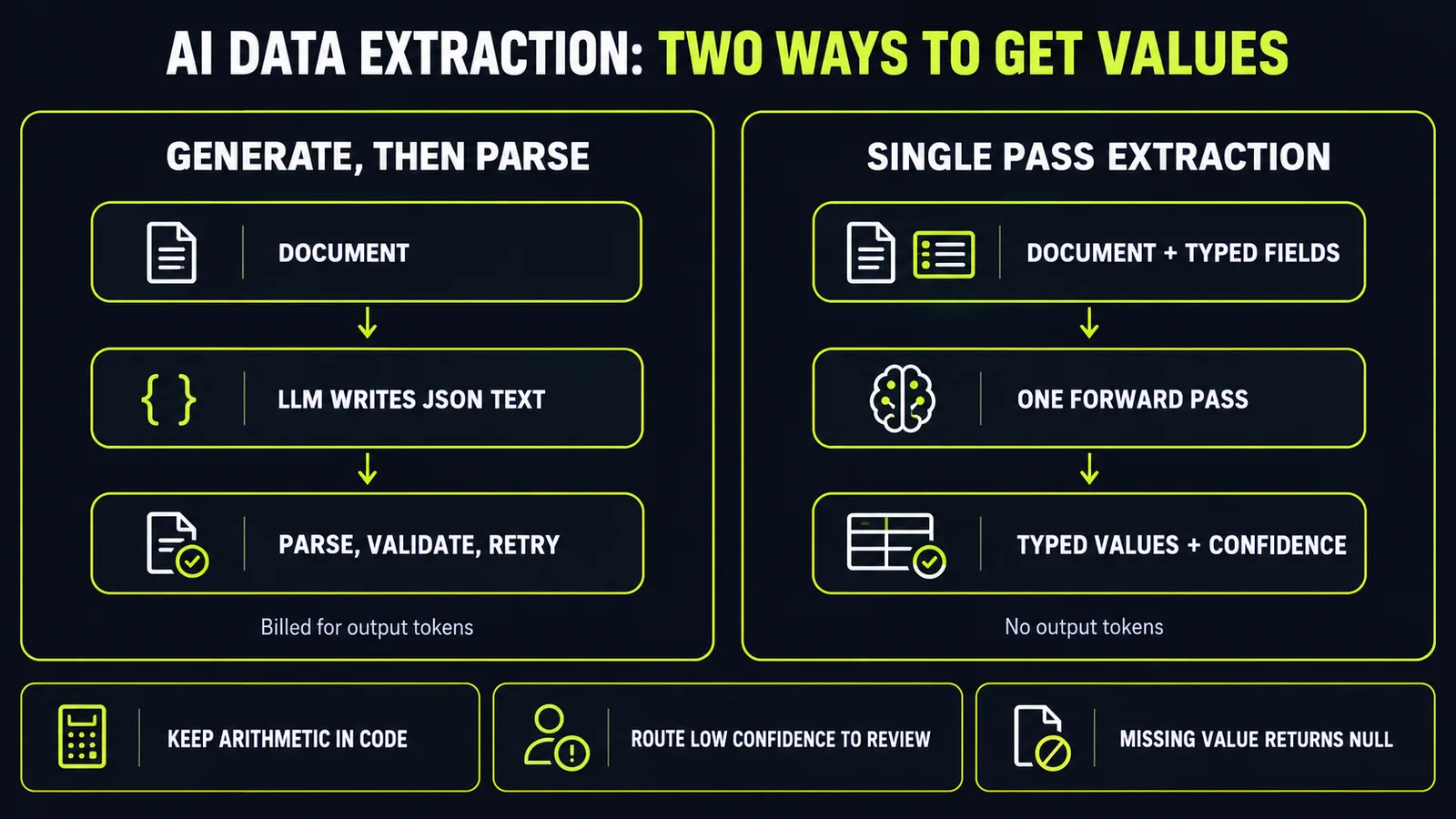
Cloudflare's pipeline test: lower cost, narrower evidence
The headline comparison is a damaged-product claims workflow. In Cloudflare's version, Clairic extracted the values and estimated a repair cost, a decision model chose between refund and repair, and a language model wrote the reply. The comparison version used that language model for all three steps. The cascade finished in 19.3 seconds against 61.7 seconds and cost $6,032 per million claims against $11,740 — 49% less — with the extraction and decision steps together taking 0.68 seconds against 38 seconds for the language model on the same two steps, per Cloudflare's Clairic model cuts AI pipeline cost 49% in its own test.
Read that result with the right weight. It is one workflow, run by the vendor, and the announcement supports its broad "higher accuracy" claim with worked examples and this single pipeline comparison rather than a general benchmark, per Cloudflare's Clairic model cuts AI pipeline cost 49% in its own test. The structural point still holds even if your numbers land lower: in the cascade, almost all remaining time was the language model writing the reply. Extraction was never the step that needed generation. It was billed as if it did.
The forecasting claim deserves the same discipline. Across a 21-day test on a public daily screening-count series, Cloudflare reports forecasts off by 3.3% on average, with 17 of 21 actual counts landing inside the model's 80% interval — and the misses clustered around a holiday weekend the series itself did not signal, per Cloudflare Releases Clairic, Its First System One Extraction Model. That is a credible basic forecaster — about 81% coverage in this sample is what a calibrated 80% interval should produce, not proof it will hold on a different series. It is not evidence for planning around events the input cannot show.
A small independent test reports lower accuracy
A same-day independent comparison ran Clairic against Haiku 5.5 on 25 deliberately hard text items and 8 images of receipts and tables, scoring 38 scalar fields across the text items and 27 fields across the images — totals needing arithmetic, a weight needing unit conversion, fields that should return null, and misspelled names on images. Clairic got 31 of 38 scalar text fields right, against 36 for the language model, and 24 of 27 image fields against a perfect score, per Clairic against Haiku 5.5 on extraction. Its median call took 0.4 seconds, and at about $0.00002 per text item against about $0.0001, it cost roughly a quarter as much per extraction, per the same test.
The misses are instructive because they cluster exactly where a one-pass model should struggle. It returned a total of 387.58 where the correct figure was 380.45, converted a weight incorrectly, counted 18 days where the answer was 17, and returned zero for a discount that was absent instead of returning null, per Clairic against Haiku 5.5 on extraction. Confidence scores flagged some errors — four of its seven wrong text answers came back with low confidence — but two wrong answers came back confident, so a threshold catches part of the problem, not all of it, per the same test. The tester is explicit that the set is small and leans on arithmetic, and that on plain reads straight off the text Clairic did well, per Clairic against Haiku 5.5 on extraction.
Cloudflare, to its credit, says much of this itself. One- and two-step arithmetic seems reliable, but longer chains and aggregation across many table rows are hard for a one-pass model with no scratchpad, so users should let code do the math; calibration is measured rather than guaranteed, intervals can run narrow on unfamiliar data, and forecasting is basic rather than a substitute for a dedicated time-series model, per Cloudflare Releases Clairic, Its First System One Extraction Model. Cloudflare's own caution is the sentence to keep: the architecture makes every answer well formed, not necessarily correct.
What this means for your business
1. Inventory your extraction calls before you buy anything. List every workflow where a language model is paid, per document, to return a total, a date, an order number, or a status as structured output — invoice intake, ticket triage, claims intake, lead scoring inputs. Those calls are the candidates. Anything where the model must explain, negotiate, or write stays on the language model.
2. Keep arithmetic in code. The consistent weakness, in both the vendor's limitations and the independent test, is multi-step calculation and conversion. Extract the raw values with the fast model, then compute totals, tax, and date differences in deterministic code you can unit-test. That split gets the speed without importing the weakest link. Preserve the difference between a missing value and a real zero while you do it: an absent discount recorded as 0 is a data error that downstream code will treat as fact.
3. Route by confidence, and prove the threshold on your own documents. Price the comparison per correctly processed document — model charges plus retries, escalation calls, and human review — not per token. Confidence and missing-value probability are only useful if a threshold sends low-scoring fields to a person or a second model. Build a small labeled set from your real invoices and emails — a few hundred fields with known answers — and measure accuracy above and below any threshold before automating either side of it. Vendor examples and a 33-item public test are starting points, not your error rate.
4. Check what you are allowed to send. Invoices, customer emails, and support tickets carry personal and financial data. Before routing production documents to any hosted extraction endpoint, verify the data-handling, retention, and access-control terms your compliance position requires. The pilot is cheap; a data-handling surprise is not.
5. Treat this as a preview, because it is one. Clairic is an early checkpoint on a hosted endpoint, offered in preview, with an open-weights release intended but not dated, per Cloudflare Releases Clairic, Its First System One Extraction Model. Pilot it behind an interface you control, so the extraction step can be swapped when the model changes — or when a competitor's version tests better on your set.
The larger shift is worth naming plainly. A growing share of business automation spend goes to models generating text that no human will ever read, only to have software parse it back into values. An AI data extraction model removes the generated-text parsing from that step: values in, values out, with the doubt attached — though it does not remove the need for validation. The savings are real but secondary. The primary gain is an extraction step you can audit field by field — provided you test it like a component, not a headline.
Want an independent review of where typed extraction, decision models, and language models each belong in your operation? Get a free AI audit — we'll map your highest-leverage automation opportunities in one session.
Sources
- https://blog.cloudflare.com/clairic-extraction-model/blog.cloudflare.com
- https://www.unite.ai/cloudflare-releases-clairic-its-first-system-one-extraction-model/unite.ai
- https://ppc.land/cloudflares-clairic-model-cuts-ai-pipeline-cost-49-in-its-own-test/ppc.land
- https://muninn.austegard.com/blog/clairic-vs-haiku.htmlmuninn.austegard.com
Want to know what this means for your stack? A free AI audit maps your workflows and shows where automation pays off — in your numbers, not ours.