Within roughly 36 hours, two of the biggest AI labs announced API pricing changes — and a third raised prices for one common workload. Anthropic cut cache-read pricing on Claude Opus 5.5 by 60% and trimmed input and output rates by 20%; OpenAI shipped GPT-6 Sol and Luna at half the cost of the GPT-5.6 series, with 90% off cached-input reads. xAI, meanwhile, kept Grok 4.7's headline price flat while doubling every rate once a prompt crosses 200,000 tokens. (Weekly AI Dev News Digest: September 19–25, 2026)
The sticker prices are falling. Your actual bill may move either way. In AI automation, the invoice is determined less by the price list than by how the system is built.
What changed this week
Reported pricing changes include:
Anthropic — Claude Opus 5.5, released September 22. Input tokens run $4 per million and output $20 per million, down 20% from Opus 5's $5 and $25. The line that moved furthest is cache reads: $0.50 down to $0.20 per million tokens, a 60% cut. Anthropic reports output over 30% faster and about 40% lower cost on typical workloads at default settings. (Anthropic Launches Claude Opus 5.5 With Lower Prices and Faster Output)
OpenAI — GPT-6 Sol and Luna, released September 22. Sol costs $2 per million input tokens and $10 per million output tokens — half the GPT-5.6 Sol rates of $4 and $20. Luna costs $0.10 input and $0.50 output, down from $0.20 and $1.20. Cached-input reads get a 90% discount, and developers can now adjust reasoning effort or tool availability without flushing cached context. (What Are GPT-6 Sol and Luna?)
xAI — Grok 4.7, released September 21. Headline price unchanged at $2 input / $6 output per million tokens. But prompts over 200,000 tokens are billed at double — $4 input / $12 output, cached input doubling from $0.50 to $1 — with the whole request at the higher tier once crossed. (Grok 4.7 API Pricing: Model Rates, Billing Rules, and Monthly Costs)
Two caveats before anyone re-budgets. First, OpenAI's "50% cheaper" is measured against GPT-5.6's promotional pricing, not the standard list price — compare it against what you actually paid. (OpenAI GPT-6 Sol and Luna Cut API Prices in Half) Second, Anthropic's "40% less on typical workloads" comes with the quiet footnote that the default effort setting moved from high to medium in the same release — some of that headline saving is a dial turned down, not cheaper compute. (Opus 5.5 is a cost story, not a leaderboard story)
The real bill is not the sticker price
Three mechanisms decide what you actually pay, and none of them is on the price list:
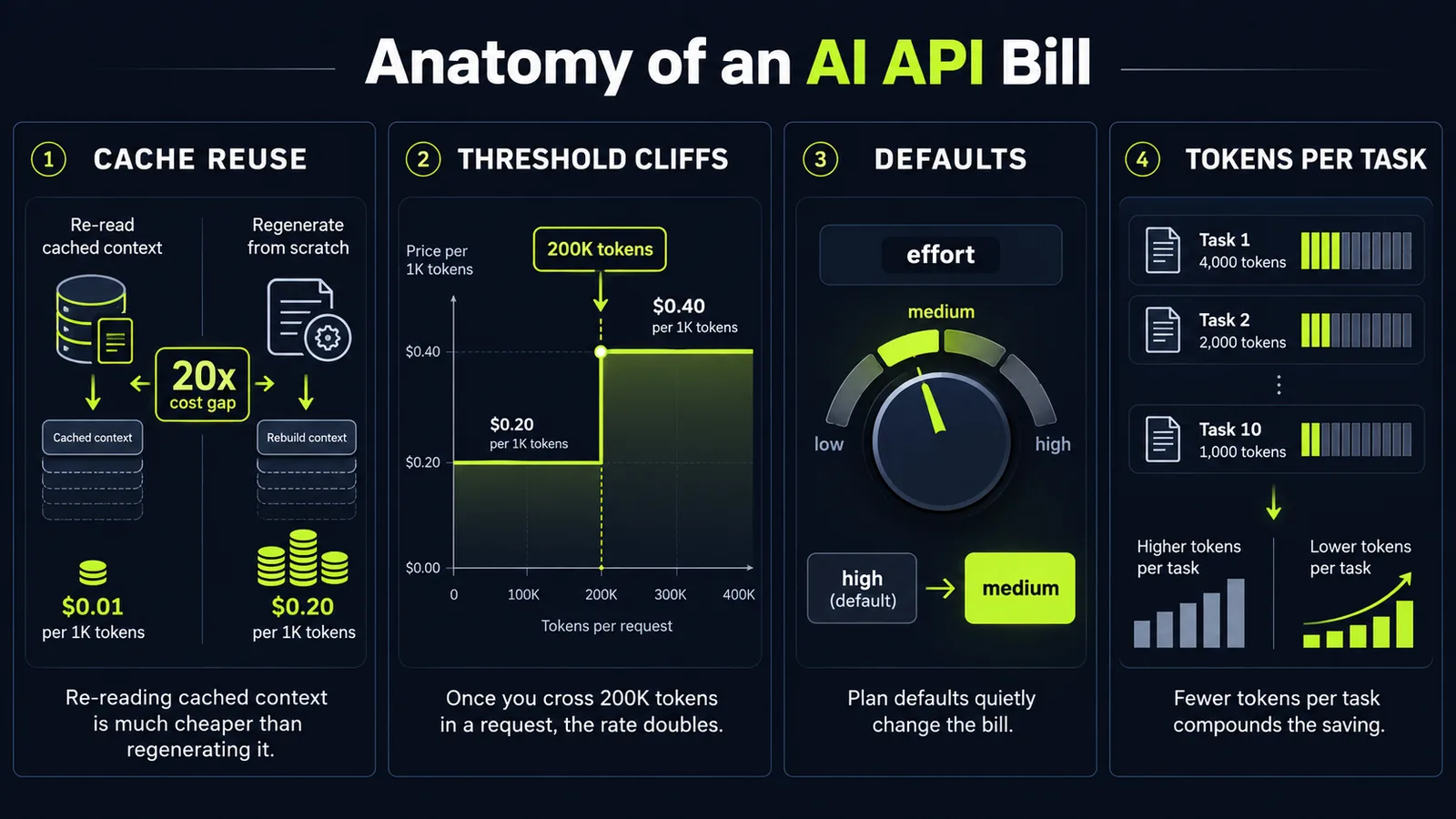
1. Cache reuse can dominate the invoice. Anthropic says cache reads constitute the majority of costs for agentic and coding workloads. At Opus 5.5's rates, a fresh input token costs $4 per million while a cache read costs $0.20 — a 20x gap. An agent that rebuilds its context on every turn pays full freight; one that keeps stable system prompts, tool definitions, and reference material cached pays a fraction. (Anthropic Ties Claude Opus 5.5 Pricing to Longer Coding Sessions)
2. Threshold cliffs raise long-context costs. xAI's 200,000-token line is per request: one oversized document search tips the entire request to 2x pricing. OpenAI has a similar split — Sol bills $2/$10 below 272K input tokens and $4/$15 above it. (Grok 4.7 Costs the Same as 4.6. What Actually Changed)
3. The defaults are part of the price. The effort-dial change on Opus 5.5 is one example. Another: Claude Code made Opus the default on Pro and Team plans and raised the five-hour limits — the price cut gets spent on volume rather than returned to you.
Why the labs are diverging
Lower API prices change the economics of applications that generate large token volumes. Providers appear to be competing for the workloads where usage frequency and operational fit matter. Meanwhile, xAI's 2x tier prices the cost of serving 500,000-token contexts: long context is genuinely expensive compute.
As generation costs decline, engineering decisions around context management, retrieval, caching, and orchestration become larger parts of the application cost model — which is why both price-cutters aimed their deepest discounts at cache reads. GitHub Copilot adding Grok 4.7 on usage-based billing at provider list prices shows where the coding-assistant money is flowing. (Weekly AI Dev News Digest: September 19–25, 2026)
What this means for your business
1. Measure cost per task before you optimize anything. Run a few hundred real requests and log cost per completed task, cache-hit rate, and the share of prompts crossing the surcharge threshold. Then set a stop rule in code — pause the job when it trips your budget threshold (one published playbook uses 30% over estimate as the tripwire). (Grok 4.7 API Pricing)
2. Design for cache reuse — it is now the biggest lever on the bill. Stable system prompts, tool definitions, and reference documents; preserve cached segments across turns; adjust effort and tools without flushing the cache. The 20x gap between fresh and cached tokens means architecture choices now outweigh model choice on most agentic workloads.
3. Watch the cliffs, and route around them. If your workload routinely crosses 200,000 tokens, compare providers before committing: xAI's above-threshold cached rate of $1.00 per million is five times Anthropic's flat $0.20. Chunk documents, cap retrieval size, and keep prompts under the surcharge tier — or route long-context work to the provider where the tier structure favors it.
4. Budget on your numbers, not the list. Model the total operating cost: tokens, tool calls, monitoring, and human review time. Token price is one line of that worksheet, and this week proved it is the least stable line. Build on provider-neutral logging and routing, so the next pricing change — or a better model — doesn't require a rewrite. And remember that the cheapest token is not always the cheapest workflow: a cheaper model that needs more retries, or more human review of uncertain outputs, can cost more per successful task.
5. Re-run the ROI math on the pilots you shelved. A 40–60% drop in workload cost changes the payback calculation on automations that were marginal last quarter. Projects previously limited by inference cost deserve a re-evaluation against current pricing and your measured workload numbers.
As model prices change, more engineering attention shifts toward context management, orchestration, evaluation, and workflow design — the parts of the stack you design, not the parts you buy by the token.
If you want a grounded assessment of where agentic automation actually pays for itself in your operations — and where it does not — start with a free AI audit: we will map your workflows, find the highest-ROI targets, and tell you honestly which ones are not worth touching yet.
Sources
- Weekly AI Dev News Digest: September 19-25, 2026everydev.ai
- Anthropic Launches Claude Opus 5.5 With Lower Prices and Faster Outputtechrepublic.com
- What Are GPT-6 Sol and Luna? OpenAI's New Coding Model and Price Cuts Explaineddevx.com
- OpenAI GPT-6 Sol and Luna Cut API Prices in Halfsqmagazine.co.uk
- Opus 5.5 is a cost story, not a leaderboard storytailabs.ai
- Anthropic Ties Claude Opus 5.5 Pricing to Longer Coding Sessionsunite.ai
- Grok API Pricing: Model Rates, Billing Rules, and Monthly Costsblog.laozhang.ai
- Grok 4.7 Costs the Same as 4.6. What Actually Changeddigitalapplied.com
Want to know what this means for your stack? A free AI audit maps your workflows and shows where automation pays off — in your numbers, not ours.