

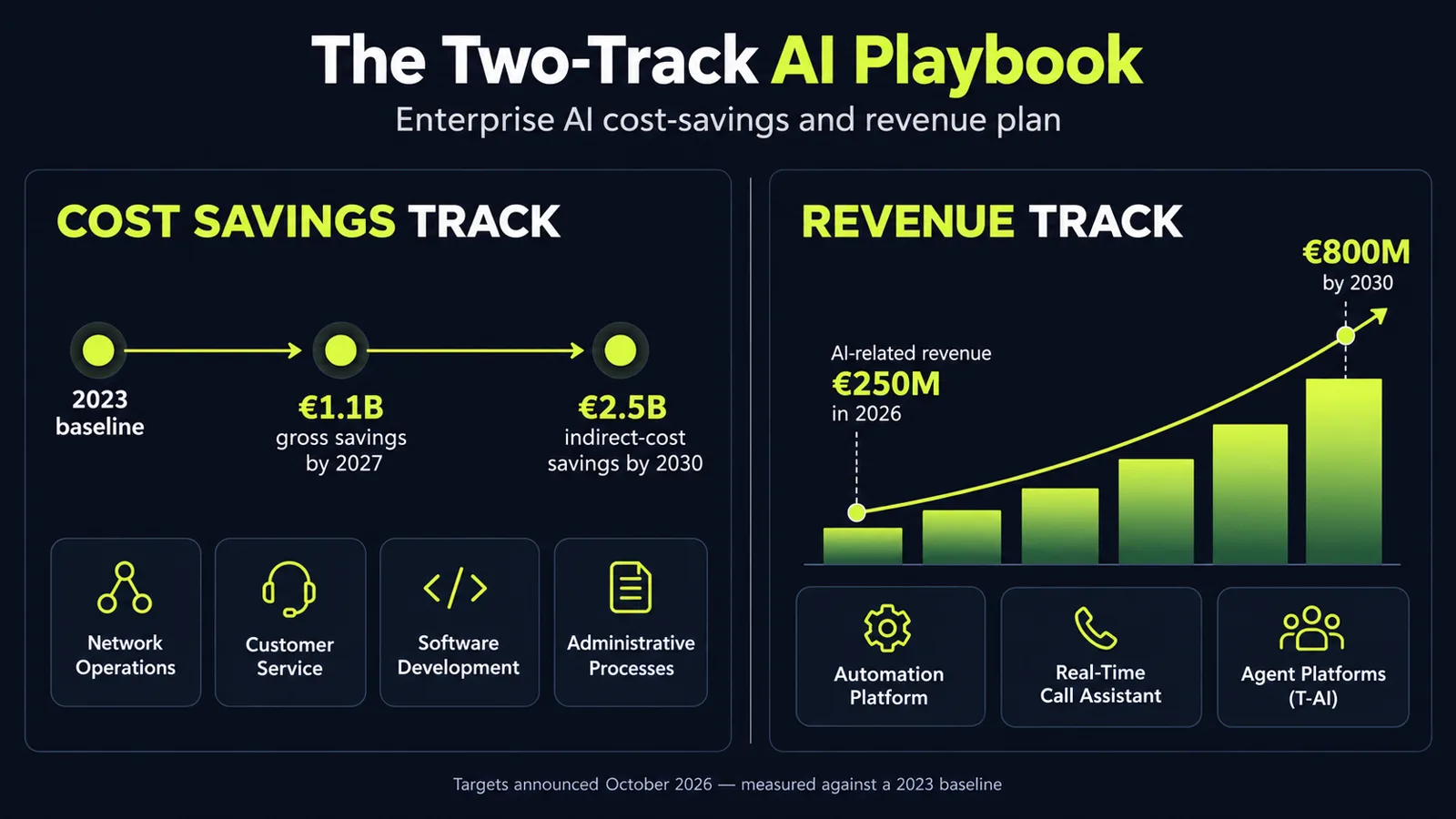
On Monday, Deutsche Telekom put a financial target on its AI and automation strategy. The company expects the technologies to contribute around €2.5 billion in indirect-cost savings by 2030, measured against a 2023 baseline, with gross savings of around €1.1 billion targeted for 2027. Reuters reported the figures from the company's statement.
The important point is not simply the size of the number. Management has attached a baseline, financial targets, and dates to the program.
There is also an important qualification: these are targets, not realized savings. The company describes the program as involving both AI and automation, so the published figures should not be read as savings attributable to generative AI or AI agents alone.
Where the €2.5 billion is supposed to come from
The company is applying AI in areas with large volumes of repetitive work. According to The Wall Street Journal, those areas include network operations, customer service, software development, and administrative processes.
Chief Executive Tim Hoettges said AI is being used to improve networks and services while supporting new business models.
Two operational examples make the cost case clearer. The company says AI can detect peak traffic on its cellular network earlier and support customer-service representatives in resolving issues. Reuters reported those examples directly from the company's statement.
The relevant pattern is volume. When a task is repeated across thousands or millions of interactions, relatively small reductions in handling time, manual work, or delay can become financially significant.
That is more useful for business planning than asking where an AI assistant might produce the most impressive demonstration. The better question is where repetitive work is frequent enough for an improvement to compound.
It is not just a cost story — it is a revenue one too
The company is also attaching targets to AI-related revenue. According to The Wall Street Journal, it expects AI-related revenue to rise from around €250 million in 2026 to around €800 million by 2030.
The revenue plan includes several enterprise AI offerings.
- A platform for automating recurring business tasks.
- A real-time AI assistant for phone calls that can translate conversations, answer questions, and summarize content.
- T-AI Agent Platform for mid-sized companies and T-AI Agentic Hub for larger organizations and public-sector customers. Reporting from ad-hoc-news describes both as offerings intended to integrate autonomous software agents into business workflows.
The important distinction is that internal savings and external revenue are separate parts of the strategy. The sources do not establish that products sold to customers were simply converted from internal automation projects.
For other businesses, however, the combination is worth noting. AI investment can be evaluated against more than one financial outcome: reduced operating cost, additional revenue, or both.
Why this announcement is different from the usual AI PR
Many AI announcements emphasize capabilities. This one also specifies financial objectives.
It has a baseline. The savings target is measured against 2023. That matters because a baseline gives management something concrete to compare future operating costs against.
It has intermediate milestones. The company has described gross savings of around €1.1 billion for 2027 and an indirect-cost savings target of around €2.5 billion for 2030. Those dates make progress easier to evaluate.
It connects AI deployment to commercial products. Agent-based systems are not presented only as internal experiments. The company is also offering platforms intended for business customers.
That direction coincides with a wider run of recent commercial AI-agent and decision-system launches. NoloWiz's weekly roundup covered several such releases during the preceding week.
None of that proves the financial targets will be achieved. But it does show what investors and operators can measure: baseline cost, implementation milestones, operating use cases, and revenue targets.
What this means for your business
You do not need a €2.5 billion target to use the same measurement discipline.
1. Point automation at volume, not novelty. Start with processes that recur frequently: service requests, document handling, reporting, internal routing, data entry, or other repetitive operational work. A low-volume workflow may not justify the implementation and operating cost even if it is technically easy to automate.
2. Separate gross savings from net savings. Reducing manual effort is not the same as reducing total cost. Include implementation work, model usage, infrastructure, integration, monitoring, human review, maintenance, and exception handling when calculating the business case.
3. Give every initiative a baseline and a target. Measure the current process before changing it. Record transaction volume, labor time, processing time, error rates where relevant, and current operating cost. Then define the outcome the automation is expected to improve.
4. Do not attribute everything to AI. The €2.5 billion target combines AI and automation. Your own program may also combine workflow software, rules, integrations, conventional automation, and language models. Measure the system as it actually operates rather than assigning every improvement to the AI component.
5. Keep accountability explicit. The customer-service example illustrates one practical operating model: AI supports representatives while people retain responsibility for the interaction. For higher-risk workflows, define which actions can run automatically, which require approval, and how decisions will be reviewed.
A 90-day path to your own savings number
A smaller organization can apply the same measurement principles without copying the scale of the telecom program.
- Days 1–14: map the volume. List recurring processes and record how often they occur, how much staff time they consume, and where errors or delays create cost.
- Days 15–30: baseline one process. Choose a high-volume candidate and document its current economics. Include labor as well as systems and operating costs that matter to the comparison.
- Days 31–75: build one working automation. Keep the scope narrow. Automate one clearly defined process, integrate it with the systems it actually needs, and add a human approval step where the consequences justify one.
- Days 76–90: compare results with the baseline. Measure processing time, manual effort, operating cost, and any relevant quality metric. Include the recurring cost of running the automation itself.
If the economics work, the result becomes evidence for expanding to another process. If they do not, the organization has learned that before committing to a broader rollout.
That is the practical lesson behind a large financial target: AI automation becomes easier to manage when the discussion moves from capabilities to measurable operating outcomes.
Want to find your number? Take the free AI audit — a short assessment that maps where automation may reduce operating cost in your business and where a deeper business case is worth building.
Sources
- https://www.reuters.com/business/media-telecom/deutsche-telekom-sees-25-billion-savings-ai-automation-by-2030-2026-10-05/reuters.com
- https://www.wsj.com/tech/ai/deutsche-telekom-bets-on-ai-to-cut-costs-boost-revenue-22a289b8wsj.com
- https://www.ad-hoc-news.de/boerse/news/unternehmensnachrichten/deutsche-telekom-chief-warns-europe-risks-becoming-an-ai-colony-as-operator-preps-investor-day/70169267ad-hoc-news.de
- https://nolowiz.com/top-ai-news-of-the-week-september-27-october-4-2026/nolowiz.com
Want to know what this means for your stack? A free AI audit maps your workflows and shows where automation pays off — in your numbers, not ours.