

Many software vendors now market their products as "AI agents," creating real confusion about what actually qualifies as agentic. Some products labeled as agents are traditional chat interfaces or workflow automations with limited autonomous behavior.
This confusion has a real price. Gartner's analysts have a name for it — "agent washing": vendors rebranding chatbots and automation as agentic AI, with Gartner estimating that of the thousands of vendors claiming agentic products, only around 130 offer what it classifies as genuinely agentic capabilities (Search Engine Land). Buyers risk paying for agent capabilities they do not need when a simpler automation approach would solve the problem — or worse, handing real decisions to a system nobody supervised.
There are three distinct tools here. They solve different problems, fail in different ways, and cost very different amounts to run. Picking the right one starts with knowing which is which.
Chatbot: it talks
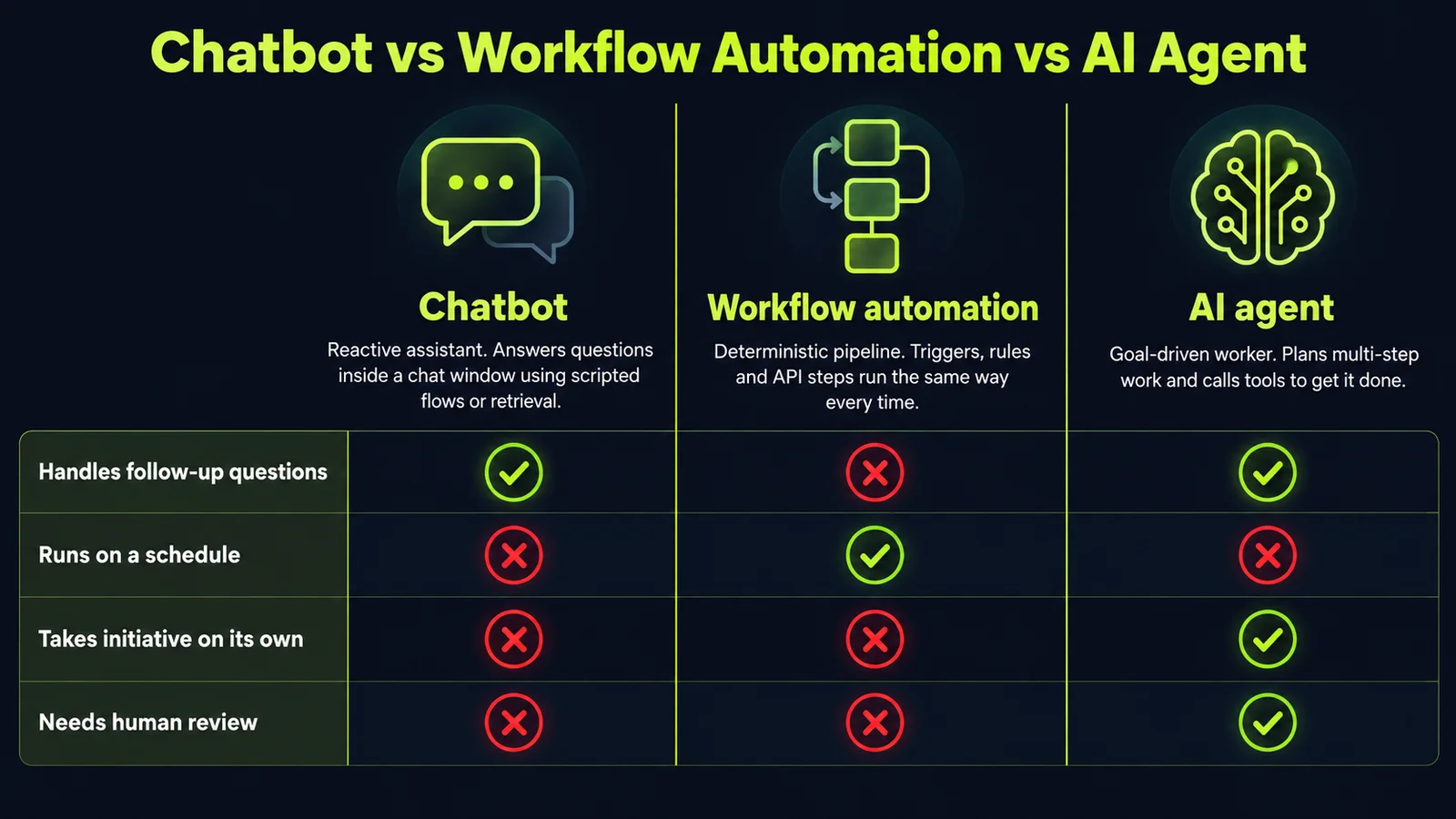
A chatbot is a conversational interface. A person types or speaks, the system responds with text. It may be a scripted decision tree, or it may be a large language model with retrieval over your knowledge base — but its job is to answer, explain, or guide. It does not take action in your other systems unless someone wires that in deliberately.
A chatbot is the right tool when the need is conversation: answering "what is the return policy," walking a new hire through onboarding docs, triaging a support ticket to the right queue. No business action required — just information, delivered well.
Its limits are honest ones. Ask it to do something and it will describe doing it rather than do it. Give it a task that spans systems — check the inventory, hold the item, email the customer — and you have left chatbot territory.
Workflow automation: it follows the recipe
A workflow is a predefined sequence of steps: when this happens, do that, then that. A new lead fills a form → the CRM creates a record → a welcome email goes out → a task lands on a rep's board. The path is defined in advance, in code or a visual builder. It runs the same way every time.
This determinism is the whole point. Workflows are testable, monitorable, and auditable — you can say exactly what will happen before it happens. For predictable, repeatable processes, workflows often provide stronger predictability and easier auditing than agents, usually at a fraction of the running cost.
Its limit is rigidity. The moment an API payload changes shape or an edge case appears that nobody coded for, the workflow breaks or silently does the wrong thing. Workflows do not improvise.
AI agent: it decides and acts
An agent is a language model placed inside a control loop where the model itself chooses the next action. You give it a goal — "resolve this customer complaint" — and it plans a sequence of steps, calls tools (your CRM, your inbox, your database), observes the results, and adjusts. Reasoning, planning, tool use, memory, dynamic decision-making: that is the full stack that makes something genuinely agentic rather than a chatbot with extra steps.
Agents are worth considering where the right next step changes case by case: triaging messy inbound requests, researching and qualifying leads across sources, handling exceptions that would stall a fixed workflow. When processes contain frequent exceptions that are difficult to encode, agents may provide more flexibility than fixed workflows.
The one question that sorts them
When a vendor demo ends and you are deciding what you actually saw, ask one question: does the tool need to decide what to do, or does it just execute a step you already defined? That distinction — decision versus execution — is a useful first filter when deciding whether a task needs autonomous reasoning or predefined execution (Albato).
- If the user only needs answers → chatbot.
- If the process is fixed and repeatable → workflow automation.
- If the system must reason over context, pick tools, and adapt → AI agent.
Some systems marketed as agents rely heavily on predefined workflows with limited autonomous decision-making. As one engineering handbook puts it, many production "agents" are actually workflows with fixed control flow — an LLM bolted onto a predefined path (engineering handbook). That is not a criticism; for many tasks the workflow version is the better product. The problem is the price tag that comes with the agent label.
Where each one wins in practice
Put side by side, the three tools cover different ground:
- Customer support triage: a chatbot handles the front door — answering common questions and classifying intent. A workflow routes the ticket, updates the CRM, and sends the confirmation. An agent earns its place on the messy middle: the multi-part complaint that needs three systems checked before anyone can reply.
- Sales follow-up: workflows own the predictable motion — new lead, enriched record, sequenced outreach, task for the rep. An agent adds value where judgment is needed: researching an account across sources and drafting a genuinely personalized first touch.
- Operations reporting: a scheduled workflow pulls the numbers and posts the digest. No agent required, and adding one would just add cost and failure modes.
- Exception handling: this is agent territory. The invoice that does not match the purchase order, the shipment with a half-readable label, the vendor email that contradicts the contract — fixed rules choke here; a system that can look, reason, and act does not.
That pattern — chatbots at the front, workflows as the plumbing, agents reserved for the judgment calls — is how many real deployments end up composed (Albato).
The price of picking wrong
Here is what the "just buy the agent" pitch leaves out. Gartner's analysis of AI inference economics, reported by Computer Weekly, found that advanced AI agents with reasoning capabilities cost roughly 150 times more to run than a similarly sized basic chatbot for a single task — because multi-step agentic work consumes tokens exponentially, often on the most expensive models. Lower model prices do not automatically reduce total AI spending if usage volume and complexity increase.
The failure data is just as sobering. Gartner predicts over 40% of agentic AI projects will be canceled by the end of 2027, citing escalating costs, unclear business value, and inadequate risk controls (Search Engine Land). One March 2026 survey of 650 enterprise technology leaders, summarized in an industry roundup, found 78% had launched AI agent pilots but fewer than 14% had reached production scale; McKinsey's November 2025 State of AI research reported only 23% of companies scaling any agentic system. The same roundup cites Cleanlab's finding of just a 5.2% production rate across nearly 2,000 respondents. And Gartner warns that without clean, well-contextualized data, agents hallucinate more, cost more, and erode the customer experiences they were bought to improve (CXOToday).
None of this means agents are a bad idea. It means they are a power tool: expensive to run, dangerous without guardrails, and wasted on jobs a cheaper tool does better.
How to choose: start with the workflow
The most useful guidance on this question comes from the people who build the underlying models. Anthropic's "Building Effective Agents" guide draws the line precisely: workflows orchestrate language models and tools through predefined code paths, while agents let the model dynamically direct its own process and tool use — and its explicit recommendation is to find the simplest solution possible and only add complexity when needed (quoted in Secureworks' research notes).
Translated into a buying process you can run this week:
1. Map the task, not the hype. Write down what actually happens today, step by step, including the exceptions. If the exceptions fit in a short list, you have a workflow.
2. Apply the decision test. Does the tool need to decide what to do next, or execute steps you define? Decide → agent candidate. Execute → workflow.
3. Start with the workflow and measure. Ship the deterministic version first. It is cheaper, testable, and it gives you the baseline the agent version has to beat.
4. Promote to agent only where the flexibility pays. The promotion criterion is concrete: the workflow keeps failing on cases a reasoning system handles, and those cases justify the premium running cost plus supervision overhead.
5. Supervise the agent like a junior employee. Step budgets, tool allow-lists, human approval on irreversible actions, cost monitoring per run, and audit logs of every tool call. Without guardrails, organizations increase the risk of unexpected costs, unreliable outputs, and failed deployments.
Gartner projects that 40% of enterprise applications will include task-specific AI agents by the end of 2026, up from under 5% in 2025 (Albato). Organizations are more likely to benefit when they match AI capabilities to specific operational needs rather than adopting agents indiscriminately: chatbots talking, workflows executing, agents deciding — each supervised at the level its failure modes demand.
One more filter belongs in every buying decision, and it matters more than the chatbot/workflow/agent label: what happens when the system is wrong? A chatbot giving a wrong answer is an embarrassment; a workflow sending the wrong email is a cleanup job; an agent issuing the wrong refund or deleting the wrong record is a liability. Reversible, low-stakes actions can tolerate autonomy. Irreversible actions touching money, customers, or compliance need human approval gates no matter what the tool is called — and if the rules are stable and the volume is low, plain automation or even manual handling may be the cheapest correct answer.
Five questions to ask any "agent" vendor
1. Can we inspect every tool call the system makes, with a full audit log?
2. Can we restrict which actions it may take without human approval?
3. How does it handle failures — does it stop, escalate, or silently continue?
4. What does a month of typical usage cost us, and what caps or alerts exist?
5. Who owns the behavior when it goes wrong — and who can revoke its access in one step?
If a vendor cannot answer these crisply, you are not buying an agent. You are buying a demo.
Not sure which one you were sold?
If you are staring at a vendor slide deck and cannot tell which of the three you are being shown, our AI automation services start with that exact question. The free AI audit maps your processes to the right tool before you spend anything — and if the numbers do not work, our ROI calculator will show it. Book the free audit here — we will tell you which tool fits, including when the answer is "none yet."
Sources
- https://albato.com/blog/publications/ai-agent-vs-chatbot-vs-workflow-automationalbato.com
- https://www.computerweekly.com/news/366648782/Gartner-Agentic-AI-wont-benefit-from-economies-of-scalecomputerweekly.com
- https://searchengineland.com/gartner-40-of-agentic-ai-projects-will-fail-making-humans-indispensable-474695searchengineland.com
- https://cxotoday.com/ai/why-your-ai-agents-are-failing-the-gartner-report-on-semantic-gaps/cxotoday.com
- https://github.com/smfworks/aiclearinghouse-site/blob/HEAD/content/blog/the-86-problem-why-enterprise-ai-agents-stall-between-pilot-and-production.mdgithub.com
- https://github.com/handbook-academy/engineering-handbook/blob/HEAD/content/hld/part-9-ai-ml-system-design/03-ai-agent-architectures.mdgithub.com
- https://github.com/secureworks-group/secureworks-backend/blob/HEAD/docs/research-autonomous-ai-agent.mdgithub.com
Want to know what this means for your stack? A free AI audit maps your workflows and shows where automation pays off — in your numbers, not ours.